Luo Yang, Lim Chea Lu, Nichols Jennifer, Martinez-Arias Alfonso, Wernisch Lorenz
Biostatistics Unit, Medical Research Council, Cambridge, UK.
J R Soc Interface. 2013 Jan 6;10(78):20120525. doi: 10.1098/rsif.2012.0525. Epub 2012 Nov 8.
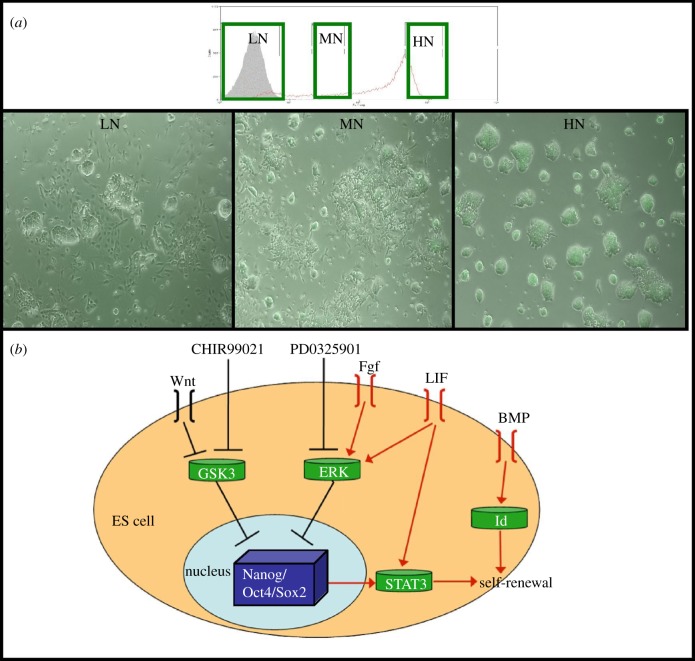
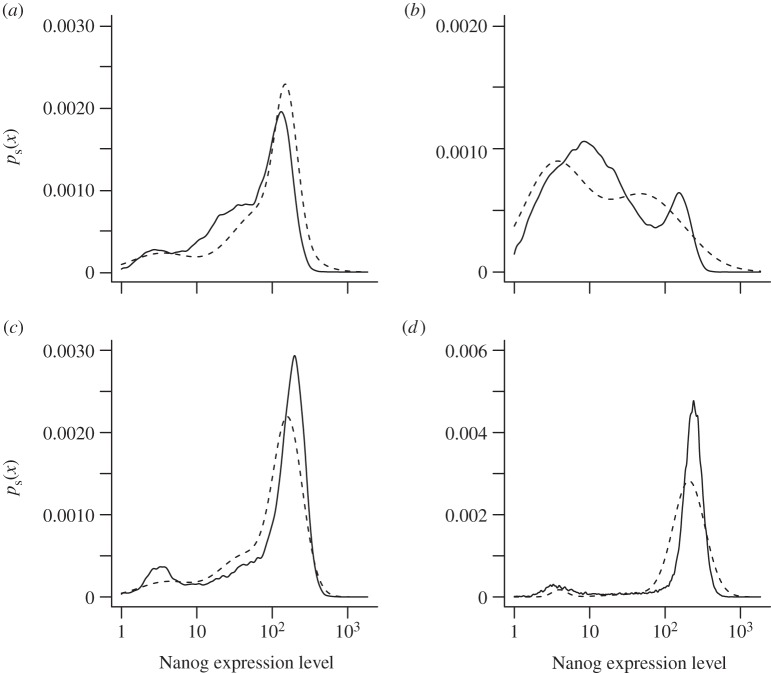
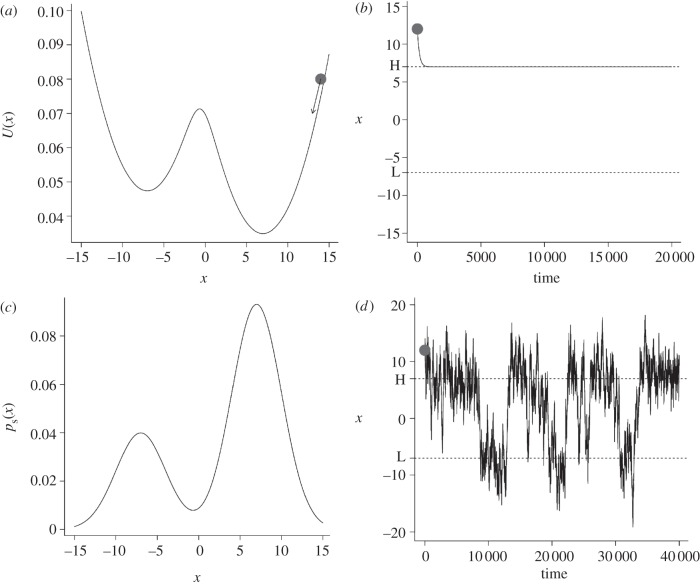
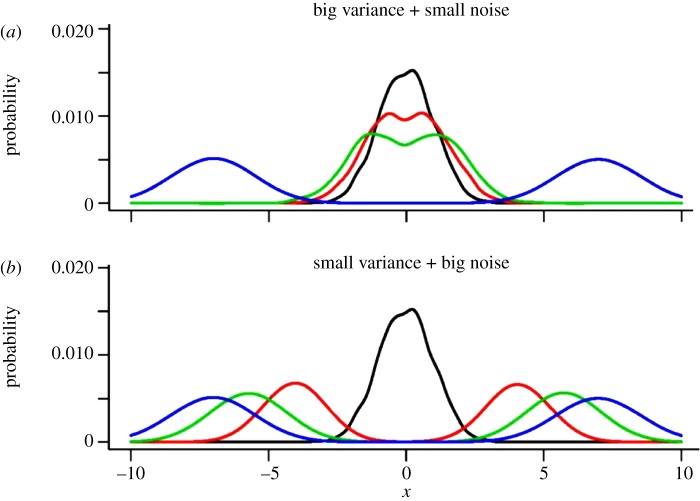
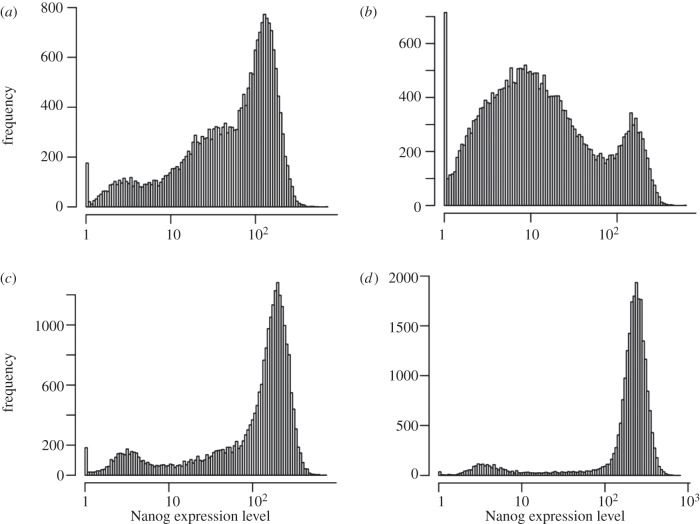
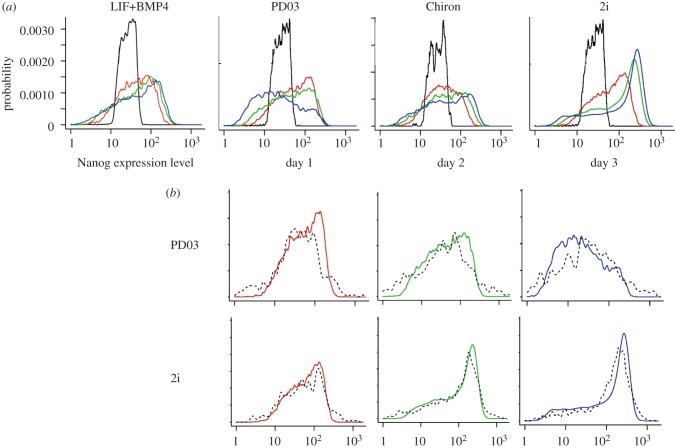
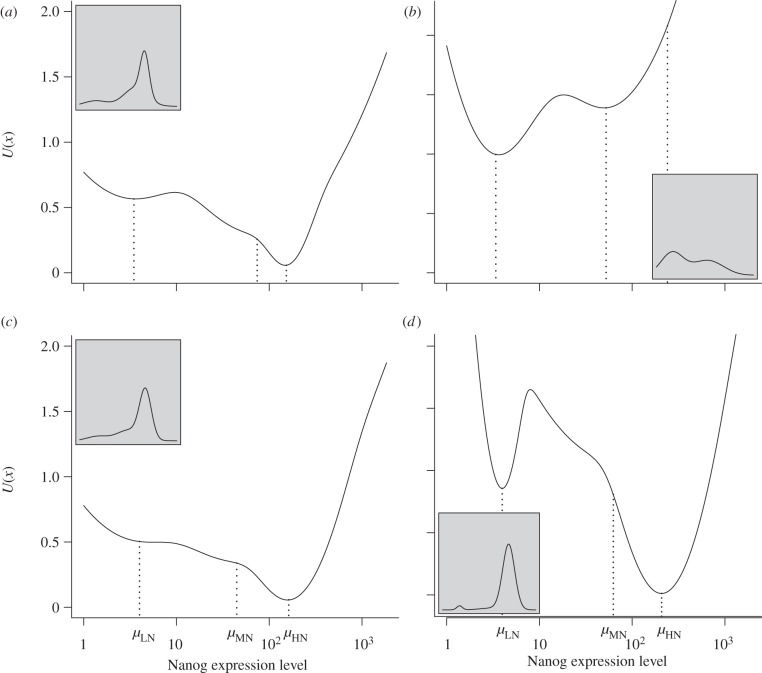
A population of mouse embryonic stem (ES) cells is characterized by a distribution of Nanog, a gene whose expression is associated with the degree of pluripotency. Cells exhibiting high levels of Nanog maintain a state of pluripotency, while those with low levels are more likely to undergo differentiation. Using a cell line with a fluorescence tag for Nanog enables measurements of the distribution of Nanog in an ES cell culture in a stationary state or after a perturbation. In order to model the dynamics of the system, we assume that the distribution of Nanog-GFP for single cells shows distinct attractor steady states of Nanog levels, with individual cells moving between these states stochastically. The addition of synthetic inhibitors of signal transduction induces strong shifts in the distribution of Nanog. In particular, the addition of Chiron and PD03, inhibitors for the ERK and GSK3 signalling pathways, induces a high level of Nanog. In this study, we placed ES cells in different culture conditions, including the above inhibitors, and recorded the change in Nanog-GFP distribution over several days. In order to interpret the measurements of Nanog levels, we propose a new stochastic modelling strategy for the dynamics of the system not requiring detailed knowledge of regulatory or signalling mechanisms, while still capturing the stochastic and the deterministic components of the stochastic dynamical system. Despite its relative simplicity, the model provides an insight into key features of the cell population under various conditions, including the level of noise and occupancy and location of attractor steady states, without the need for strong assumptions about the underlying cellular mechanisms. By applying the model to our experimental data, we infer the existence of three stable steady states for Nanog levels, which are the same in all the different conditions of the cell-culture medium. Noise, on the other hand, and the proportion of cells in each steady state are subject to large shifts. Surprisingly, the isolated effects of PD03 and Chiron on noise and dynamics of the system are quite different from their combined effect. Our results show that signalling determines the occupancy of each state, with a particular role for GSK3 in the regulation of the noise across the population.
一群小鼠胚胎干细胞的特征在于Nanog的分布,Nanog是一种基因,其表达与多能性程度相关。表现出高水平Nanog的细胞维持多能状态,而低水平的细胞更有可能发生分化。使用带有Nanog荧光标签的细胞系能够测量处于静止状态或受到扰动后的胚胎干细胞培养物中Nanog的分布。为了模拟该系统的动力学,我们假设单细胞的Nanog-GFP分布显示出Nanog水平的不同吸引子稳态,单个细胞在这些状态之间随机移动。添加信号转导的合成抑制剂会导致Nanog分布发生强烈变化。特别是,添加Chiron和PD03(分别为ERK和GSK3信号通路的抑制剂)会诱导高水平的Nanog。在本研究中,我们将胚胎干细胞置于不同的培养条件下,包括上述抑制剂,并记录了数天内Nanog-GFP分布的变化。为了解释Nanog水平的测量结果,我们提出了一种新的随机建模策略,用于该系统的动力学,该策略不需要详细了解调控或信号机制,同时仍能捕捉随机动力系统的随机和确定性成分。尽管该模型相对简单,但它能深入了解各种条件下细胞群体的关键特征,包括噪声水平、吸引子稳态的占有率和位置,而无需对潜在的细胞机制做出强有力的假设。通过将该模型应用于我们的实验数据,我们推断出Nanog水平存在三个稳定稳态,在细胞培养基的所有不同条件下都是相同的。另一方面,噪声以及每个稳态中的细胞比例会发生很大变化。令人惊讶的是,PD03和Chiron对系统噪声和动力学的单独影响与它们的联合影响有很大不同。我们的结果表明,信号传导决定了每个状态的占有率,其中GSK3在调节群体噪声方面具有特殊作用。