Department of Epidemiology and the Welch Center for Prevention, Epidemiology and Clinical Research, Johns Hopkins Bloomberg School of Public Health, Baltimore, MD, USA.
Diabetes Care. 2013 Mar;36(3):569-73. doi: 10.2337/dc12-0404. Epub 2012 Oct 15.
Current recommendations for the use of hemoglobin A(1c) (HbA(1c)) in diabetes screening and diagnosis aim to identify those at greatest risk for diabetic microvascular complications. However, there is current controversy regarding the clinical implications of ethnic differences in HbA(1c) values. The objective of this study was to determine whether the association between HbA(1c) and retinopathy differs by ethnic group in a representative sample of U.S. adults.
The study was a cross-sectional analysis of 2,945 non-Hispanic white, 1,046 non-Hispanic black, and 1,231 Hispanic American participants aged ≥40 years from the 2005-2008 National Health and Nutrition Examination Survey.
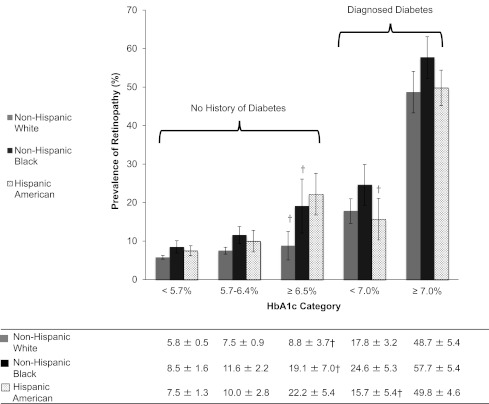
Among nondiabetic adults, the mean HbA(1c) was 5.5% in non-Hispanic whites, 5.7% in non-Hispanic blacks, and 5.6% in Hispanic Americans. Among those with diagnosed diabetes, mean HbA(1c) was 6.9% in non-Hispanic whites, 7.5% in non-Hispanic Blacks, and 7.7% in Hispanic Americans. Overall, non-Hispanic blacks had the highest prevalence of retinopathy. In multivariable logistic models, HbA(1c) clinical categories were strongly associated with prevalent retinopathy. However, the magnitude of the association did not differ by ethnic group (all P values for interaction ≥ 0.7). Similar results were observed with HbA(1c) modeled continuously (per one percentage point) and stratified by diabetes status (all P for interactions > 0.3).
We observed no ethnic differences in the association of HbA(1c) with retinopathy. These data do not support ethnic-specific cut points for HbA(1c) for diagnosis or screening of diabetes mellitus.
目前,血红蛋白 A1c(HbA1c)在糖尿病筛查和诊断中的应用建议旨在识别那些患有糖尿病微血管并发症风险最高的人群。然而,目前关于 HbA1c 数值在不同种族之间存在差异的临床意义存在争议。本研究的目的是确定在美国成年人的代表性样本中,HbA1c 与视网膜病变之间的关联是否因种族而异。
这是一项横断面分析,纳入了 2945 名非西班牙裔白人、1046 名非西班牙裔黑人以及 1231 名西班牙裔美国人,年龄均≥40 岁,来自 2005-2008 年全国健康和营养调查。
在非糖尿病成年人中,非西班牙裔白人为 5.5%,非西班牙裔黑人为 5.7%,西班牙裔美人为 5.6%。在确诊为糖尿病的成年人中,非西班牙裔白人为 6.9%,非西班牙裔黑人为 7.5%,西班牙裔美人为 7.7%。总体而言,非西班牙裔黑人群体的视网膜病变患病率最高。在多变量逻辑模型中,HbA1c 临床分类与常见视网膜病变密切相关。然而,这种关联的程度在不同种族之间没有差异(所有交互作用的 P 值均≥0.7)。以 HbA1c 连续(每增加一个百分点)和分层糖尿病状态(所有交互作用 P 值均>0.3)进行建模,也观察到了类似的结果。
我们没有观察到 HbA1c 与视网膜病变之间存在种族差异。这些数据不支持 HbA1c 用于糖尿病诊断或筛查的种族特异性切点。