Center for Cell Analysis and Modeling, University of Connecticut Health Sciences Center, Farmington, CT 06030, USA.
Nucleic Acids Res. 2012 Dec;40(22):11202-12. doi: 10.1093/nar/gks925. Epub 2012 Oct 15.
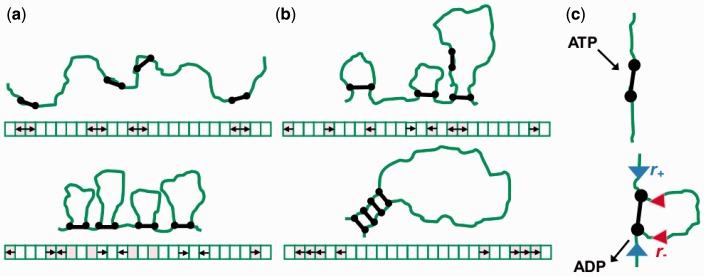
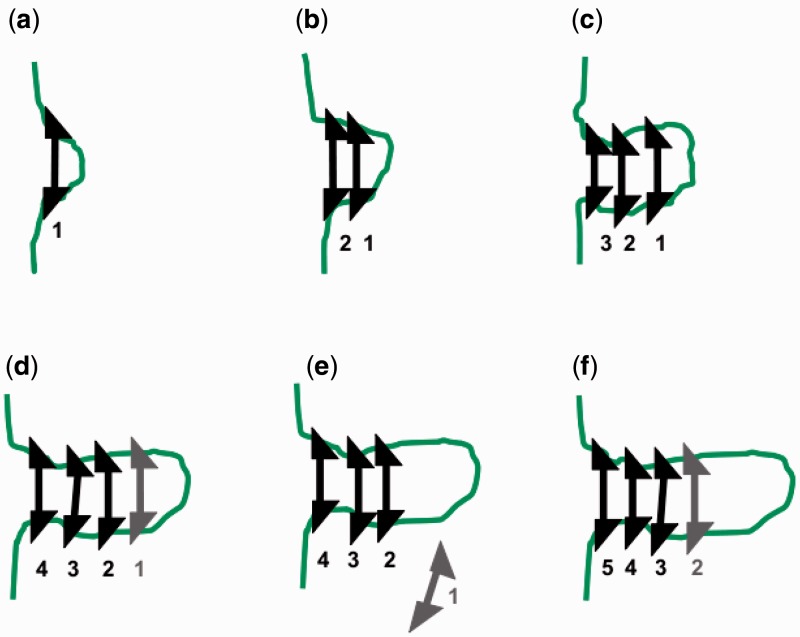
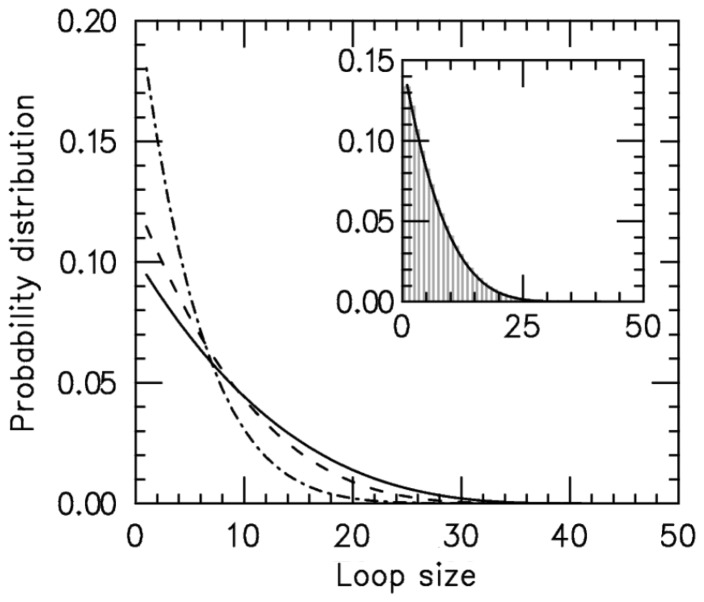
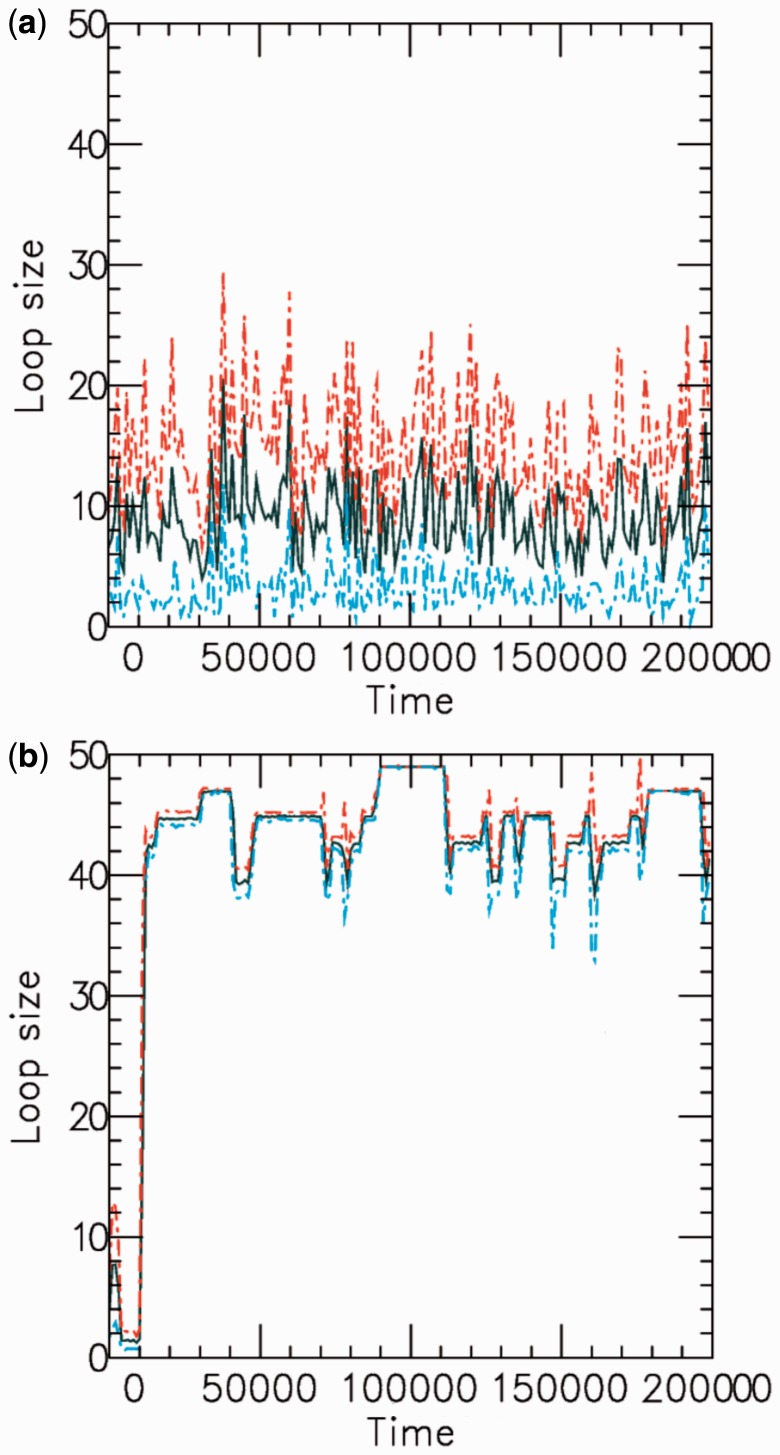
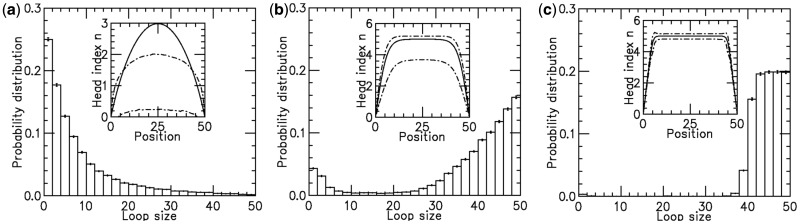
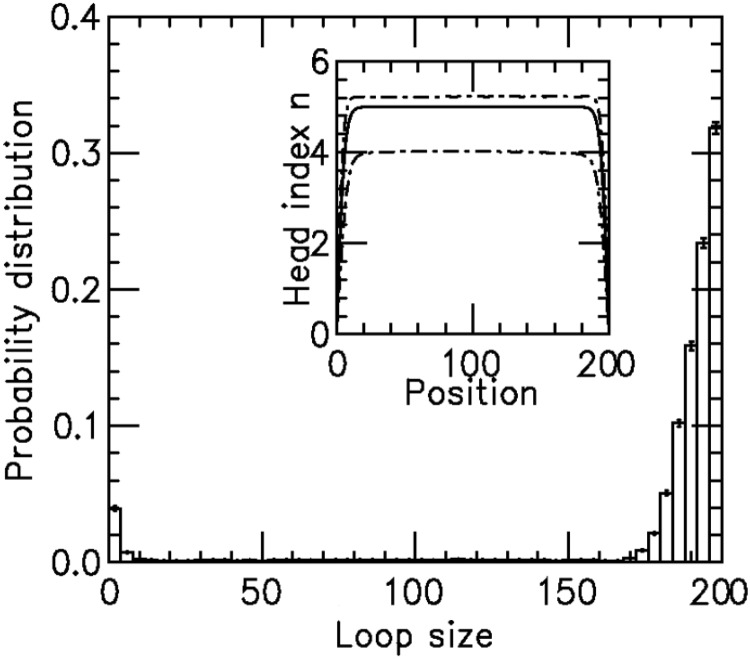
The long chromosomal DNAs of cells are organized into loop domains much larger in size than individual DNA-binding enzymes, presenting the question of how formation of such structures is controlled. We present a model for generation of defined chromosomal loops, based on molecular machines consisting of two coupled and oppositely directed motile elements which extrude loops from the double helix along which they translocate, while excluding one another sterically. If these machines do not dissociate from DNA (infinite processivity), a disordered, exponential steady-state distribution of small loops is obtained. However, if dissociation and rebinding of the machines occurs at a finite rate (finite processivity), the steady state qualitatively changes to a highly ordered 'stacked' configuration with suppressed fluctuations, organizing a single large, stable loop domain anchored by several machines. The size of the resulting domain can be simply regulated by boundary elements, which halt the progress of the extrusion machines. Possible realizations of these types of molecular machines are discussed, with a major focus on structural maintenance of chromosome complexes and also with discussion of type I restriction enzymes. This mechanism could explain the geometrically uniform folding of eukaryote mitotic chromosomes, through extrusion of pre-programmed loops and concomitant chromosome compaction.
细胞的长染色体 DNA 被组织成比单个 DNA 结合酶大得多的环域,这就提出了如何控制这种结构形成的问题。我们提出了一种基于分子机器的定义染色体环形成的模型,该模型由两个耦合且方向相反的运动元件组成,这些元件沿着它们迁移的双螺旋挤出环,同时在空间上排斥彼此。如果这些机器不与 DNA 解离(无限的连续性),则会得到无序的、指数稳态的小环分布。然而,如果机器的解离和再结合以有限的速率发生(有限的连续性),则稳态会定性地转变为高度有序的“堆积”构型,抑制波动,由几个机器锚定一个大的、稳定的环域。通过边界元件可以简单地调节所得域的大小,边界元件阻止挤出机器的前进。讨论了这些类型的分子机器的可能实现方式,主要关注染色体复合物的结构维持,以及对 I 型限制酶的讨论。这种机制可以通过挤出预先编程的环并伴随染色体紧缩,来解释真核有丝分裂染色体的几何均匀折叠。