Electrical Engineering Department, Henry Samueli School of Engineering and Applied Science, University of California, Los Angeles, California 90095, United States.
ACS Nano. 2012 Nov 27;6(11):10013-23. doi: 10.1021/nn303719m. Epub 2012 Oct 23.
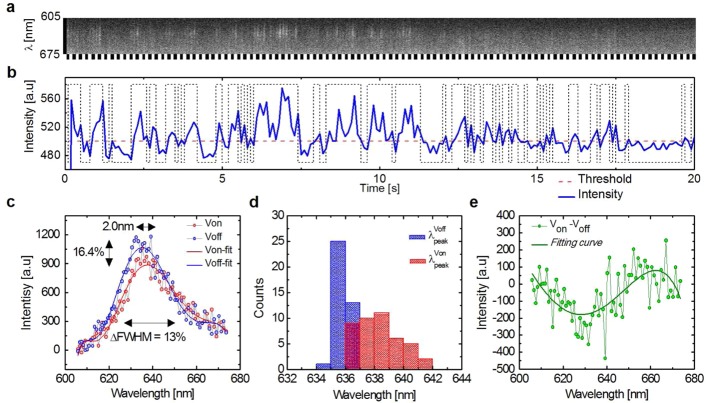
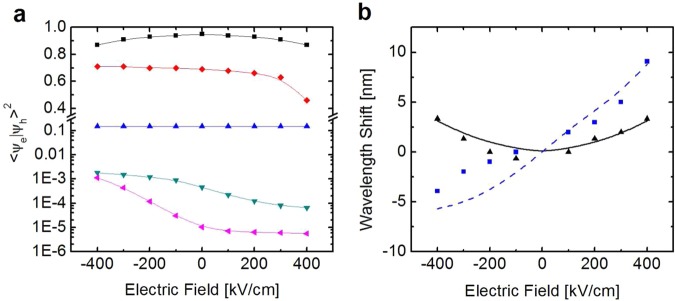
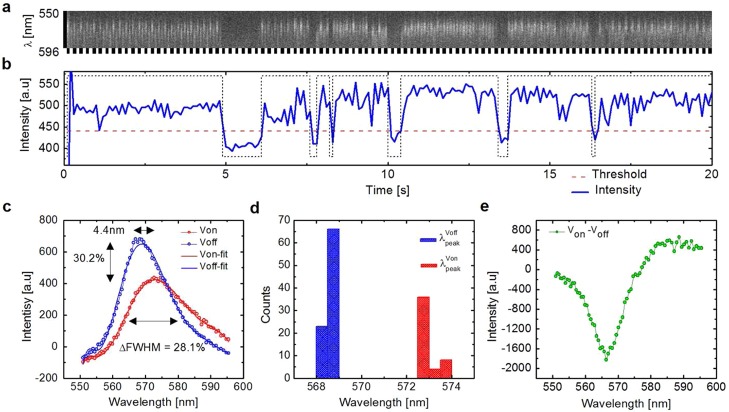
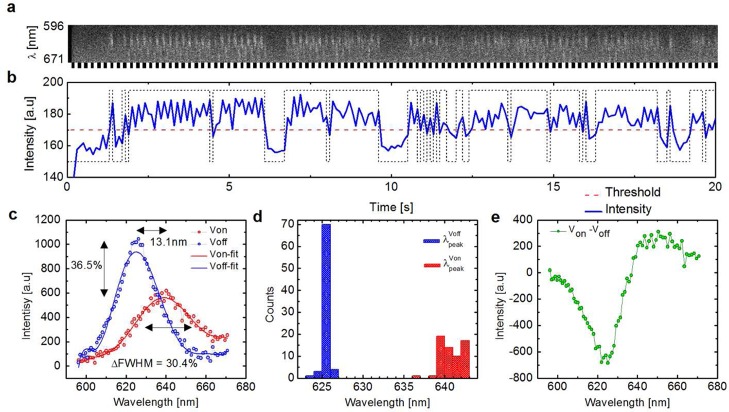
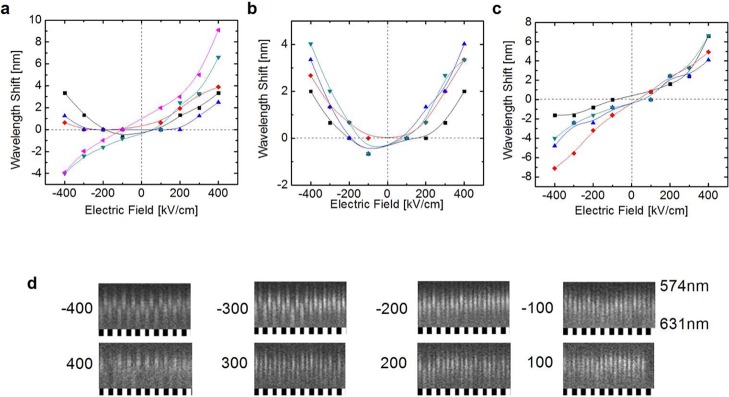
We measured the quantum-confined Stark effect (QCSE) of several types of fluorescent colloidal semiconductor quantum dots and nanorods at the single molecule level at room temperature. These measurements demonstrate the possible utility of these nanoparticles for local electric field (voltage) sensing on the nanoscale. Here we show that charge separation across one (or more) heterostructure interface(s) with type-II band alignment (and the associated induced dipole) is crucial for an enhanced QCSE. To further gain insight into the experimental results, we numerically solved the Schrödinger and Poisson equations under self-consistent field approximation, including dielectric inhomogeneities. Both calculations and experiments suggest that the degree of initial charge separation (and the associated exciton binding energy) determines the magnitude of the QCSE in these structures.
我们在室温下测量了几种类型的荧光胶体半导体量子点和纳米棒的量子限制斯塔克效应 (QCSE),达到单分子水平。这些测量表明,这些纳米粒子在纳米尺度上进行局部电场 (电压) 传感具有潜在的应用价值。在这里,我们表明,具有 II 型能带排列的异质结构界面 (或多个) 的电荷分离 (以及相关的诱导偶极子) 对于增强 QCSE 至关重要。为了进一步深入了解实验结果,我们在自洽场近似下数值求解了薛定谔和泊松方程,包括介电不均匀性。计算和实验都表明,初始电荷分离的程度 (以及相关的激子束缚能) 决定了这些结构中 QCSE 的大小。