Núcleo de Pós-graduação em Medicina da Universidade Federal de Sergipe, Rua Claudio Batista s/n B Santo Antonio, Aracaju, SE 49060-100, Brazil.
BMC Public Health. 2012 Oct 19;12:883. doi: 10.1186/1471-2458-12-883.
Breast cancer incidence within an area is usually proportional to the area's income level. High-income areas have shown the highest incidence rates and since 2003, negative trends. As for mortality, rates are often higher in low-income regions. The purpose of this study was to analyze trends in incidence and mortality in a capital city of a northeastern Brazilian state with an intermediate human development index.
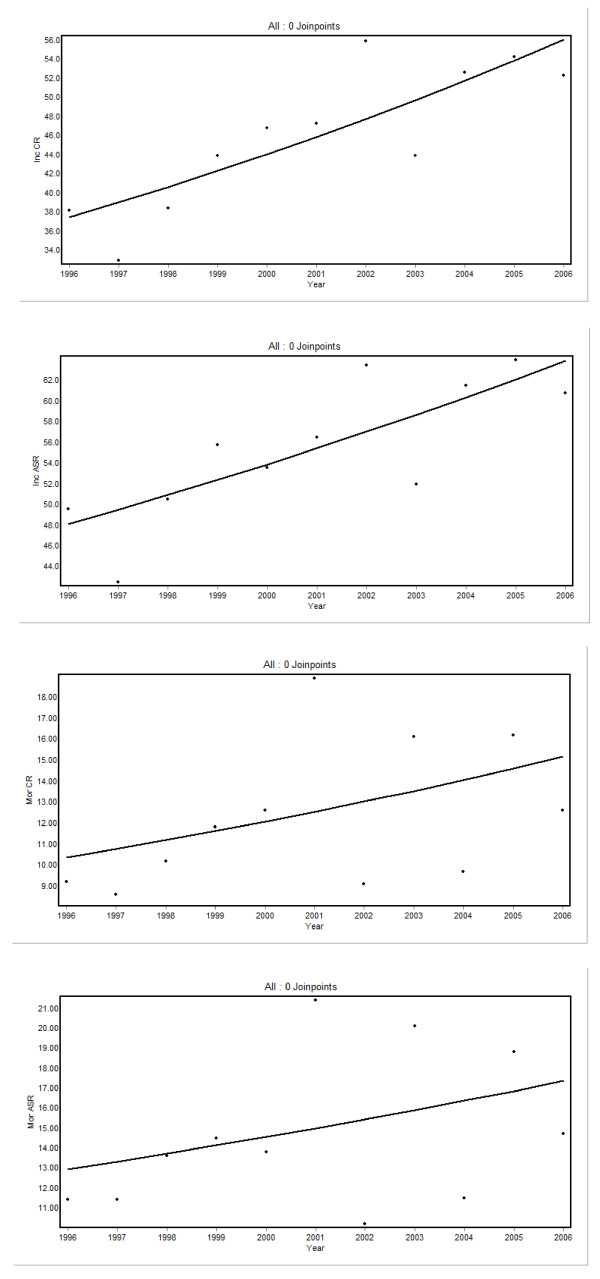
Incidence data from the Population-Based Cancer Registry of Aracaju and mortality data from the Official State Database for the period 1996-2006 were used. Incidence and mortality crude and age-standardized rates were calculated. Time trends were obtained using the Joinpoint Regression Model.
For the period studied, invasive breast cancer age-standardized incidence rates increased annually with an annual percentage change (APC) of 2.9 (95% CI: 1.2-4.6). Significant increasing trends were observed in groups aged 45-54 years (APC: 3.9, 95% CI: 1.4 to 6.6), and 55-64 years (APC: 5.6, 95% CI: 1.8 to 9.6). Age-standardized mortality rates did not show an increasing trend (APC: 3.0, (95% CI: -2.8 to9.1), except for the group aged 55-64 years (APC: 11.3, 95% CI: 1.1 to 22.4).
In the study community, breast cancer showed increasing incidence among women in the peri- and postmenopausal periods. However, mortality did not present increasing overall trends, except for among the group aged 55-64 years. For better outcomes, screening policies should focus on the peri- and postmenopausal periods of women's lives to diagnose disease.
一个地区的乳腺癌发病率通常与该地区的收入水平成正比。高收入地区的发病率最高,自 2003 年以来呈下降趋势。至于死亡率,低收入地区通常更高。本研究旨在分析巴西东北部一个首府城市的发病率和死亡率趋势,该城市的人类发展指数处于中等水平。
使用来自阿拉卡茹人群癌症登记处的发病率数据和来自官方州数据库的死亡率数据,计算了 1996-2006 年期间的发病率和死亡率的粗率和年龄标准化率。使用 Joinpoint 回归模型获得时间趋势。
在所研究的期间,浸润性乳腺癌的年龄标准化发病率每年以 2.9%的年百分比变化(APC)增加(95%CI:1.2-4.6)。在 45-54 岁年龄组(APC:3.9,95%CI:1.4 至 6.6)和 55-64 岁年龄组(APC:5.6,95%CI:1.8 至 9.6)观察到显著的上升趋势。年龄标准化死亡率没有呈现上升趋势(APC:3.0,95%CI:-2.8 至 9.1),除了 55-64 岁年龄组(APC:11.3,95%CI:1.1 至 22.4)。
在研究社区,绝经前后的女性乳腺癌发病率呈上升趋势。然而,除了 55-64 岁年龄组外,死亡率总体上没有呈现上升趋势。为了获得更好的结果,筛查政策应侧重于女性绝经前后的生命阶段,以诊断疾病。