Centre for Primary Care and Public Health, St Barts and the London School of Medicine and Dentistry, Queen Mary University of London, London, UK.
BMJ Open. 2012 Oct 18;2(5). doi: 10.1136/bmjopen-2012-001477. Print 2012.
To assess whether in people with poorly controlled type 2 diabetes (HbA1c>7.5%) improvement in HbA1c varies by ethnic and social group.
Prospective 2-year cohort of type 2 diabetes treated in general practice.
All patients with type 2 diabetes in 100 of the 101 general practices in two London boroughs. The sample consisted of an ethnically diverse group with uncontrolled type 2 diabetes aged 37-71 years in 2007 and with HbA1c recording in 2008-2009.
Change from baseline HbA1c in 2007 and achievement of HbA1c control in 2008 and 2009 were estimated for each ethnic, social and treatment group using multilevel modelling.
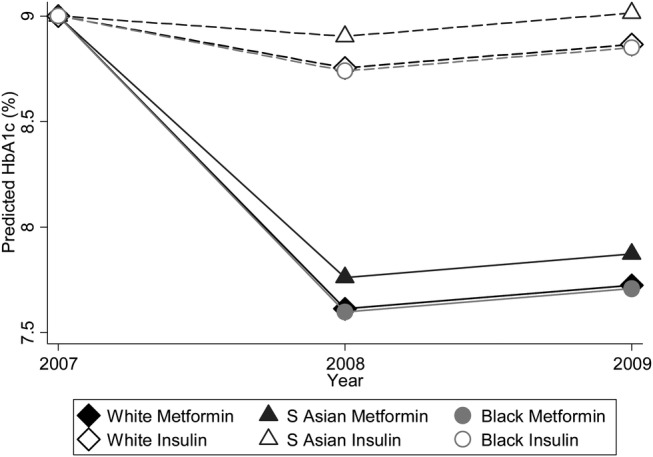
The sample consisted of 6104 people; 18% were white, 63% south Asian, 16% black African/Caribbean and 3% other ethnic groups. HbA1c was lower after 1 and 2 years in all ethnic groups but south Asian people received significantly less benefit from each diabetes treatment. After adjustment, south Asian people were found to have 0.14% less reduction in HbA1c compared to white people (95% CI 0.04% to 0.24%) and white people were 1.6 (95% CI 1.2 to 2.0) times more likely to achieve HbA1c controlled to 7.5% or less relative to south Asian people. HbA1c reduction and control in black African/Caribbean and white people did not differ significantly. There was no evidence that social deprivation influenced HbA1c reduction or control in this cohort.
In all treatment groups, south Asian people with poorly controlled diabetes are less likely to achieve controlled HbA1c, with less reduction in mean HbA1c than white or black African/Caribbean people.
评估在糖化血红蛋白(HbA1c)控制不佳的 2 型糖尿病患者(HbA1c>7.5%)中,HbA1c 的改善是否因种族和社会群体而异。
在伦敦两个行政区的 101 家全科诊所中进行的为期 2 年的 2 型糖尿病前瞻性队列研究。
所有在这两个伦敦行政区的 101 家全科诊所中接受治疗的 2 型糖尿病患者。该样本由一组年龄在 37-71 岁之间的种族多样化的、糖化血红蛋白控制不佳的 2 型糖尿病患者组成,他们于 2007 年接受了治疗,并在 2008-2009 年进行了糖化血红蛋白检测。
采用多水平模型,根据每个种族、社会和治疗组,估计从 2007 年基线糖化血红蛋白到 2008 年和 2009 年的变化以及糖化血红蛋白控制情况。
该样本共包括 6104 人;18%为白人,63%为南亚人,16%为黑非洲/加勒比人,3%为其他种族群体。所有种族群体的糖化血红蛋白在 1 年和 2 年后均有所下降,但南亚人群从每种糖尿病治疗中获益明显较少。调整后发现,与白人相比,南亚人的糖化血红蛋白降低幅度少 0.14%(95%可信区间为 0.04%至 0.24%),而白人达到糖化血红蛋白控制在 7.5%或以下的可能性是南亚人的 1.6 倍(95%可信区间为 1.2 至 2.0)。黑非洲/加勒比和白人的糖化血红蛋白降低和控制情况无显著差异。本队列中,社会贫困程度并未对糖化血红蛋白的降低或控制产生影响。
在所有治疗组中,糖化血红蛋白控制不佳的南亚 2 型糖尿病患者实现糖化血红蛋白控制的可能性较小,糖化血红蛋白平均降低幅度低于白人或黑非洲/加勒比人。