Bae Seong Hwan, Bae Yong Chan, Nam Su Bong, Choi Soo Jong
Department of Plastic and Reconstructive Surgery, Pusan National University School of Medicine, Busan, Korea.
Arch Plast Surg. 2012 Sep;39(5):457-62. doi: 10.5999/aps.2012.39.5.457. Epub 2012 Sep 12.
The elasticity of the back skin of the rat reduced the tension around wounds during the wound healing process in that region, and thus activates wound contraction. The authors proposed two skin fixation methods using readily available materials to decrease the influence of wound contraction on wound healing and designed an experiment to determine their effects.
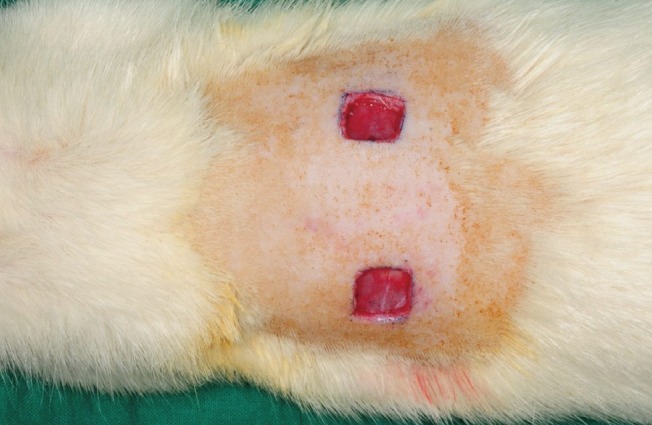
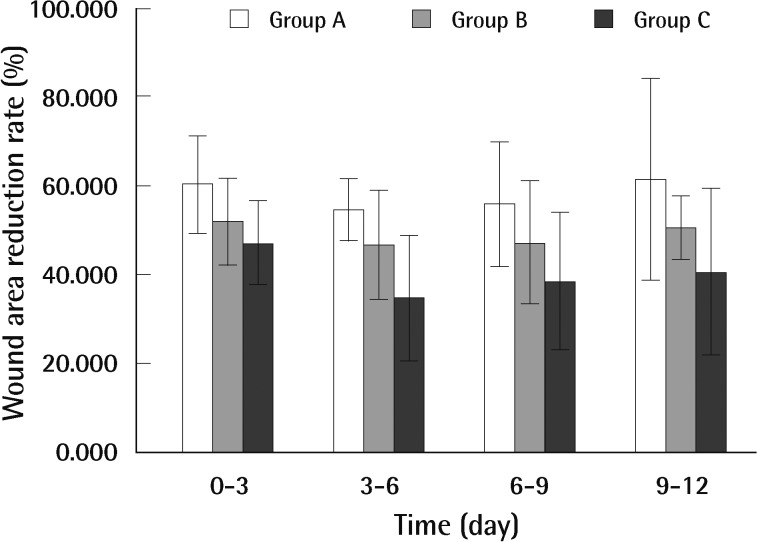
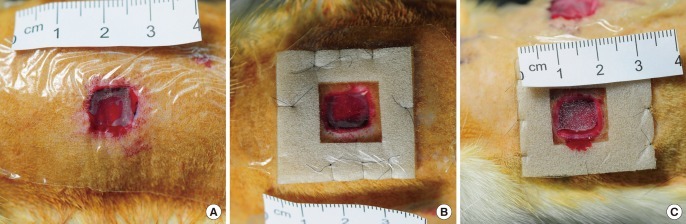
The authors made 36 skin wounds on the backs of 18 rats, and they divided them into three groups. Each group was treated with three different kinds of dressing materials, each with different skin fixing characteristics. Group A was a control group. Group B and group C were dressed by the first and the second skin fixation method. We measured the areas of the wounds post-surgically and calculated the wound area reduction rates.
The two skin fixation methods both reduced the effect of wound contraction compared to the control group. Each of the two methods had different outcomes in reducing wound contraction.
The experiment demonstrated significant differences among the wound areas and the wound area reduction rates of the three groups as a result of differences in the degree of wound contraction. To obtain accurate results from wound healing experiments, appropriate skin fixation methods must be adopted.
大鼠背部皮肤的弹性在该区域伤口愈合过程中降低了伤口周围的张力,从而激活伤口收缩。作者提出了两种使用现成材料的皮肤固定方法,以减少伤口收缩对伤口愈合的影响,并设计了一项实验来确定其效果。
作者在18只大鼠的背部制造了36个皮肤伤口,并将它们分为三组。每组用三种不同的敷料材料进行处理,每种材料具有不同的皮肤固定特性。A组为对照组。B组和C组分别采用第一种和第二种皮肤固定方法进行包扎。我们在手术后测量了伤口面积,并计算了伤口面积缩小率。
与对照组相比,两种皮肤固定方法均降低了伤口收缩的效果。两种方法在减少伤口收缩方面有不同的结果。
实验表明,由于伤口收缩程度不同,三组的伤口面积和伤口面积缩小率存在显著差异。为了从伤口愈合实验中获得准确的结果,必须采用适当的皮肤固定方法。