Department of Chemical Engineering, Chungnam National University, Daejon 305-764, Korea.
Microb Cell Fact. 2012 Oct 24;11:139. doi: 10.1186/1475-2859-11-139.
In nature, mussel adhesive proteins (MAPs) show remarkable adhesive properties, biocompatibility, and biodegradability. Thus, they have been considered promising adhesive biomaterials for various biomedical and industrial applications. However, limited production of natural MAPs has hampered their practical applications. Recombinant production in bacterial cells could be one alternative to obtain useable amounts of MAPs, although additional post-translational modification of tyrosine residues into 3,4-dihydroxyphenyl-alanine (Dopa) and Dopaquinone is required. The superior properties of MAPs are mainly attributed to the introduction of quinone-derived intermolecular cross-links. To solve this problem, we utilized a co-expression strategy of recombinant MAP and tyrosinase in Escherichia coli to successfully modify tyrosine residues in vivo.
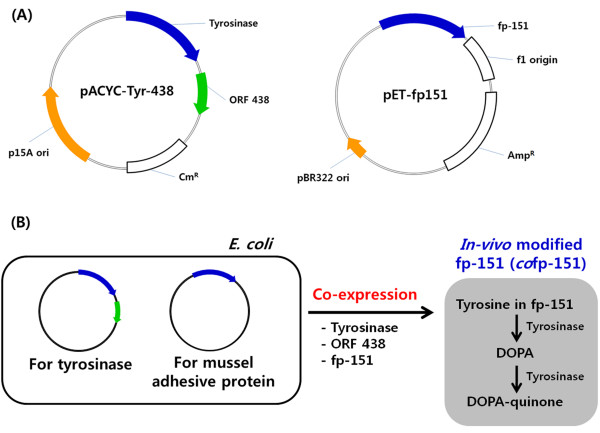
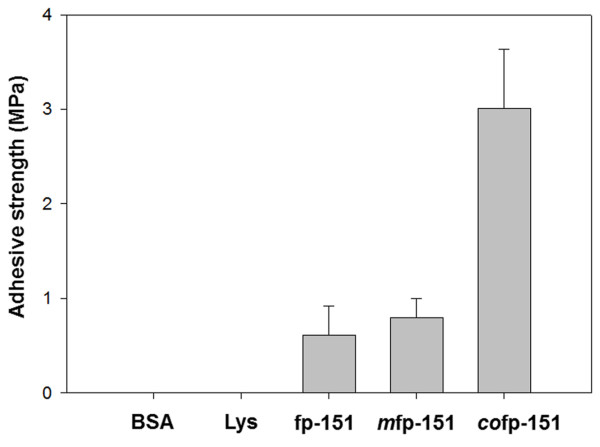
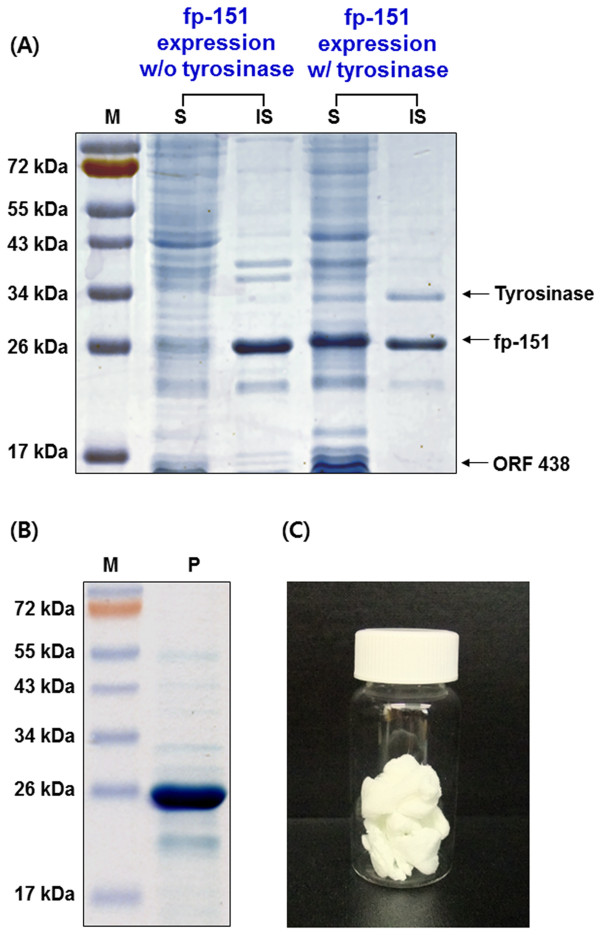
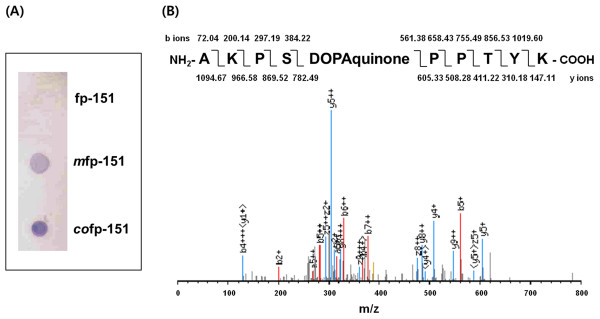
A recombinant hybrid MAP, fp-151, was used as a target for in vivo modification, and a dual vector system of pET and pACYC-Duet provided co-expression of fp-151 and tyrosinase. As a result, fp-151 was over-expressed and mainly obtained from the soluble fraction in the co-expression system. Without tyrosinase co-expression, fp-151 was over-expressed in an insoluble form in inclusion bodies. The modification of tyrosine residues in the soluble-expressed fp-151 was clearly observed from nitroblue tetrazolium staining and liquid-chromatography-mass/mass spectrometry analyses. The purified, in vivo modified, fp-151 from the co-expression system showed approximately 4-fold higher bulk-scale adhesive strength compared to in vitro tyrosinase-treated fp-151.
Here, we reported a co-expression system to obtain in vivo modified MAP; additional in vitro tyrosinase modification was not needed to obtain adhesive properties and the in vivo modified MAP showed superior adhesive strength compared to in vitro modified protein. It is expected that this co-expression strategy will accelerate the use of functional MAPs in practical applications and can be successfully applied to prepare other Dopa/Dopaquinone-based biomaterials.
在自然界中,贻贝类黏附蛋白(MAPs)表现出显著的黏附特性、生物相容性和生物可降解性。因此,它们被认为是有前途的黏附生物材料,可用于各种生物医学和工业应用。然而,天然 MAPs 的产量有限,限制了它们的实际应用。在细菌细胞中进行重组生产可能是获得可用量 MAPs 的一种替代方法,尽管需要对酪氨酸残基进行额外的翻译后修饰,将其转化为 3,4-二羟基苯丙氨酸(Dopa)和 Dopaquinone。MAPs 的优异性能主要归因于引入醌衍生的分子间交联。为了解决这个问题,我们利用重组 MAP 和酪氨酸酶在大肠杆菌中的共表达策略,成功地在体内修饰了酪氨酸残基。
我们将重组混合 MAP fp-151 作为体内修饰的靶标,使用 pET 和 pACYC-Duet 双载体系统共表达 fp-151 和酪氨酸酶。结果,fp-151 得到了过表达,主要从共表达系统的可溶性部分中获得。在没有酪氨酸酶共表达的情况下,fp-151 以不溶性包涵体的形式过表达。从硝基蓝四唑染色和液相色谱-质谱/质谱分析中可以清楚地观察到可溶性表达的 fp-151 中酪氨酸残基的修饰。与体外酪氨酸酶处理的 fp-151 相比,从共表达系统中纯化的、体内修饰的 fp-151 具有约 4 倍的整体规模黏附强度。
本研究报道了一种获得体内修饰 MAP 的共表达系统;不需要额外的体外酪氨酸酶修饰即可获得黏附性能,且体内修饰的 MAP 比体外修饰的蛋白质具有更高的黏附强度。预计这种共表达策略将加速功能性 MAP 在实际应用中的使用,并可成功应用于制备其他 Dopa/Dopaquinone 基生物材料。