Department of Biology, University of North Carolina Chapel Hill, NC, USA.
Front Plant Sci. 2012 Oct 23;3:237. doi: 10.3389/fpls.2012.00237. eCollection 2012.
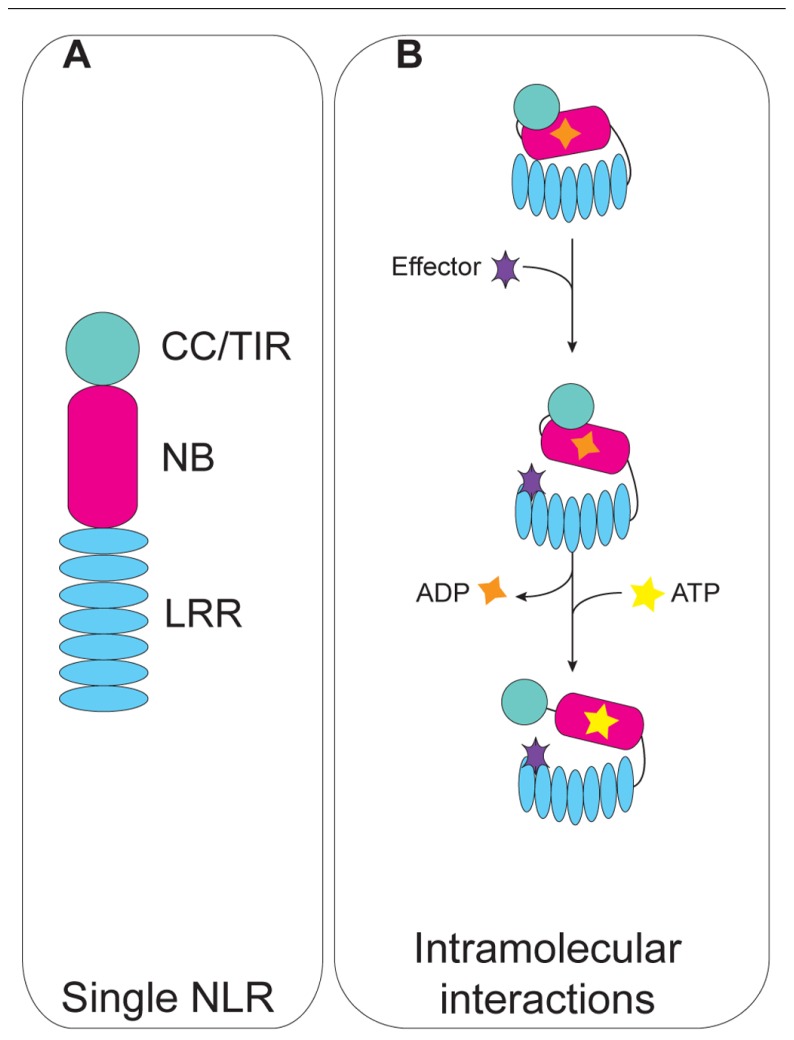
Nucleotide binding leucine-rich repeat proteins (NLRs) are the major class of intracellular immune receptors in plants. NLRs typically function to specifically recognize pathogen effectors and to initiate and control defense responses that severely limit pathogen growth in plants (termed effector-triggered immunity, or ETI). Despite numerous reports supporting a central role in innate immunity, the molecular mechanisms driving NLR activation and downstream signaling remain largely elusive. Recent reports shed light on the pre- and post-activation dynamics of a few NLR-containing protein complexes. Recent technological advances in the use of proteomics may enable high-resolution definition of immune protein complexes and possible activation-relevant post-translational modifications of the components in these complexes. In this review, we focus on research aimed at characterizing pre- and post-activation NLR protein complexes and the molecular events that follow activation. We discuss the use of new or improved technologies as tools to unveil the molecular mechanisms that define NLR-mediated pathogen recognition.
核苷酸结合富含亮氨酸重复蛋白 (NLRs) 是植物中主要的细胞内免疫受体类别。NLRs 的典型功能是特异性识别病原体效应物,并启动和控制防御反应,从而严重限制植物中病原体的生长(称为效应物触发的免疫,或 ETI)。尽管有大量报告支持其在先天免疫中的核心作用,但驱动 NLR 激活和下游信号转导的分子机制在很大程度上仍难以捉摸。最近的报告揭示了少数含有 NLR 的蛋白复合物的预激活和后激活动力学。近年来,蛋白质组学在使用方面的技术进步可能使免疫蛋白复合物的高分辨率定义以及这些复合物中成分的可能与激活相关的翻译后修饰成为可能。在这篇综述中,我们重点介绍了旨在表征预激活和后激活 NLR 蛋白复合物以及激活后发生的分子事件的研究。我们讨论了使用新的或改进的技术作为揭示定义 NLR 介导的病原体识别的分子机制的工具。