Centre for General Practice, Vaccine & Infectious Disease Institute (VAXINFECTIO), Laboratory of microbiology, University of Antwerp, Antwerp, Belgium.
BMC Fam Pract. 2012 Oct 11;13:101. doi: 10.1186/1471-2296-13-101.
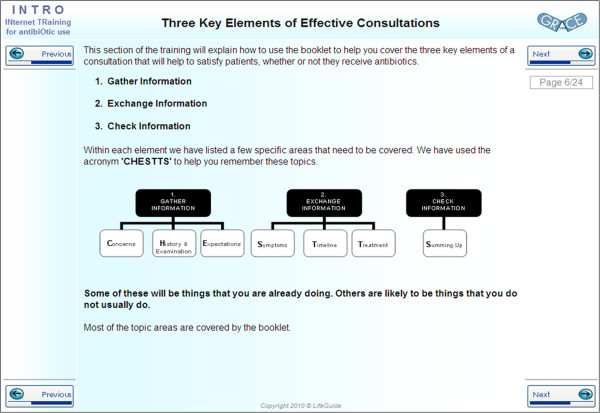
Interventions to promote prudent antibiotic prescribing by general practitioners (GPs) have often only been developed for use in one country. We aimed to develop an intervention which would be appropriate to implement in multiple European countries in order to offer greater benefit to practice whilst using fewer resources. The INTRO (INternet TRaining for antibiOtic use) intervention needed to deliver training to GPs in the use of C-Reactive Protein (CRP) near patient tests to help diagnose acute cough and in communication skills to help explain prescribing decisions to patients. We explored GPs' views on the initial version of INTRO to test acceptability and potentially increase applicability for use in multiple countries before the start of a randomised trial.
30 GPs from five countries (Belgium, England, the Netherlands, Poland and Spain), were interviewed using a "think aloud" approach. GPs were asked to work through the intervention and discuss their views on the content and format in relation to following the intervention in their own practice. GPs viewed the same intervention but versions were created in five languages. Data were coded using thematic analysis.
GPs in all five countries reported the view that the intervention addressed an important topic, was broadly acceptable and feasible to use, and would be a useful tool to help improve clinical practice. However, GPs in the different countries identified aspects of the intervention that did not reflect their national culture or healthcare system. These included perceived differences in communication style used in the consultation, consultation length and the stage of illness at which patient typically presented.
An online intervention to support evidence-based use of antibiotics is acceptable and feasible to implement amongst GPs in multiple countries. However, tailoring of the intervention to suit national contexts was necessary by adding local information and placing more emphasis on the fact that GPs could select the communication skills they wished to use in practice. Using think aloud methods to complement the development of interventions is a powerful method to identify regional contextual barriers to intervention implementation.
旨在促进初级保健医生(GP)合理使用抗生素的干预措施通常仅在一个国家开发和使用。我们旨在开发一种干预措施,以便在多个欧洲国家实施,以便在使用较少资源的同时为实践带来更大的益处。INTRO(INternet TRaining for antibiOtic use)干预措施需要为 GP 提供使用 C-反应蛋白(CRP)即时检测来帮助诊断急性咳嗽的培训,并提供沟通技巧来帮助向患者解释处方决策。我们探讨了 GP 对 INTRO 初始版本的看法,以在随机试验开始之前测试其可接受性并提高其在多个国家的适用性。
来自五个国家(比利时、英国、荷兰、波兰和西班牙)的 30 名 GP 使用“出声思考”方法进行了访谈。要求 GP 通过干预措施进行工作,并讨论他们对内容和格式的看法,以便在自己的实践中遵循干预措施。GP 查看了相同的干预措施,但版本是用五种语言创建的。数据使用主题分析进行编码。
所有五个国家的 GP 都报告说,干预措施解决了一个重要的话题,具有广泛的可接受性和可行性,并且是帮助改善临床实践的有用工具。然而,不同国家的 GP 确定了干预措施中没有反映其国家文化或医疗保健系统的方面。这些方面包括在咨询中使用的沟通风格、咨询时间长度和患者通常就诊的疾病阶段方面的差异。
一种支持基于证据使用抗生素的在线干预措施在多个国家的 GP 中是可接受和可行的。然而,通过添加本地信息并更加强调 GP 可以选择他们希望在实践中使用的沟通技巧,对干预措施进行适应当地情况的调整是必要的。使用出声思考方法来补充干预措施的开发是一种强大的方法,可以确定干预措施实施的区域背景障碍。