INRA, UMR1345, IRHS (INRA, Agrocampus-Ouest, Université d'Angers) SFR QUASAV, Beaucouzé, France.
Evol Appl. 2012 Nov;5(7):694-704. doi: 10.1111/j.1752-4571.2012.00246.x.
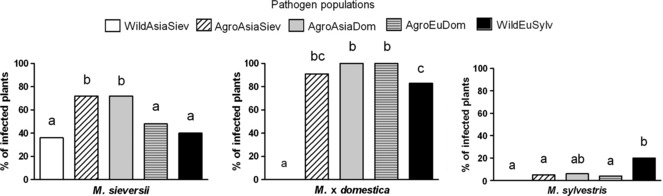
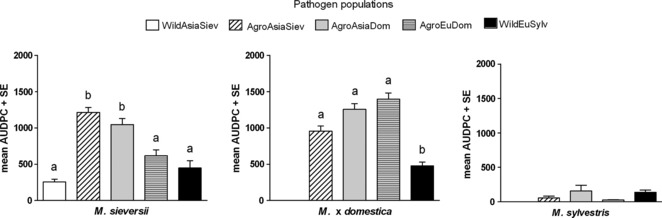
Understanding how pathogens emerge is essential to bring disease-causing agents under durable human control. Here, we used cross-pathogenicity tests to investigate the changes in life-history traits of the fungal pathogen Venturia inaequalis associated with host-tracking during the domestication of apple and subsequent host-range expansion on the wild European crabapple (Malus sylvestris). Pathogenicity of 40 isolates collected in wild and domesticated ecosystems was assessed on the domesticated apple, its Central Asian main progenitor (M. sieversii) and M. sylvestris. Isolates from wild habitats in the centre of origin of the crop were not pathogenic on the domesticated apple and less aggressive than other isolates on their host of origin. Isolates from the agro-ecosystem in Central Asia infected a higher proportion of plants with higher aggressiveness, on both the domesticated host and its progenitor. Isolates from the European crabapple were still able to cause disease on other species but were less aggressive and less frequently virulent on these hosts than their endemic populations. Our results suggest that the domestication of apple was associated with the acquisition of virulence in the pathogen following host-tracking. The spread of the disease in the agro-ecosystem would also have been accompanied by an increase in overall pathogenicity.
了解病原体的出现方式对于持久地控制致病因子至关重要。在这里,我们使用跨病原体测试来研究与苹果驯化过程中宿主追踪相关的真菌病原体梨火疫病菌(Venturia inaequalis)的生活史特征变化,以及随后在野生欧洲野苹果(Malus sylvestris)上的宿主范围扩张。我们评估了在野生和驯化生态系统中收集的 40 个分离株在驯化苹果、其中亚主要祖先是(M. sieversii)和 M. sylvestris 上的致病性。来自作物起源中心的野生栖息地的分离株对驯化苹果没有致病性,而且在其起源宿主上的侵袭性比其他分离株弱。来自中亚农业生态系统的分离株在驯化宿主及其祖先后者上感染了更高比例的植物,侵袭性也更高。来自欧洲野苹果的分离株仍然能够在其他物种上引起疾病,但与它们的地方种群相比,在这些宿主上的侵袭性和毒性较弱。我们的研究结果表明,苹果的驯化伴随着病原体在宿主追踪后获得了毒力。该疾病在农业生态系统中的传播也伴随着整体致病性的增加。