Exercise Physiology Research Group, Department of Kinesiology, Faculty of Kinesiology and Rehabilitation Sciences, KU Leuven, Heverlee, Belgium.
PLoS One. 2012;7(11):e49281. doi: 10.1371/journal.pone.0049281. Epub 2012 Nov 8.
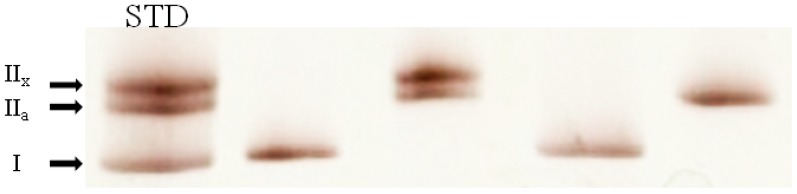
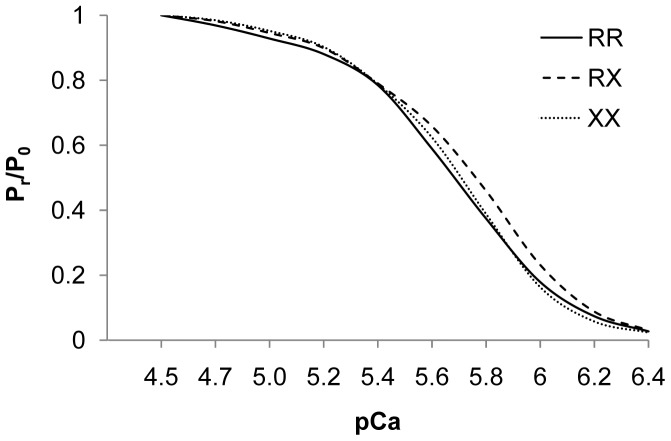
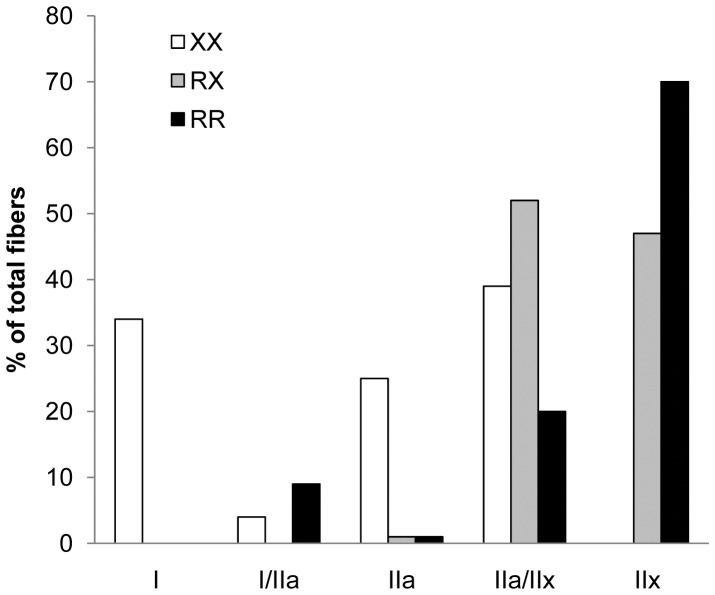
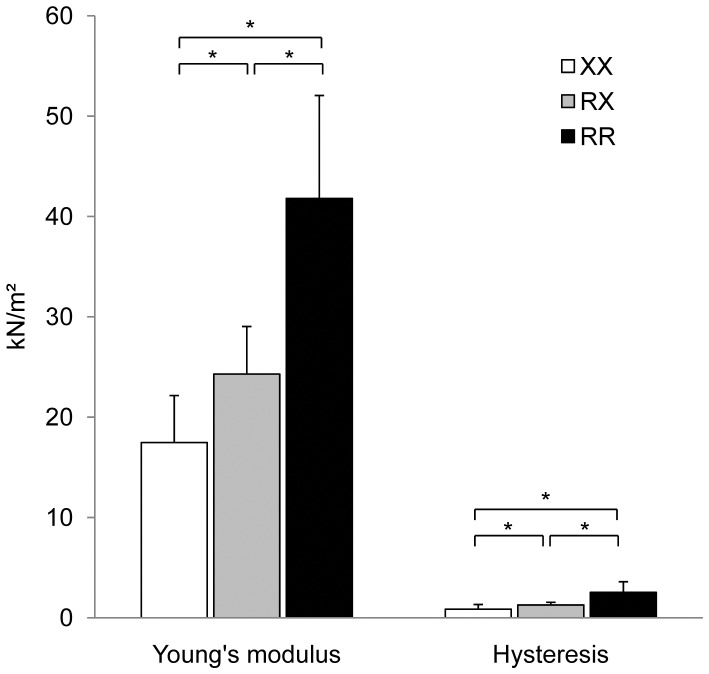
A common nonsense polymorphism in the ACTN3 gene results in the absence of α-actinin-3 in XX individuals. The wild type allele has been associated with power athlete status and an increased force output in numeral studies, though the mechanisms by which these effects occur are unclear. Recent findings in the Actn3(-/-) (KO) mouse suggest a shift towards 'slow' metabolic and contractile characteristics of fast muscle fibers lacking α-actinin-3. Skinned single fibers from the quadriceps muscle of three men with spinal cord injury (SCI) were tested regarding peak force, unloaded shortening velocity, force-velocity relationship, passive tension and calcium sensitivity. The SCI condition induces an 'equal environment condition' what makes these subjects ideal to study the role of α-actinin-3 on fiber type expression and single muscle fiber contractile properties. Genotyping for ACTN3 revealed that the three subjects were XX, RX and RR carriers, respectively. The XX carrier's biopsy was the only one that presented type I fibers with a complete lack of type II(x) fibers. Properties of hybrid type II(a)/II(x) fibers were compared between the three subjects. Absence of α-actinin-3 resulted in less stiff type II(a)/II(x) fibers. The heterozygote (RX) exhibited the highest fiber diameter (0.121±0.005 mm) and CSA (0.012±0.001 mm(2)) and, as a consequence, the highest peak force (2.11±0.14 mN). Normalized peak force was similar in all three subjects (P = 0.75). Unloaded shortening velocity was highest in R-allele carriers (P<0.001). No difference was found in calcium sensitivity. The preservation of type I fibers and the absence of type II(x) fibers in the XX individual indicate a restricted transformation of the muscle fiber composition to type II fibers in response to long-term muscle disuse. Lack of α-actinin-3 may decrease unloaded shortening velocity and increase fiber elasticity.
在 ACTN3 基因中常见的无意义多态性导致 XX 个体中缺乏 α-辅肌动蛋白-3。野生型等位基因与力量型运动员状态和多项研究中增加的力输出有关,但这些影响发生的机制尚不清楚。最近在 Actn3(-/-)(KO)小鼠中的发现表明,缺乏 α-辅肌动蛋白-3 的快肌纤维向“慢”代谢和收缩特性发生转变。对来自三名脊髓损伤(SCI)男性的股四头肌的去皮单纤维进行了峰值力、空载缩短速度、力-速度关系、被动张力和钙敏感性测试。SCI 条件诱导出“同等环境条件”,这使得这些受试者成为研究 α-辅肌动蛋白-3 对纤维类型表达和单肌纤维收缩特性的理想选择。ACTN3 的基因分型显示,这三个受试者分别为 XX、RX 和 RR 携带者。XX 携带者的活检是唯一一种完全缺乏 II(x)型纤维的 I 型纤维。在这三个受试者之间比较了混合 II(a)/II(x)纤维的特性。缺乏 α-辅肌动蛋白-3 导致 II(a)/II(x)纤维的硬度降低。杂合子(RX)表现出最大的纤维直径(0.121±0.005 mm)和 CSA(0.012±0.001 mm(2)),因此,峰值力最高(2.11±0.14 mN)。所有三个受试者的归一化峰值力相似(P=0.75)。在 R 等位基因携带者中,空载缩短速度最高(P<0.001)。钙敏感性没有差异。XX 个体中 I 型纤维的保留和 II(x)型纤维的缺失表明,在长期肌肉失用的情况下,肌肉纤维组成向 II 型纤维的转化受到限制。缺乏 α-辅肌动蛋白-3 可能会降低空载缩短速度并增加纤维弹性。