Department of Biology, University of Victoria PO Box 3020, STN CSC, Victoria, British Columbia, V8W 3N5, Canada.
Ecol Evol. 2012 Oct;2(10):2450-9. doi: 10.1002/ece3.369. Epub 2012 Aug 29.
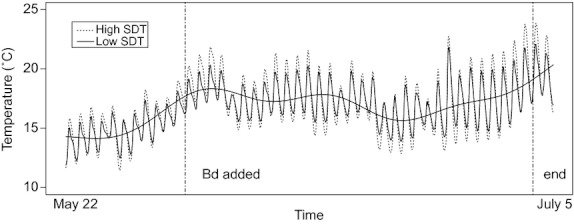
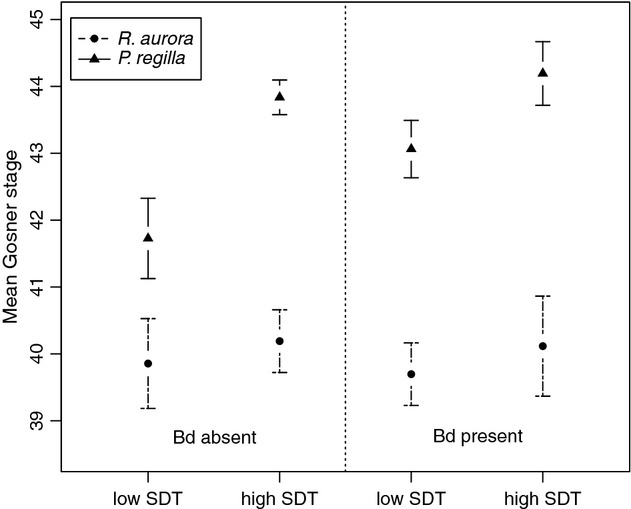
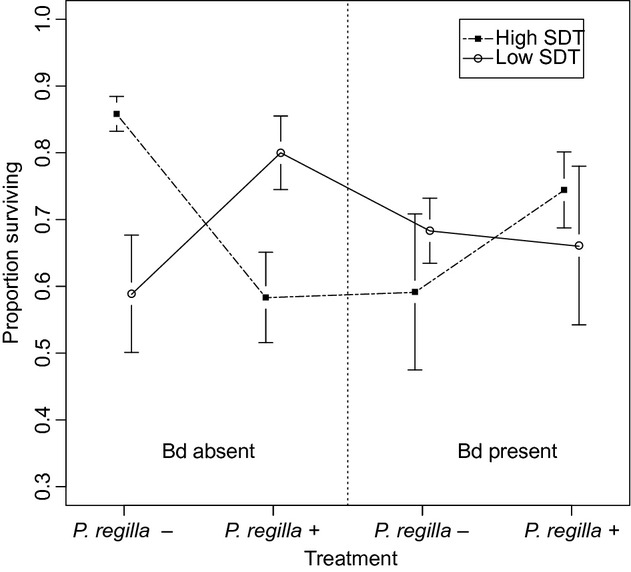
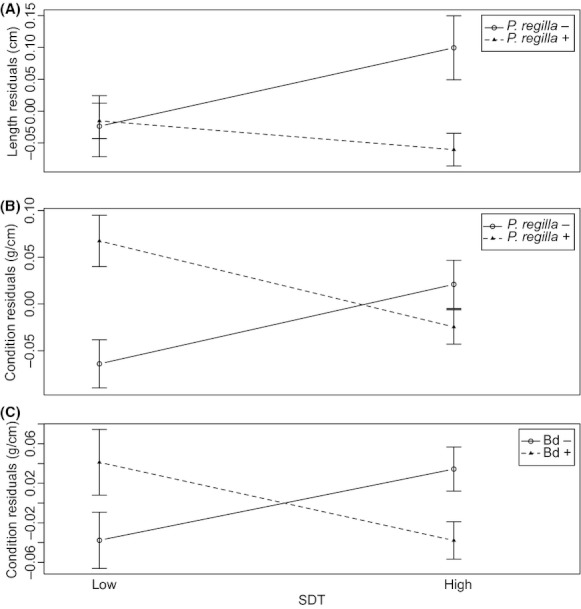
The emergence of amphibian chytridiomycosis, caused by the fungus Batrachochytrium dendrobatidis (Bd) has led to the decline and extinction of numerous amphibian species. Multiple studies have observed links between climatic factors and amphibian declines apparently caused by Bd. Using outdoor experimental mesocosms, we tested the response of red-legged frog (Rana aurora) tadpoles to increased variation in temperature, a component of climate linked to amphibian declines, and Bd exposure. We included tadpoles of a sympatric competitor species, Pacific chorus frog (Pseudacris regilla), in a fully factorial design to test the effects of Bd and temperature on interspecific interactions. We found that higher variation in temperature had numerous effects in mesocosms, including interacting with Bd presence to decrease the condition of R. aurora, shifting the relative performance of competing P. regilla and R. aurora, and accelerating the development of P. regilla relative to R. aurora. Our results demonstrate that increased variation in temperature can affect amphibians in multiple ways that will be contingent on ecological context, including the presence of Bd and competing species.
两栖动物壶菌病的出现是由真菌巴特拉科奇特里亚姆 dendrobatidis(Bd)引起的,导致许多两栖动物物种的减少和灭绝。多项研究观察到气候因素与显然由 Bd 引起的两栖动物减少之间存在联系。我们使用户外实验中观生物系统,测试了温度变化对红斑腿蛙(Rana aurora)蝌蚪的反应,温度变化是与两栖动物减少有关的气候组成部分,以及 Bd 的暴露。我们将一种同域竞争物种,太平洋角蟾(Pseudacris regilla)的蝌蚪纳入完全析因设计中,以测试 Bd 和温度对种间相互作用的影响。我们发现,温度变化幅度较大对中观生物系统有许多影响,包括与 Bd 的存在相互作用,降低红斑腿蛙的状况,改变竞争物种太平洋角蟾和红斑腿蛙的相对表现,并加速太平洋角蟾的发育相对于红斑腿蛙。我们的研究结果表明,温度变化幅度的增加可以以多种方式影响两栖动物,这将取决于生态背景,包括 Bd 的存在和竞争物种。