Department of Physiology, Perelman School of Medicine, University of Pennsylvania, Philadelphia, PA 19104, USA.
J Gen Physiol. 2012 Dec;140(6):697-716. doi: 10.1085/jgp.201210804. Epub 2012 Nov 12.
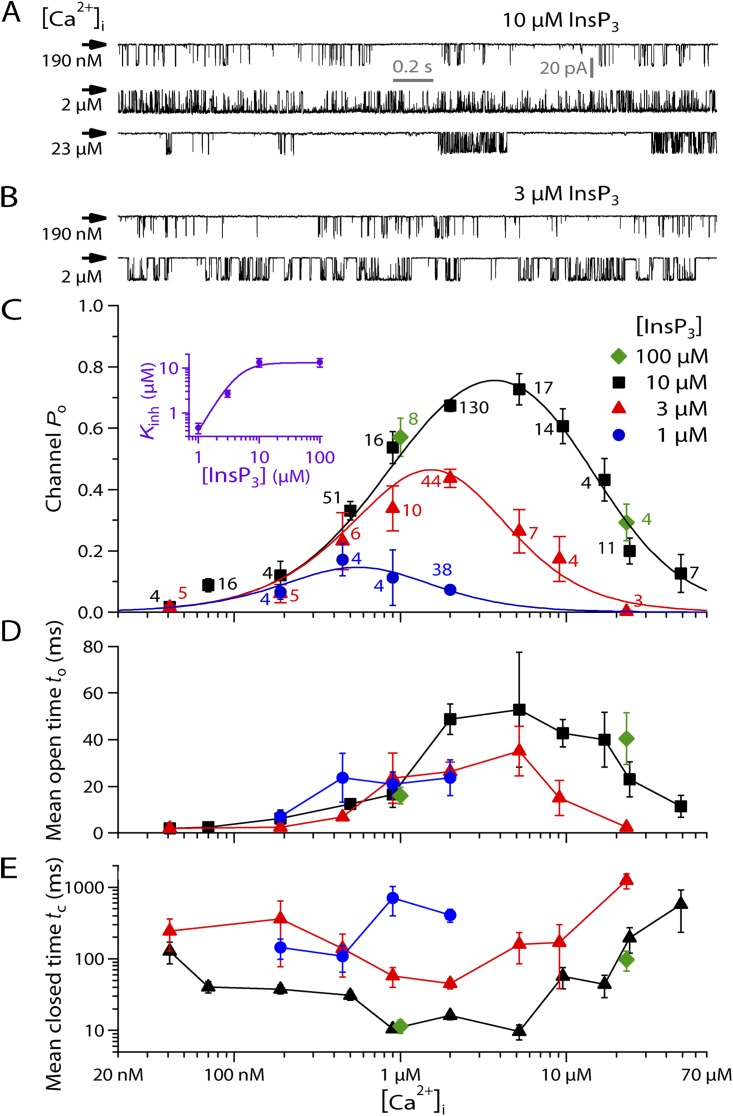
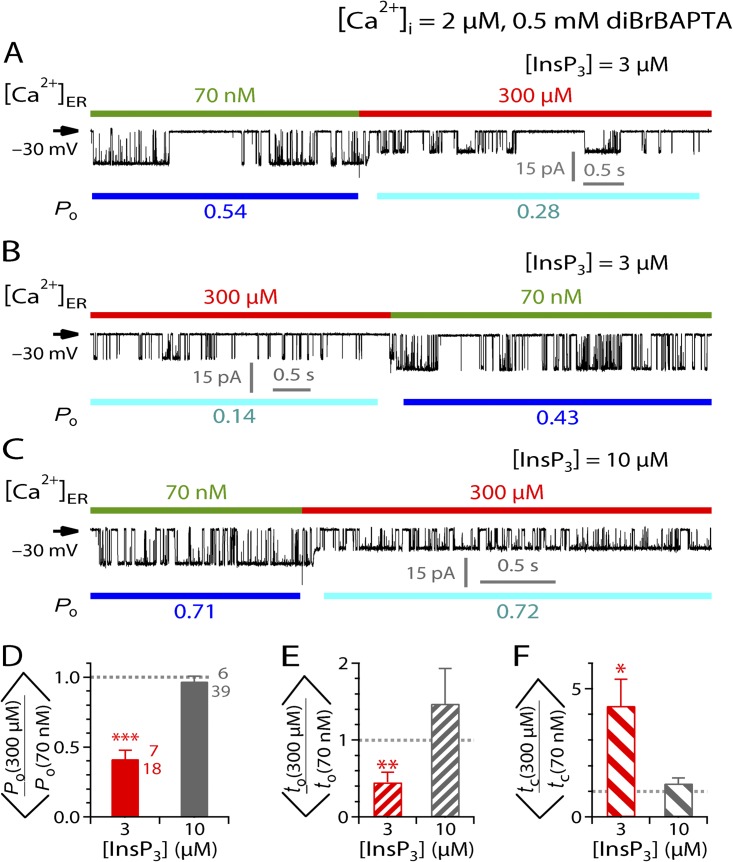
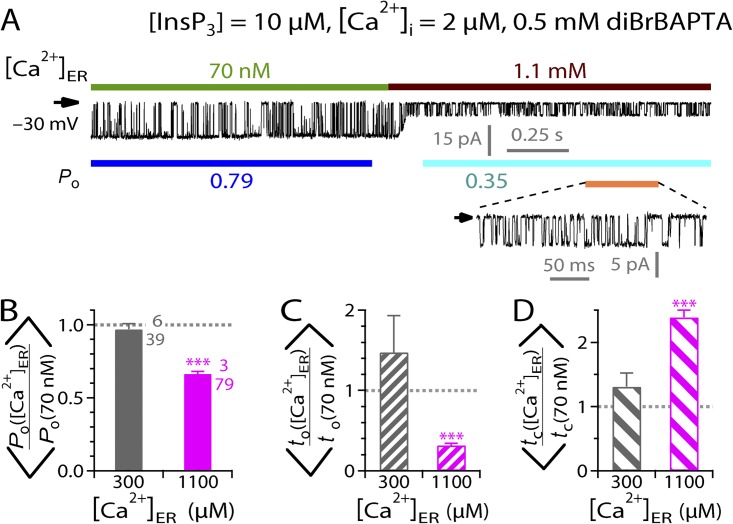
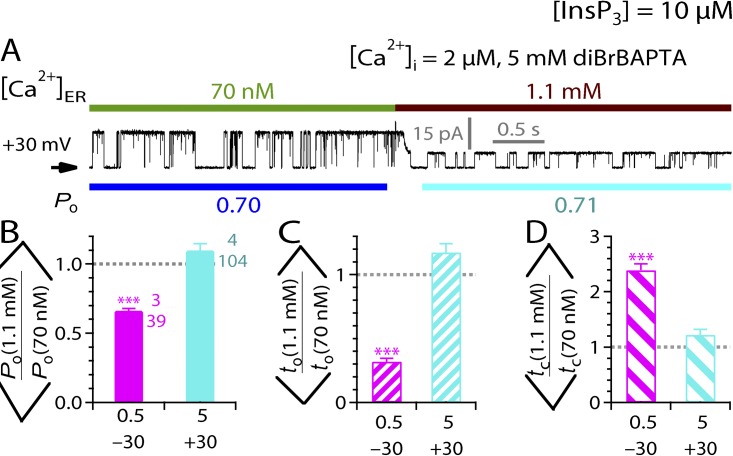
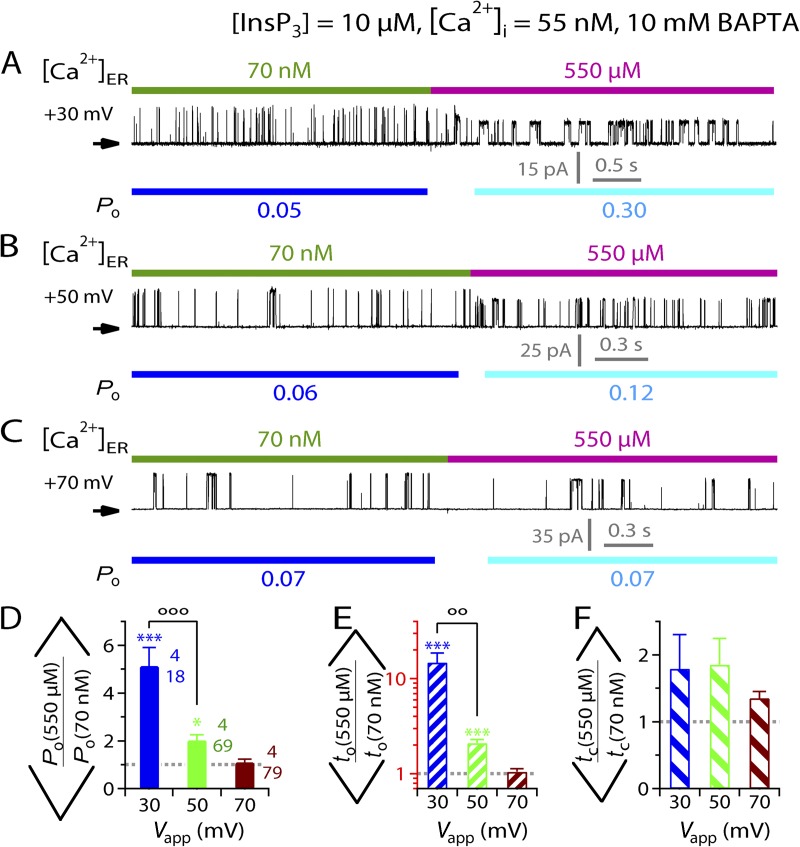
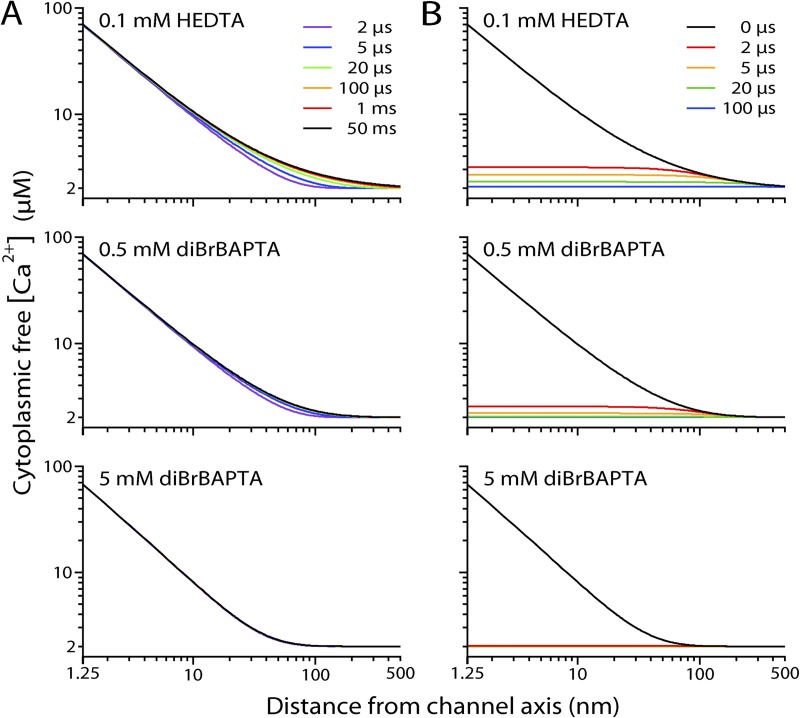
The ubiquitous inositol 1,4,5-trisphosphate (InsP(3)) receptor (InsP(3)R) Ca(2+) release channel plays a central role in the generation and modulation of intracellular Ca(2+) signals, and is intricately regulated by multiple mechanisms including cytoplasmic ligand (InsP(3), free Ca(2+), free ATP(4-)) binding, posttranslational modifications, and interactions with cytoplasmic and endoplasmic reticulum (ER) luminal proteins. However, regulation of InsP(3)R channel activity by free Ca(2+) in the ER lumen (Ca(2+)) remains poorly understood because of limitations of Ca(2+) flux measurements and imaging techniques. Here, we used nuclear patch-clamp experiments in excised luminal-side-out configuration with perfusion solution exchange to study the effects of Ca(2+) on homotetrameric rat type 3 InsP(3)R channel activity. In optimal Ca(2+) and subsaturating [InsP(3)], jumps of Ca(2+) from 70 nM to 300 µM reduced channel activity significantly. This inhibition was abrogated by saturating InsP(3) but restored when Ca(2+) was raised to 1.1 mM. In suboptimal Ca(2+), jumps of Ca(2+) (70 nM to 300 µM) enhanced channel activity. Thus, Ca(2+) effects on channel activity exhibited a biphasic dependence on Ca(2+). In addition, the effect of high Ca(2+) was attenuated when a voltage was applied to oppose Ca(2+) flux through the channel. These observations can be accounted for by Ca(2+) flux driven through the open InsP(3)R channel by Ca(2+), raising local Ca(2+) around the channel to regulate its activity through its cytoplasmic regulatory Ca(2+)-binding sites. Importantly, Ca(2+) regulation of InsP(3)R channel activity depended on cytoplasmic Ca(2+)-buffering conditions: it was more pronounced when Ca(2+) was weakly buffered but completely abolished in strong Ca(2+)-buffering conditions. With strong cytoplasmic buffering and Ca(2+) flux sufficiently reduced by applied voltage, both activation and inhibition of InsP(3)R channel gating by physiological levels of Ca(2+) were completely abolished. Collectively, these results rule out Ca(2+) regulation of channel activity by direct binding to the luminal aspect of the channel.
普遍存在的肌醇 1,4,5-三磷酸(InsP(3))受体(InsP(3)R)Ca(2+)释放通道在细胞内 Ca(2+)信号的产生和调节中发挥核心作用,并且通过多种机制进行复杂的调节,包括细胞质配体(InsP(3)、游离 Ca(2+)、游离 ATP(4-))结合、翻译后修饰以及与细胞质和内质网(ER)腔蛋白的相互作用。然而,由于 Ca(2+)流量测量和成像技术的限制,内质网腔游离 Ca(2+)(Ca(2+))对 InsP(3)R 通道活性的调节仍然知之甚少。在这里,我们使用核片钳实验,在具有灌流液交换的腔内外翻位构型中,研究了 Ca(2+)对同型四聚体大鼠 3 型 InsP(3)R 通道活性的影响。在最佳 Ca(2+)和亚饱和 [InsP(3)]下,Ca(2+)从 70 nM 跃升至 300 µM 显著降低了通道活性。这种抑制作用被饱和 InsP(3)消除,但当 Ca(2+)升高至 1.1 mM 时恢复。在亚最佳 Ca(2+)下,Ca(2+)(70 nM 至 300 µM)的跃升增强了通道活性。因此,Ca(2+)对通道活性的影响表现出对 Ca(2+)的双相依赖性。此外,当施加电压以阻止 Ca(2+)通过通道的通量时,高 Ca(2+)的作用会减弱。这些观察结果可以通过由 Ca(2+)驱动的通过开放 InsP(3)R 通道的 Ca(2+)通量来解释,从而通过其细胞质调节 Ca(2+)-结合位点来调节通道周围的局部 Ca(2+),从而调节其活性。重要的是,Ca(2+)对 InsP(3)R 通道活性的调节取决于细胞质 Ca(2+)缓冲条件:当 Ca(2+)被弱缓冲时,这种调节更为明显,但在强 Ca(2+)缓冲条件下完全消除。在细胞质强缓冲和通过施加电压充分降低 Ca(2+)通量的情况下,生理水平的 Ca(2+)对 InsP(3)R 通道门控的激活和抑制作用完全被消除。总的来说,这些结果排除了通道活性通过直接结合通道腔侧面进行 Ca(2+)调节的可能性。