Istituto di Ricerche Farmacologiche Mario Negri, via G. La Masa 19, 20156 Milan, Italy.
Br J Cancer. 2013 Jan 15;108(1):222-8. doi: 10.1038/bjc.2012.492. Epub 2012 Nov 20.
Hepatocellular carcinoma (HCC) has been associated to diabetes and obesity, but a possible association with the metabolic syndrome (MetS) and its potential interaction with hepatitis is open to discussion.
We analysed data from an Italian case-control study, including 185 HCC cases and 404 controls. Odds ratios (ORs) and 95% confidence intervals (CIs) were computed from unconditional logistic regression models.
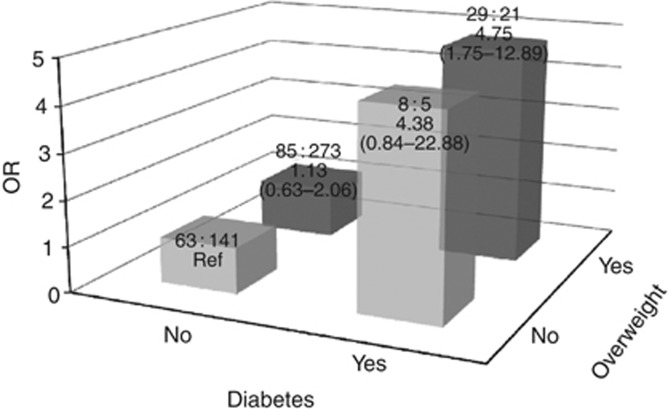
Among the MetS components, diabetes and obesity (i.e, body mass index (BMI)≥30 kg m(-2)) were positively associated to HCC risk, with ORs of 4.33 (95% CI, 1.89-9.86) and 1.97 (95% CI, 1.03-3.79), respectively. The ORs for the MetS were 4.06 (95% CI, 1.33-12.38) defining obesity as BMI≥25, and 1.92 (95% CI, 0.38-9.76) defining it as BMI≥30. The risk increased with the number of MetS components, up to an almost four-fold excess risk among subjects with ≥2 MetS factors. Among subjects without chronic infection with hepatitis B and/or C, the OR for those with ≥2 MetS components was over six-fold elevated. There was no consistent association in subjects with serological evidence of hepatitis B and/or C infection.
This study found that the risk of HCC increases with the number of MetS components in subjects not chronically infected with hepatitis viruses.
肝细胞癌 (HCC) 与糖尿病和肥胖有关,但代谢综合征 (MetS) 与其之间的可能关联及其与肝炎的潜在相互作用仍存在争议。
我们分析了一项意大利病例对照研究的数据,包括 185 例 HCC 病例和 404 例对照。采用非条件逻辑回归模型计算比值比 (OR) 和 95%置信区间 (CI)。
在 MetS 成分中,糖尿病和肥胖(即 BMI≥30 kg/m2)与 HCC 风险呈正相关,OR 值分别为 4.33(95%CI,1.89-9.86)和 1.97(95%CI,1.03-3.79)。当肥胖定义为 BMI≥25 时,MetS 的 OR 为 4.06(95%CI,1.33-12.38),当肥胖定义为 BMI≥30 时,OR 为 1.92(95%CI,0.38-9.76)。风险随 MetS 成分数量的增加而增加,在没有慢性乙型肝炎和/或丙型肝炎感染的受试者中,存在≥2 个 MetS 因素的受试者的风险增加近四倍。在乙型肝炎和/或丙型肝炎血清学证据阳性的受试者中,这种关联并不一致。
本研究发现,在未感染乙型肝炎和/或丙型肝炎病毒的受试者中,随着 MetS 成分数量的增加,HCC 的风险增加。