Department of Physical Education and Sport, School of Sport Sciences, University of Granada, Granada, Spain.
BMJ. 2012 Nov 20;345:e7279. doi: 10.1136/bmj.e7279.
To explore the extent to which muscular strength in adolescence is associated with all cause and cause specific premature mortality (<55 years).
Prospective cohort study.
Sweden.
1,142,599 Swedish male adolescents aged 16-19 years were followed over a period of 24 years.
Baseline examinations included knee extension, handgrip, and elbow flexion strength tests, as well as measures of diastolic and systolic blood pressure and body mass index. Cox regression was used to estimate hazard ratios for mortality according to muscular strength categories (tenths).
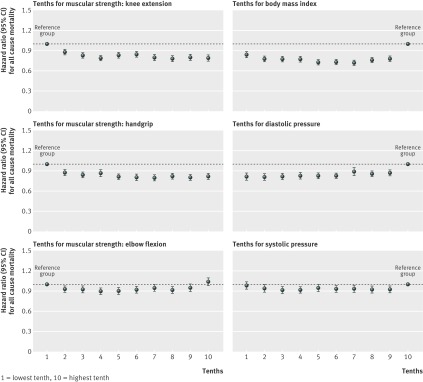
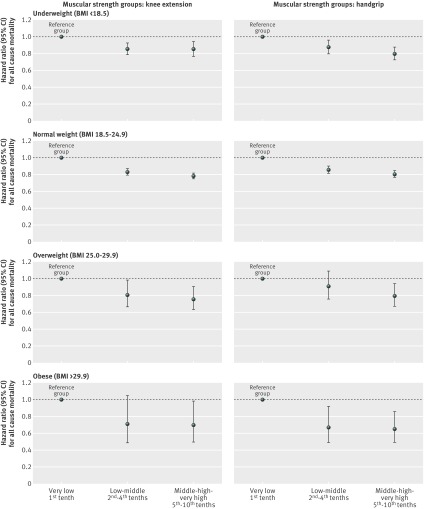
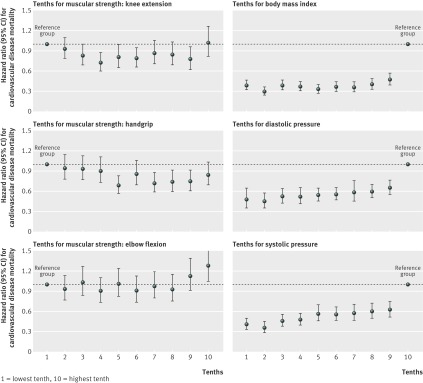
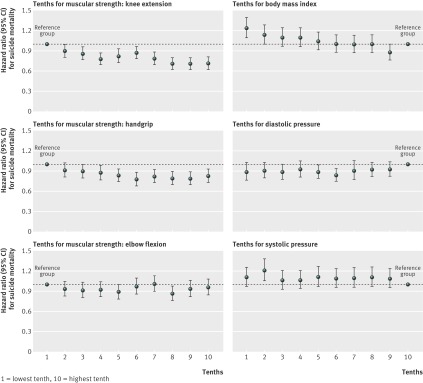
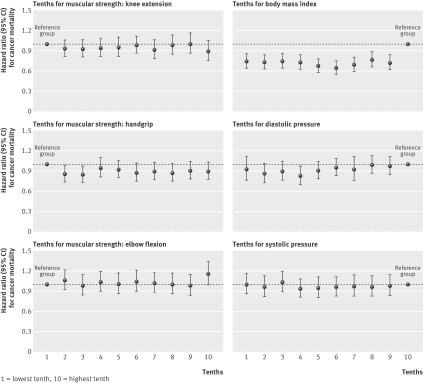
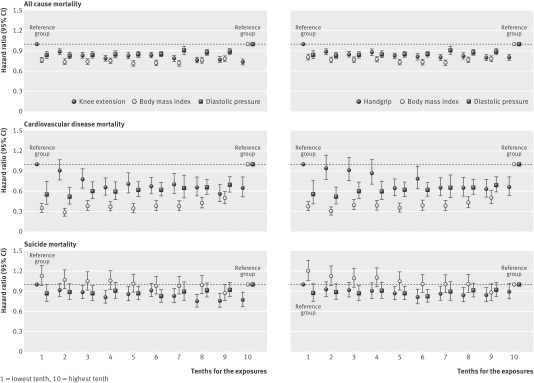
During a median follow-up period of 24 years, 26,145 participants died. Suicide was a more frequent cause of death in young adulthood (22.3%) than was cardiovascular diseases (7.8%) or cancer (14.9%). High muscular strength in adolescence, as assessed by knee extension and handgrip tests, was associated with a 20-35% lower risk of premature mortality due to any cause or cardiovascular disease, independently of body mass index or blood pressure; no association was observed with mortality due to cancer. Stronger adolescents had a 20-30% lower risk of death from suicide and were 15-65% less likely to have any psychiatric diagnosis (such as schizophrenia and mood disorders). Adolescents in the lowest tenth of muscular strength showed by far the highest risk of mortality for different causes. All cause mortality rates (per 100,000 person years) ranged between 122.3 and 86.9 for the weakest and strongest adolescents; corresponding figures were 9.5 and 5.6 for mortality due to cardiovascular diseases and 24.6 and 16.9 for mortality due to suicide.
Low muscular strength in adolescents is an emerging risk factor for major causes of death in young adulthood, such as suicide and cardiovascular diseases. The effect size observed for all cause mortality was equivalent to that for well established risk factors such as elevated body mass index or blood pressure.
探讨青少年时期肌肉力量与全因和特定原因过早死亡(<55 岁)的关联程度。
前瞻性队列研究。
瑞典。
1142599 名年龄在 16-19 岁的瑞典男性青少年在 24 年的时间内接受了随访。
基线检查包括膝关节伸展、手握力和肘屈肌力量测试,以及舒张压和收缩压以及体重指数的测量。使用 Cox 回归估计死亡率的风险比(按肌肉力量类别(十分位))。
在中位随访期 24 年内,有 26145 名参与者死亡。在青年时期,自杀是比心血管疾病(7.8%)或癌症(14.9%)更常见的死亡原因。青少年时期的膝关节伸展和手握力测试表明肌肉力量较强与全因和心血管疾病导致的过早死亡风险降低 20-35%独立于体重指数或血压有关;与癌症导致的死亡率无关。较强壮的青少年自杀死亡风险降低 20-30%,有任何精神科诊断(如精神分裂症和情绪障碍)的可能性降低 15-65%。肌肉力量最低十分位的青少年死亡率最高。全因死亡率(每 10 万人年)在肌肉力量最弱和最强的青少年中分别为 122.3 和 86.9;心血管疾病死亡率分别为 9.5 和 5.6,自杀死亡率分别为 24.6 和 16.9。
青少年时期肌肉力量较弱是导致青年期主要死亡原因(如自杀和心血管疾病)的新兴危险因素。观察到的全因死亡率的效应大小与体重指数或血压等已确立的危险因素相当。