Department of Internal and Integrative Medicine, Kliniken Essen-Mitte, academic teaching hospital of the University of Duisburg-Essen, Am Deimelsberg 34 a, 45276 Essen, Germany.
BMC Cancer. 2012 Nov 21;12:539. doi: 10.1186/1471-2407-12-539.
Malignant breast neoplasms are among the most frequent forms of cancer in the Western world. Conventional treatment of breast cancer may include surgery, hormonal therapy, chemotherapy, radiation and/or immunotherapy, all of which are often accompanied by severe side effects. Complementary and alternative medicine (CAM) treatments have been shown to be effective in alleviating those symptoms. Furthermore, with patient survival rates increasing, oncologists, psychologists and other therapists have to become more sensitive to the needs of cancer survivors that go beyond than the mere alleviation of symptoms. Many CAM methods are geared to treat the patient in a holistic manner and thus are also concerned with the patient's psychological and spiritual needs.
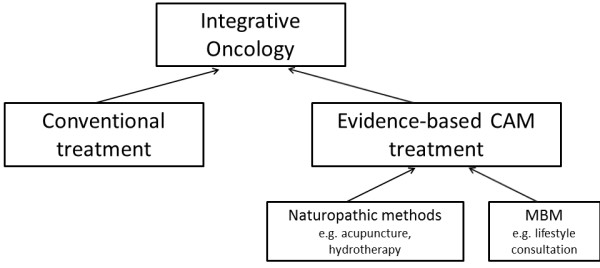
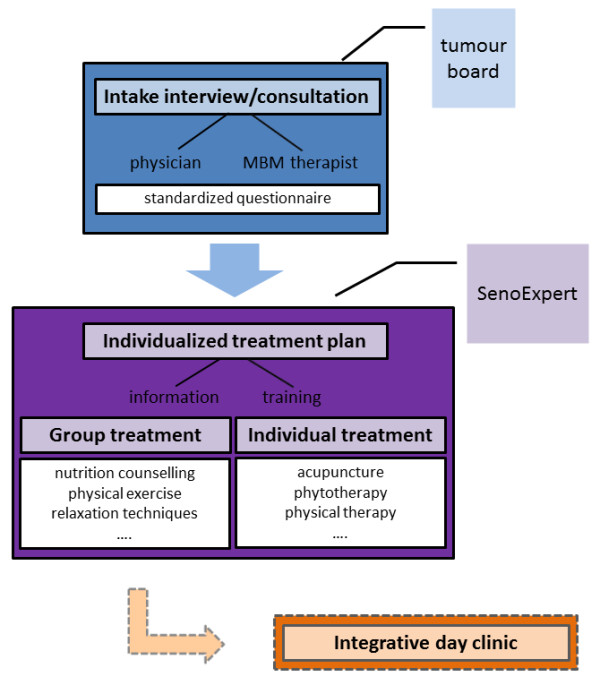
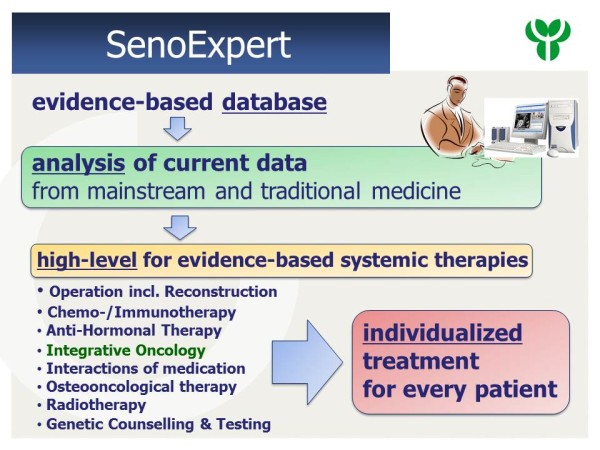
The use of certain CAM methods may become problematic when, as frequently occurs, patients use them indiscriminately and without informing their oncologists. Herbal medicines and dietary supplements, especially, may interfere with primary cancer treatments or have other detrimental effects. Thus, expertise in this highly specialized field of integrative medicine should be available to patients so that they can be advised about the benefits and negative effects of such preparations and practices.Being a beneficial combination of conventional and CAM care, integrative oncology makes possible the holistic approach to cancer care. The concept of integrative oncology for breast cancer is jointly practiced by the Department of Internal and Integrative Medicine, Kliniken Essen-Mitte, academic teaching hospital of the University of Duisburg-Essen, and the Breast Center at Kliniken Essen-Mitte in Germany. This model is introduced here; its scope is reviewed, and its possible implications for the practice of integrative medicine are discussed.
Evidence-based integrative care is crucial to the field of oncology in establishing state-of-the-art care for breast cancer patients.
恶性乳腺肿瘤是西方世界最常见的癌症之一。乳腺癌的常规治疗可能包括手术、激素治疗、化疗、放疗和/或免疫治疗,所有这些治疗通常伴随着严重的副作用。补充和替代医学(CAM)的治疗已被证明可以有效地缓解这些症状。此外,随着患者生存率的提高,肿瘤学家、心理学家和其他治疗师必须更加敏感地满足癌症幸存者的需求,而不仅仅是缓解症状。许多 CAM 方法旨在全面治疗患者,因此也关注患者的心理和精神需求。
当患者经常不加区分地使用 CAM 方法而不告知肿瘤学家时,某些 CAM 方法的使用可能会成为问题。草药和膳食补充剂尤其可能干扰主要的癌症治疗或产生其他不利影响。因此,患者应该能够获得该领域的专业知识,以便就这些制剂和实践的益处和负面影响提供建议。
整合医学是常规和 CAM 护理的有益结合,使癌症护理的整体方法成为可能。德国埃森中部诊所的内科和整合医学系以及埃森中部诊所的乳房中心共同实践了乳腺癌的整合肿瘤学概念。本文介绍了该模型;审查了其范围,并讨论了其对整合医学实践的可能影响。
循证整合护理对于肿瘤学领域至关重要,可为乳腺癌患者提供最先进的护理。