Division of Health Behavior Research, Washington University School of Medicine, Saint Louis, MO, USA.
PLoS One. 2012;7(11):e49929. doi: 10.1371/journal.pone.0049929. Epub 2012 Nov 19.
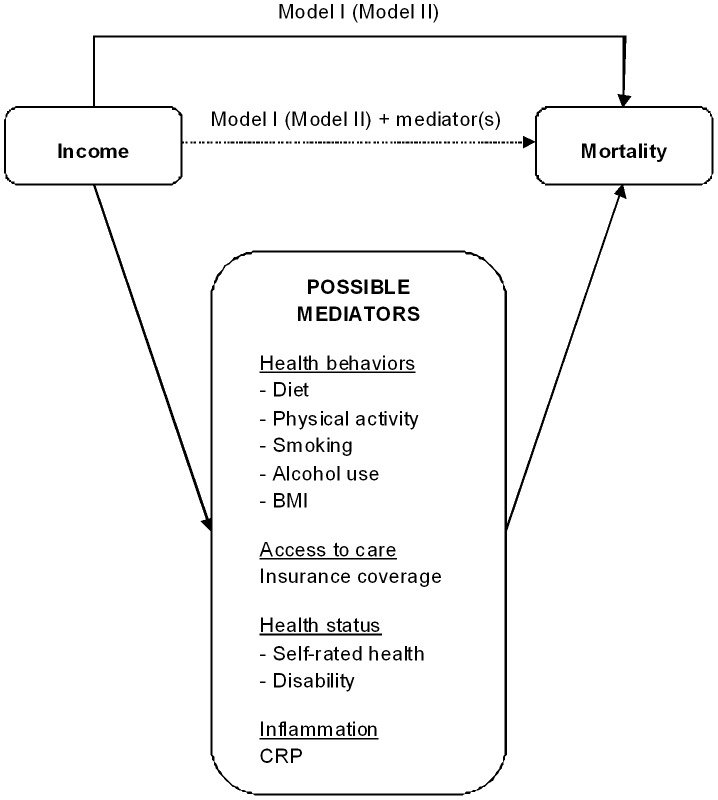
Income disparities in mortality are profound in the United States, but reasons for this remain largely unexplained. The objective of this study was to assess the effects of health behaviors, and other mediating pathways, separately and simultaneously, including health insurance, health status, and inflammation, in the association between income and mortality.
This study used data from 9925 individuals aged 20 years or older who participated in the 1999-2004 National Health and Nutrition Examination Survey (NHANES) and were followed up through December 31, 2006 for mortality. The outcome measures were all-cause and CVD/diabetes mortality. During follow-up 505 persons died, including 196 deaths due to CVD or diabetes.
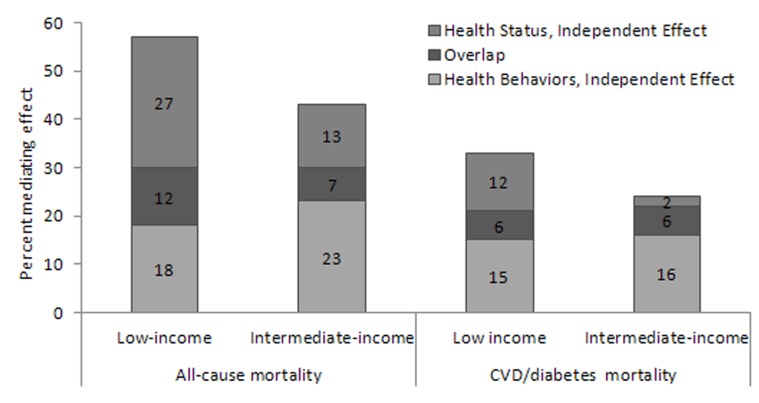
After adjusting for age, sex, education, and race/ethnicity, risk of death was higher in low-income than high-income group for both all-cause mortality (Hazard ratio [HR], 1.98; 95% confidence interval [CI]: 1.37, 2.85) and cardiovascular disease (CVD)/diabetes mortality (HR, 3.68; 95% CI: 1.64, 8.27). The combination of the four pathways attenuated 58% of the association between income and all-cause mortality and 35% of that of CVD/diabetes mortality. Health behaviors attenuated the risk of all-cause and CVD/diabetes mortality by 30% and 21%, respectively, in the low-income group. Health status attenuated 39% of all-cause mortality and 18% of CVD/diabetes mortality, whereas, health insurance and inflammation accounted for only a small portion of the income-associated mortality (≤6%).
Excess mortality associated with lower income can be largely accounted for by poor health status and unhealthy behaviors. Future studies should address behavioral modification, as well as possible strategies to improve health status in low-income people.
美国的收入差异对死亡率的影响非常显著,但造成这种情况的原因在很大程度上仍未得到解释。本研究的目的是评估健康行为以及其他中介途径(包括医疗保险、健康状况和炎症)对收入与死亡率之间关联的单独和综合影响。
本研究使用了 1999-2004 年全国健康和营养调查(NHANES)中年龄在 20 岁及以上的 9925 名参与者的数据,并对其进行了随访,直到 2006 年 12 月 31 日记录死亡率。结果测量指标为全因死亡率和心血管疾病/糖尿病死亡率。在随访期间,有 505 人死亡,其中 196 人死于心血管疾病或糖尿病。
在调整年龄、性别、教育程度和种族/民族后,低收入组的全因死亡率(危险比[HR],1.98;95%置信区间[CI]:1.37,2.85)和心血管疾病(CVD)/糖尿病死亡率(HR,3.68;95%CI:1.64,8.27)均高于高收入组。四条途径的结合降低了收入与全因死亡率之间 58%的关联,降低了 CVD/糖尿病死亡率之间 35%的关联。在低收入组中,健康行为分别降低了全因和 CVD/糖尿病死亡率风险的 30%和 21%。健康状况降低了全因死亡率的 39%和 CVD/糖尿病死亡率的 18%,而医疗保险和炎症仅占与收入相关的死亡率的一小部分(≤6%)。
与较低收入相关的超额死亡率在很大程度上可以归因于较差的健康状况和不健康的行为。未来的研究应该关注行为改变,以及改善低收入人群健康状况的可能策略。