IRBA & UMR6236, Marseille, France.
Malar J. 2010 Nov 8;9:317. doi: 10.1186/1475-2875-9-317.
Assessment exposure and immunity to malaria is an important step in the fight against the disease. Increased malaria infection in non-immune travellers under anti-malarial chemoprophylaxis, as well as the implementation of malaria elimination programmes in endemic countries, raises new issues that pertain to these processes. Notably, monitoring malaria immunity has become more difficult in individuals showing low antibody (Ab) responses or taking medications against the Plasmodium falciparum blood stages. Commonly available techniques in malaria seroepidemiology have limited sensitivity, both against pre-erythrocytic, as against blood stages of the parasite. Thus, the aim of this study was to develop a sensitive tool to assess the exposure to malaria or to bites from the vector Anopheles gambiae, despite anti-malarial prophylactic treatment.
Ab responses to 13 pre-erythrocytic P. falciparum-specific peptides derived from the proteins Lsa1, Lsa3, Glurp, Salsa, Trap, Starp, CSP and Pf11.1, and to 2 peptides specific for the Anopheles gambiae saliva protein gSG6 were tested. In this study, 253 individuals from three Senegalese areas with different transmission intensities and 124 European travellers exposed to malaria during a short period of time were included.
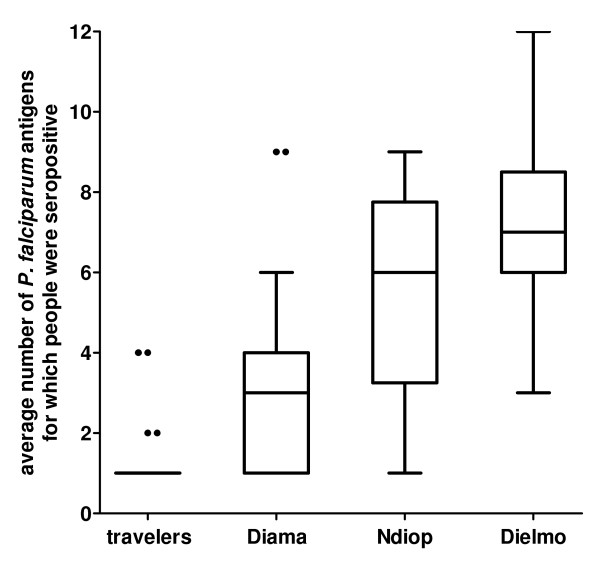
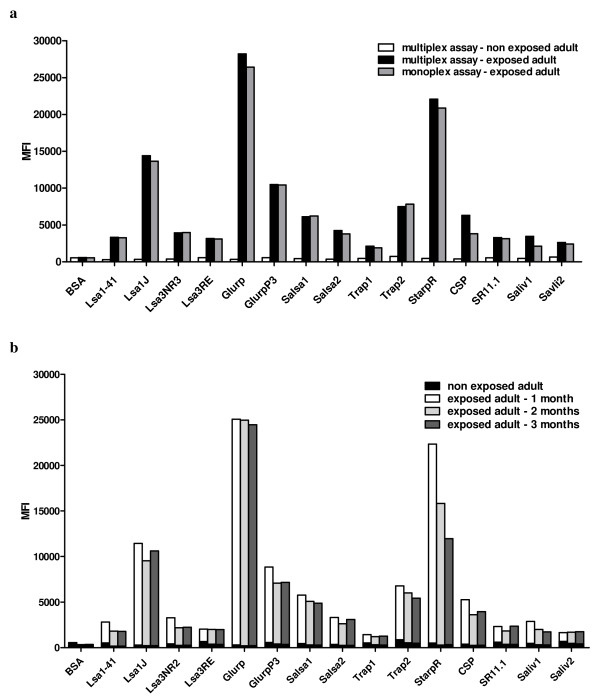
The multiplex assay was optimized for most but not all of the antigens. It was rapid, reproducible and required a small volume of serum. Proportions of Ab-positive individuals, Ab levels and the mean number of antigens (Ags) recognized by each individual increased significantly with increases in the level of malaria exposure.
The multiplex assay developed here provides a useful tool to evaluate immune responses to multiple Ags in large populations, even when only small amounts of serum are available, or Ab titres are low, as in case of travellers. Finally, the relationship of Ab responses with malaria endemicity levels provides a way to monitor exposure in differentially exposed autochthonous individuals from various endemicity areas, as well as in travellers who are not immune, thus indirectly assessing the parasite transmission and malaria risk in the new eradication era.
评估疟疾的暴露和免疫情况是抗击该疾病的重要步骤。在抗疟化学预防下,非免疫旅行者的疟疾感染增加,以及在流行地区实施消除疟疾计划,这带来了与这些过程相关的新问题。值得注意的是,在表现出低抗体(Ab)反应或服用抗疟原虫血期药物的个体中,监测疟疾免疫变得更加困难。疟疾血清流行病学中常用的技术对原虫的红细胞前和血期均具有有限的敏感性。因此,本研究旨在开发一种敏感工具,以评估暴露于疟疾或冈比亚按蚊叮咬的情况,尽管有抗疟预防治疗。
检测了来自 Pfalciparum 蛋白 Lsa1、Lsa3、Glurp、Salsa、Trap、Starp、CSP 和 Pf11.1 的 13 个原虫前红细胞特异性肽,以及针对按蚊唾液蛋白 gSG6 的 2 个肽的 Ab 反应。本研究纳入了来自三个塞内加尔地区的 253 名个体,这些地区的传播强度不同,还有 124 名欧洲旅行者在短时间内接触过疟疾。
多重分析针对大多数抗原进行了优化,但不是所有抗原都进行了优化。该方法快速、可重复,仅需少量血清。Ab 阳性个体的比例、Ab 水平以及每个个体识别的抗原数量(Ags)随着疟疾暴露水平的增加而显著增加。
这里开发的多重分析提供了一种有用的工具,可用于评估大人群中对多种 Ag 的免疫反应,即使只有少量血清可用,或者 Ab 滴度较低,如旅行者。最后,Ab 反应与疟疾流行水平的关系提供了一种监测来自不同流行地区的不同暴露程度的本地个体以及非免疫旅行者暴露情况的方法,从而间接评估新的消除时代的寄生虫传播和疟疾风险。