Department of Aeronautics and Astronautics, Stanford University, 496 Lomita Mall, Stanford, CA 94305, USA.
Sensors (Basel). 2012 Oct 1;12(10):13417-40. doi: 10.3390/s121013417.
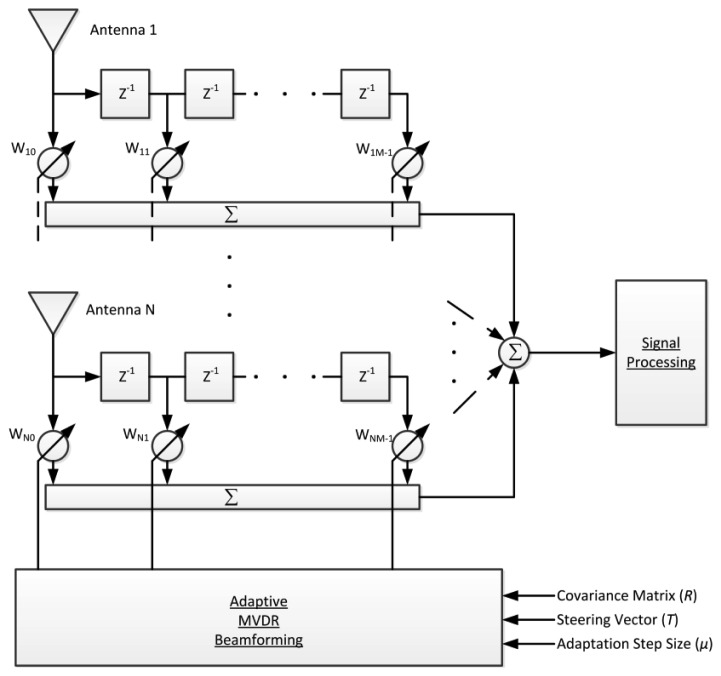
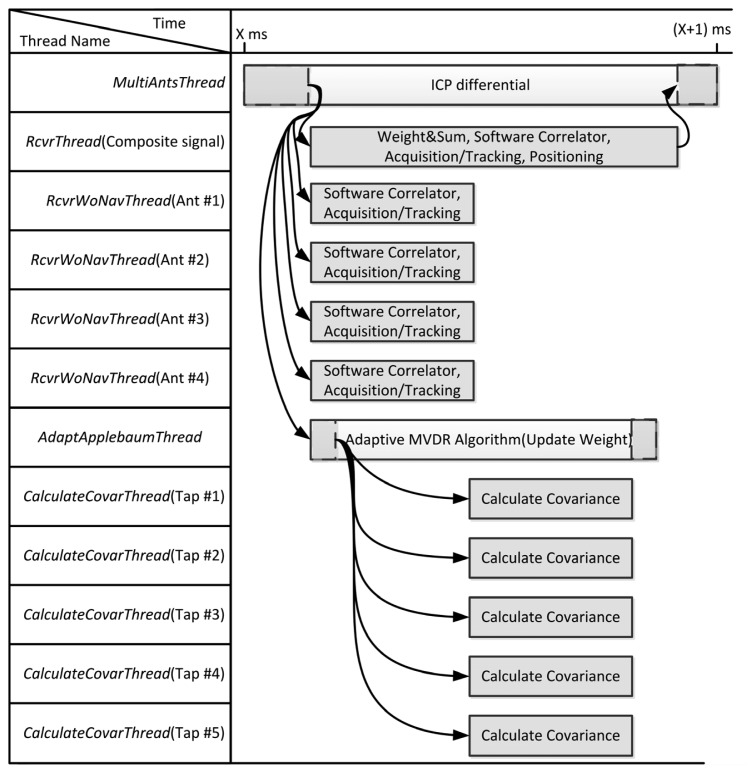
Adaptive antenna array processing is widely known to provide significant anti-interference capabilities within a Global Navigation Satellite Systems (GNSS) receiver. A main challenge in the quest for such receiver architecture has always been the computational/processing requirements. Even more demanding would be to try and incorporate the flexibility of the Software-Defined Radio (SDR) design philosophy in such an implementation. This paper documents a feasible approach to a real-time SDR implementation of a beam-steered GNSS receiver and validates its performance. This research implements a real-time software receiver on a widely-available x86-based multi-core microprocessor to process four-element antenna array data streams sampled with 16-bit resolution. The software receiver is capable of 12 channels all-in-view Controlled Reception Pattern Antenna (CRPA) array processing capable of rejecting multiple interferers. Single Instruction Multiple Data (SIMD) instructions assembly coding and multithreaded programming, the key to such an implementation to reduce computational complexity, are fully documented within the paper. In conventional antenna array systems, receivers use the geometry of antennas and cable lengths known in advance. The documented CRPA implementation is architected to operate without extensive set-up and pre-calibration and leverages Space-Time Adaptive Processing (STAP) to provide adaptation in both the frequency and space domains. The validation component of the paper demonstrates that the developed software receiver operates in real time with live Global Positioning System (GPS) and Wide Area Augmentation System (WAAS) L1 C/A code signal. Further, interference rejection capabilities of the implementation are also demonstrated using multiple synthetic interferers which are added to the live data stream.
自适应天线阵处理在全球导航卫星系统 (GNSS) 接收机中被广泛认为具有很强的抗干扰能力。在寻求这种接收机架构的过程中,一个主要的挑战一直是计算/处理要求。更具挑战性的是,试图在这种实现中纳入软件定义无线电 (SDR) 设计理念的灵活性。本文记录了一种可行的方法,即将波束导向 GNSS 接收机实时实现到 SDR 中,并验证其性能。该研究在广泛使用的基于 x86 的多核微处理器上实现了一个实时软件接收机,以处理用 16 位分辨率采样的四元天线阵数据流。该软件接收机能够处理 12 个全视场可控接收模式天线 (CRPA) 阵列处理通道,能够拒绝多个干扰源。单指令多数据 (SIMD) 指令集编码和多线程编程是实现这种降低计算复杂度的关键,本文对此进行了全面记录。在传统的天线阵系统中,接收器使用预先知道的天线几何形状和电缆长度。本文记录的 CRPA 实现旨在无需大量设置和预校准的情况下运行,并利用空时自适应处理 (STAP) 在频率和空间域提供自适应。本文的验证部分证明,所开发的软件接收机能够实时处理实时全球定位系统 (GPS) 和广域增强系统 (WAAS) L1 C/A 码信号。此外,还通过向实时数据流中添加多个合成干扰源来演示实现的干扰抑制能力。