Department of Respiratory Diseases, Affiliated Hospital of Nantong University, Nantong City, Jiangsu Province, 226001, People's Republic of China.
Respir Res. 2012 Dec 4;13(1):111. doi: 10.1186/1465-9921-13-111.
Prognostic assessment is important for the management of patients with acute pulmonary embolism (APE). Pulmonary Embolism Severity Index (PESI) and simple PESI (sPESI) are new emerged prognostic assessment tools for APE. The aim of this meta-analysis is to assess the accuracy of the PESI and the sPESI to predict prognostic outcomes (all-cause and PE-related mortality, serious adverse events) in APE patients, and compare between these two PESIs.
MEDLINE and EMBASE database were searched up to June 2012 using the terms "Pulmonary Embolism Severity Index" and "pulmonary embolism". Summary odds ratio (OR) with 95% confidence intervals (CIs) for prognostic outcomes in low risk PESI versus high risk PESI were calculated. Summary receiver operating characteristic curve (SROC) used to estimate overall predicting accuracies of prognostic outcomes.
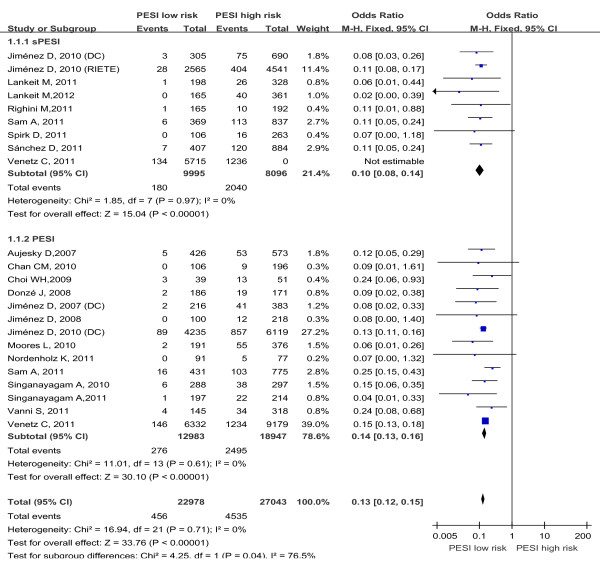
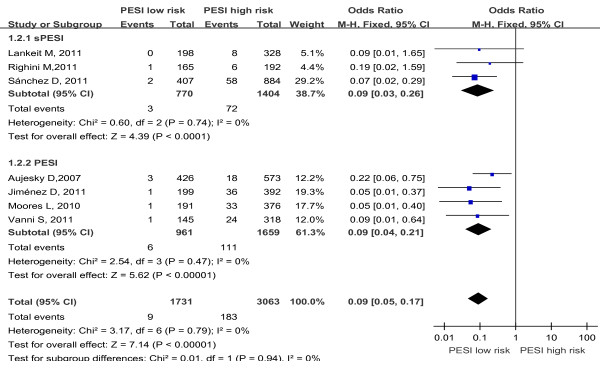
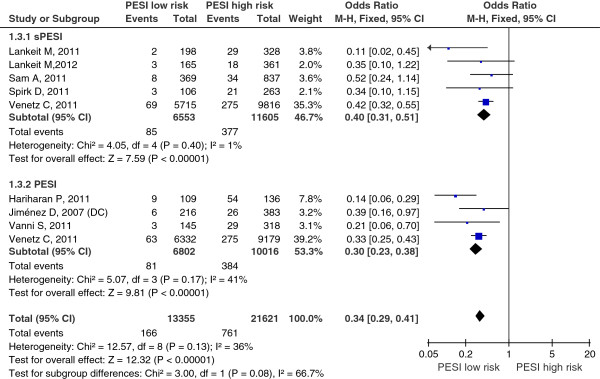
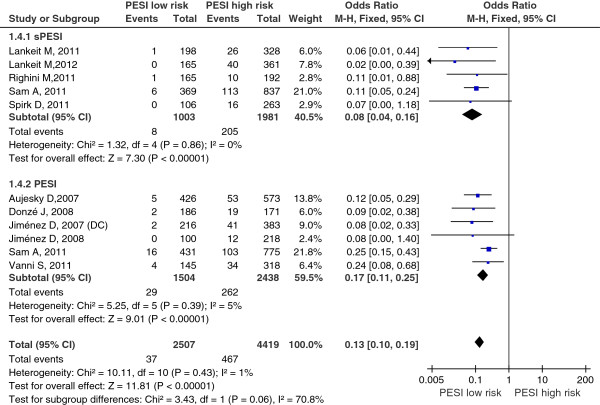
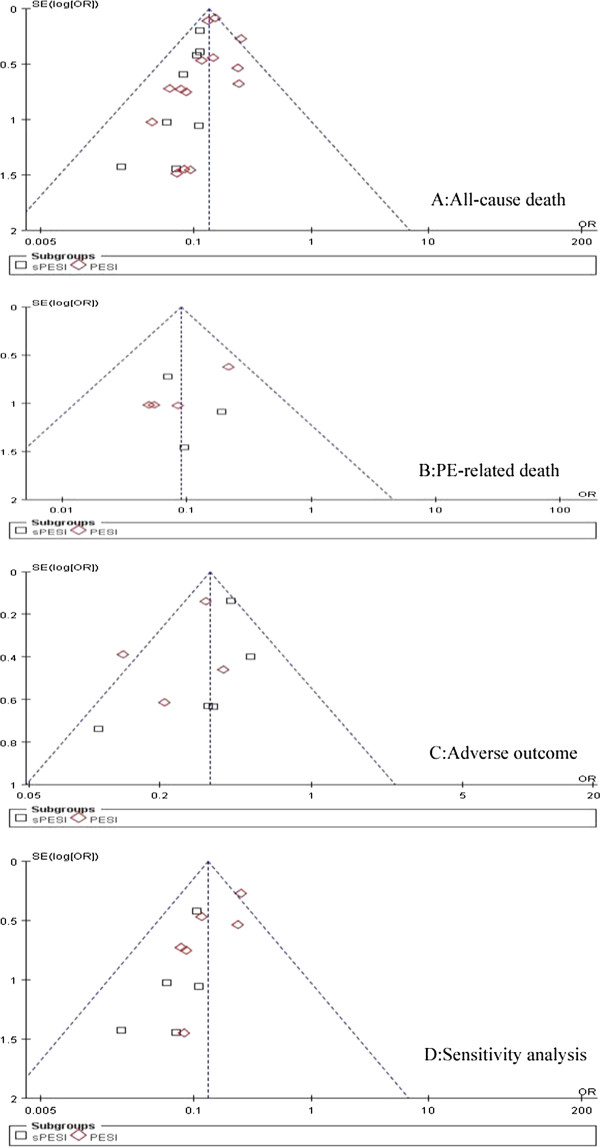
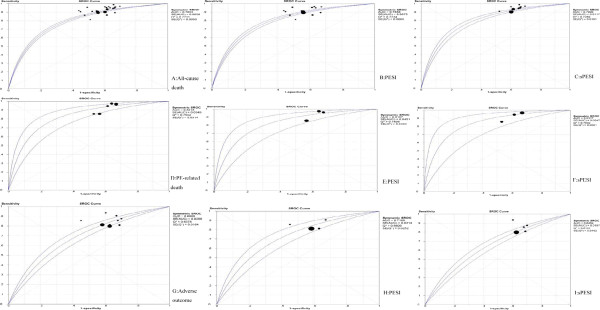
Twenty-one studies were included in this meta-analysis. The results showed low-risk PESI was significantly associated with lower all-cause mortality (OR 0.13; 95% CI 0.12 to 0.15), PE-related mortality (OR 0.09; 95% CI 0.05 to 0.17) and serious adverse events (OR 0.34; 95% CI 0.29 to 0.41), with no homogeneity across studies. In sPESI subgroup, the OR of all-cause mortality, PE-related mortality, and serious adverse events was 0.10 (95% CI 0.08 to 0.14), 0.09 (95% CI 0.03 to 0.26) and 0.40 (95% CI 0.31 to 0.51), respectively; while in PESI subgroup, the OR was 0.14 (95% CI 0.13 to 0.16), 0.09 (95% CI 0.04 to 0.21), and 0.30 (95% CI 0.23 to 0.38), respectively. For accuracy analysis, the pooled sensitivity, the pooled specificity, and the overall weighted AUC for PESI predicting all-cause mortality was 0.909 (95% CI: 0.900 to 0.916), 0.411 (95% CI: 0.407 to 0.415), and 0.7853±0.0058, respectively; for PE-related mortality, it was 0.953 (95% CI: 0.913 to 0.978), 0.374 (95% CI: 0.360 to 0.388), and 0.8218±0.0349, respectively; for serious adverse events, it was 0.821 (95% CI: 0.795 to 0.845), 0.389 (95% CI: 0.384 to 0.394), and 0.6809±0.0208, respectively. In sPESI subgroup, the AUC for predicting all-cause mortality, PE-related mortality, and serious adverse events was 0.7920±0.0117, 0.8317±0.0547, and 0.6454±0.0197, respectively. In PESI subgroup, the AUC was 0.7856±0.0075, 0.8158±0.0451, and 0.6609±0.0252, respectively.
PESI has discriminative power to predict the short-term death and adverse outcome events in patients with acute pulmonary embolism, the PESI and the sPESI have similar accuracy, while sPESI is easier to use. However, the calibration for predicting prognosis can't be calculated from this meta-analysis, some prospective studies for accessing PESI predicting calibration can be recommended.
预后评估对于急性肺栓塞(APE)患者的管理非常重要。肺栓塞严重指数(PESI)和简化的 PESI(sPESI)是用于 APE 的新的预后评估工具。本荟萃分析的目的是评估 PESI 和 sPESI 预测 APE 患者预后结局(全因和 PE 相关死亡率、严重不良事件)的准确性,并比较这两种 PESI。
截至 2012 年 6 月,使用“肺栓塞严重指数”和“肺栓塞”这两个术语,在 MEDLINE 和 EMBASE 数据库中进行了搜索。计算低危 PESI 与高危 PESI 之间预测预后结局(全因和 PE 相关死亡率、严重不良事件)的汇总优势比(OR)及 95%置信区间(CI)。使用综合受试者工作特征曲线(SROC)来估计预后结局的整体预测准确性。
本荟萃分析纳入了 21 项研究。结果显示,低危 PESI 与全因死亡率(OR 0.13;95%CI 0.12 至 0.15)、PE 相关死亡率(OR 0.09;95%CI 0.05 至 0.17)和严重不良事件(OR 0.34;95%CI 0.29 至 0.41)的发生率较低显著相关,研究间无同质性。在 sPESI 亚组中,全因死亡率、PE 相关死亡率和严重不良事件的 OR 分别为 0.10(95%CI 0.08 至 0.14)、0.09(95%CI 0.03 至 0.26)和 0.40(95%CI 0.31 至 0.51);而在 PESI 亚组中,OR 分别为 0.14(95%CI 0.13 至 0.16)、0.09(95%CI 0.04 至 0.21)和 0.30(95%CI 0.23 至 0.38)。对于准确性分析,PESI 预测全因死亡率的汇总敏感性、特异性和总体加权 AUC 分别为 0.909(95%CI:0.900 至 0.916)、0.411(95%CI:0.407 至 0.415)和 0.7853±0.0058;对于 PE 相关死亡率,其分别为 0.953(95%CI:0.913 至 0.978)、0.374(95%CI:0.360 至 0.388)和 0.8218±0.0349;对于严重不良事件,其分别为 0.821(95%CI:0.795 至 0.845)、0.389(95%CI:0.384 至 0.394)和 0.6809±0.0208。在 sPESI 亚组中,预测全因死亡率、PE 相关死亡率和严重不良事件的 AUC 分别为 0.7920±0.0117、0.8317±0.0547 和 0.6454±0.0197。在 PESI 亚组中,AUC 分别为 0.7856±0.0075、0.8158±0.0451 和 0.6609±0.0252。
PESI 具有预测急性肺栓塞患者短期死亡和不良结局事件的区分能力,PESI 和 sPESI 具有相似的准确性,而 sPESI 更易于使用。然而,本荟萃分析无法计算预测预后的校准,建议进行一些前瞻性研究来评估 PESI 预测的校准。