Beijing Key Laboratory of Respiratory and Pulmonary Circulation Disorders, Beijing Chao-yang Hospital, Capital Medical University, Beijing, China.
PLoS One. 2011;6(11):e26861. doi: 10.1371/journal.pone.0026861. Epub 2011 Nov 1.
There has not been sufficient evidence to support the Asians being less susceptible to pulmonary embolism (PE) than other ethnicities, because the prevalence of PE/deep venous thrombosis (DVT) in different racial and ethnic groups has not been carefully studied until recently except in Caucasians. To test the hypothesis that the Chinese population has a lower risk for PE, this study comprehensively assessed the hospital-based incidence and case fatality rates for PE during the 1997-2008 in China.
A registration study of patients with suspected PE syndromes admitted to 60 level-3 hospitals involved in the National Cooperative Project for the Prevention and Treatment of Venous Thromboembolism (NCPPT) was conducted from January 1997 to December 2008. The only exclusion criterion was an age of less than 18 years. Helical computed tomography scan, ventilation-perfusion lung scintigraphy or pulmonary angiography was carried out before or after hospitalization. All images were reviewed and evaluated independently by two specialists.
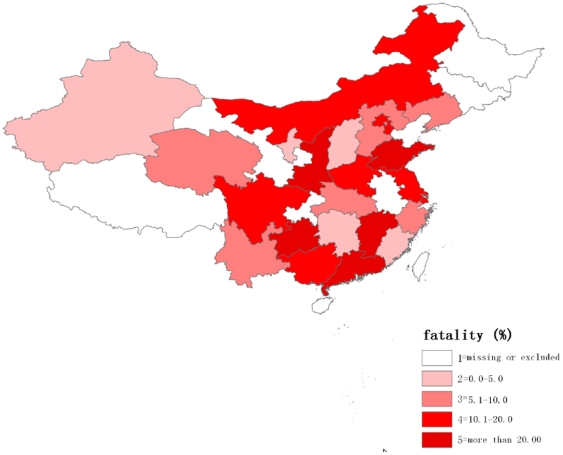
A total of 18,206 patients were confirmed with PE from 16,972,182 hospital admissions. The annual incidence was 0.1% (95% CI: 0.1% to 0.2%). The overall incidence of PE in male patients (0.2%, 95% CI: 0.1% to 0.3%) was higher than that in female patients (0.1% and 95% CI: 0.0% to 0.1%). An increasing incidence gradient for PE was noticed from Southern to Northern China. In addition, the case fatality rate was apparently decreasing: 25.1% (95% CI: 16.2% to 36.9%) in 1997 to 8.7% (95% CI: 3.5% to 15.8%) in 2008.
Our findings suggest the relatively stable PE incidence and decreasing fatality trends in Chinese hospitals may be partially attributable to the implementation of the NCCPT and suggest the government should reevaluate the severity of PE so that health resources for the prevention, diagnosis and treatment of PE could be used to their fullest.
目前尚无充分证据支持亚洲人比其他种族人群不易患肺栓塞(PE),因为直到最近才对不同种族和族裔人群中 PE/深静脉血栓形成(DVT)的流行情况进行了仔细研究,除了在白种人群中进行了研究。为了验证中国人患 PE 的风险较低的假说,本研究全面评估了 1997 年至 2008 年期间中国医院内 PE 的发病率和病死率。
1997 年 1 月至 2008 年 12 月,对参与全国静脉血栓形成防治协作组(NCPPT)的 60 家三级医院的疑似 PE 综合征患者进行了登记研究。唯一的排除标准是年龄<18 岁。在住院前或住院后进行螺旋 CT 扫描、通气-灌注肺闪烁显像或肺动脉造影。由两位专家独立对所有图像进行回顾和评估。
在 16972182 例住院患者中,共有 18206 例患者被确诊为 PE。每年发病率为 0.1%(95%可信区间:0.1%至 0.2%)。男性患者(0.2%,95%可信区间:0.1%至 0.3%)的总体 PE 发病率高于女性患者(0.1%和 95%可信区间:0.0%至 0.1%)。从南到北,PE 的发病率呈逐渐增加的梯度。此外,病死率明显下降:1997 年为 25.1%(95%可信区间:16.2%至 36.9%),2008 年为 8.7%(95%可信区间:3.5%至 15.8%)。
我们的研究结果表明,中国医院的 PE 发病率相对稳定,病死率呈下降趋势,这可能部分归因于 NCPPT 的实施,并提示政府应重新评估 PE 的严重程度,以便充分利用预防、诊断和治疗 PE 的卫生资源。