da Silva Sidney C, Monteiro Walace D, Cunha Felipe A, Myers Jonathan, Farinatti Paulo T V
Department of Sports Science, Brazilian Olympic Committee, Avenida das Américas 899, 22631-000 Rio de Janeiro, RJ, Brazil.
Pulm Med. 2012;2012:542402. doi: 10.1155/2012/542402. Epub 2012 Nov 1.
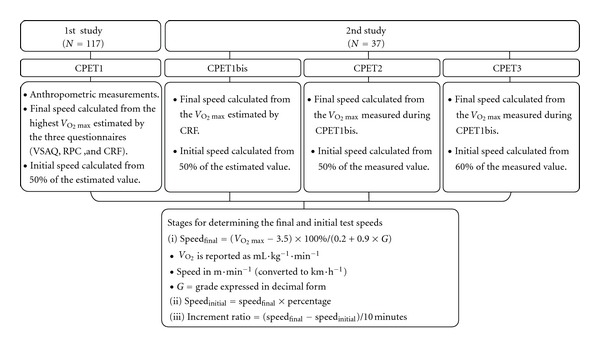
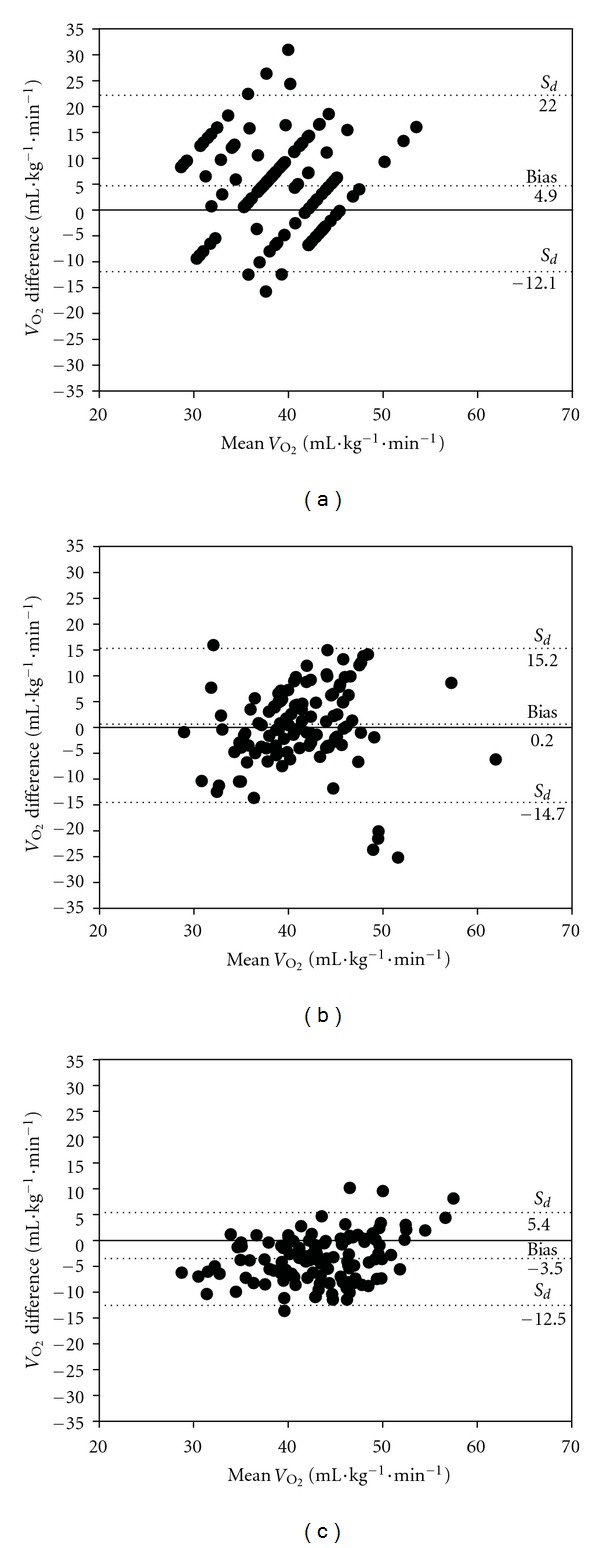
This study compared strategies to define final and initial speeds for designing ramp protocols. V(O(2)max ) was directly assessed in 117 subjects (29 ± 8 yrs) and estimated by three nonexercise models: (1) Veterans Specific Activity Questionnaire (VSAQ); (2) Rating of Perceived Capacity (RPC); (3) Questionnaire of Cardiorespiratory Fitness (CRF). Thirty seven subjects (30 ± 9 yrs) performed three additional tests with initial speeds corresponding to 50% of estimated V(O(2)max ) and 50% and 60% of measured V(O(2)max ). Significant differences (P < 0.001) were found between V(O(2)max ) measured (41.5 ± 6.6 mL·kg(-1)·min(-1)) and estimated by VSAQ (36.6 ± 6.6 mL·kg(-1)·min(-1)) and CRF (45.0 ± 5.3 mL·kg(-1)·min(-1)), but not RPC (41.3 ± 6.2 mL·kg(-1)·min(-1)). The CRF had the highest ICC, the lowest SEE, and better limits of agreement with V(O(2)max ) compared to the other instruments. Initial speeds from 50%-60% V(O(2)max ) estimated by CRF or measured produced similar V(O(2)max ) (40.7 ± 5.9; 40.0 ± 5.6; 40.3 ± 5.5 mL·kg(-1)·min(-1) resp., P = 0.14). The closest relationship to identity line was found in tests beginning at 50% V(O(2)max ) estimated by CRF. In conclusion, CRF was the best option to estimate V(O(2)max ) and therefore to define the final speed for ramp protocols. The measured V(O(2)max ) was independent of initial speeds, but speeds higher than 50% V(O(2)max ) produced poorer submaximal relationships between workload and V(O(2) ).
本研究比较了为制定斜坡运动方案而确定最终速度和初始速度的策略。对117名受试者(29±8岁)直接评估了最大摄氧量(V̇O₂max),并通过三种非运动模型进行估计:(1)退伍军人特定活动问卷(VSAQ);(2)自感运动能力分级(RPC);(3)心肺适能问卷(CRF)。37名受试者(30±9岁)进行了另外三项测试,初始速度分别对应估计V̇O₂max的50%以及实测V̇O₂max的50%和60%。实测V̇O₂max(41.5±6.6 mL·kg⁻¹·min⁻¹)与通过VSAQ估计的(36.6±6.6 mL·kg⁻¹·min⁻¹)和CRF估计的(45.0±5.3 mL·kg⁻¹·min⁻¹)之间存在显著差异(P<0.001),但与RPC估计的(41.3±6.2 mL·kg⁻¹·min⁻¹)无显著差异。与其他工具相比,CRF的组内相关系数(ICC)最高,标准误(SEE)最低,且与V̇O₂max的一致性界限更好。由CRF估计或实测的50%-60%V̇O₂max的初始速度产生的V̇O₂max相似(分别为40.7±5.9;40.0±5.6;40.3±5.5 mL·kg⁻¹·min⁻¹,P = 0.14)。在以CRF估计的50%V̇O₂max开始的测试中,发现与恒等线的关系最密切。总之,CRF是估计V̇O₂max从而确定斜坡运动方案最终速度的最佳选择。实测V̇O₂max与初始速度无关,但高于50%V̇O₂max的速度在次最大负荷下工作量与V̇O₂之间产生的关系较差。