Wiestad Tor Helge, Raastad Truls, Nordin Karin, Igelström Helena, Henriksson Anna, Demmelmaier Ingrid, Berntsen Sveinung
Department of Oncology and Medical Physics, Haukeland University Hospital, Box 1400, 5021 Bergen, PO Norway.
Department of Physical Performance, Norwegian School of Sport Sciences, Oslo, Norway.
BMC Sports Sci Med Rehabil. 2020 Sep 3;12:53. doi: 10.1186/s13102-020-00205-9. eCollection 2020.
Adjuvant therapy may cause multiple sideeffects on long term health, including reduced cardiorespiratory fitness (CRF) in patients with breast cancer (1, 2). However, there is currently limited knowledge regarding the effect of different types of adjuvant cancer treatment on CRF in other cancer populations. The primary objective of the present study was to assess whether previously known correlates (age, diagnosis, initial CRF, physical activity level), type of adjuvant treatment and cancer-related fatigue were associated with changes in in patients with breast, prostate or colorectal cancer.
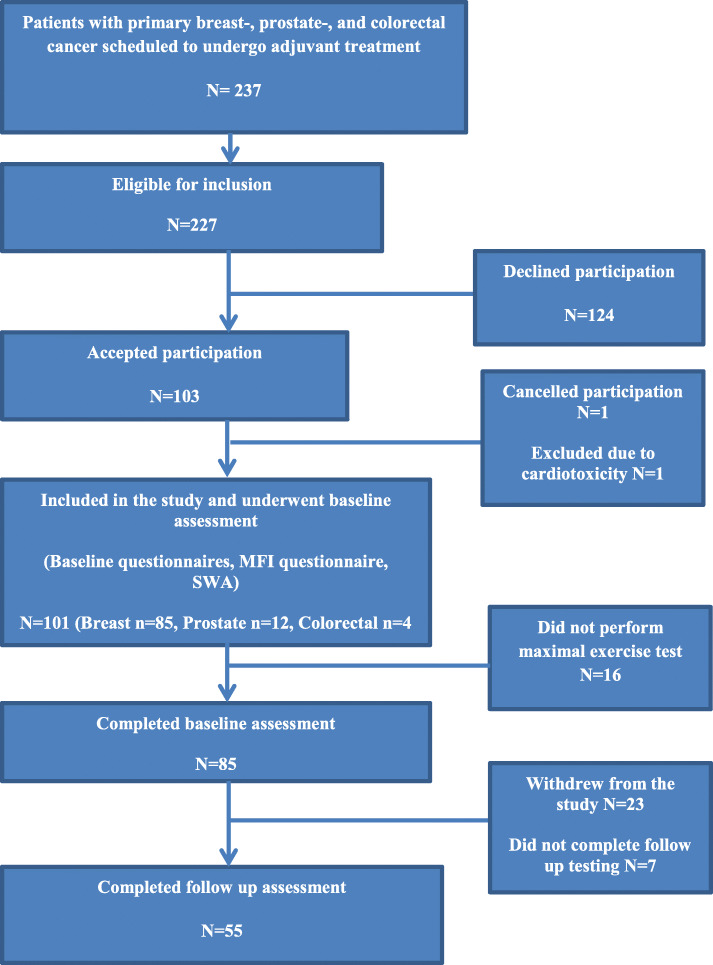
Prospective study with two time points of assessment, 85 patients scheduled for adjuvant cancer treatment were included. Cardiorespiratory fitness was assessed by during a maximal incremental exercise test on a treadmill before start of adjuvant therapy and again six months later. Physical activity level was recorded with a physical activity monitor (Sense Wear™ Mini) at baseline as average minutes of moderate-to-vigorous intensity physical activity (MVPA) per day. Physical fatigue at baseline was reported using the Multidimensional Fatigue Inventory-20 questionaire.
In multivariate linear regression analysis, 30 min higher daily MVPA at baseline was associated with a 5% higher at six months follow up when adjusted for adjuvant treatment ( = 0.010). Patients receiving adjuvant chemotherapy had a mean decline in of 10% (- 19, - 1; 95% confidence interval) compared to patients receiving adjuvant endocrine treatment ( = 0.028). Adjuvant radiotherapy, fatigue, age and diagnosis were not significantly associated with changes in .
The results of the present study indicate that adjuvant chemotherapy is associated with a subsequent reduction in in patients with cancer whereas MVPA before start of adjuvant treatment is positively associated with a higher after end of adjuvant treatment.
辅助治疗可能会对长期健康造成多种副作用,包括降低乳腺癌患者的心肺适能(CRF)(1,2)。然而,目前对于不同类型的辅助癌症治疗对其他癌症人群CRF的影响了解有限。本研究的主要目的是评估先前已知的相关因素(年龄、诊断、初始CRF、身体活动水平)、辅助治疗类型和癌症相关疲劳是否与乳腺癌、前列腺癌或结直肠癌患者的CRF变化相关。
进行一项有两个评估时间点的前瞻性研究,纳入85例计划接受辅助癌症治疗的患者。在辅助治疗开始前,通过在跑步机上进行最大递增运动试验来评估心肺适能,六个月后再次评估。在基线时使用身体活动监测器(Sense Wear™ Mini)记录身体活动水平,以每天中等至剧烈强度身体活动(MVPA)的平均分钟数来表示。使用多维疲劳量表-20问卷报告基线时的身体疲劳情况。
在多变量线性回归分析中,当对辅助治疗进行校正后,基线时每日MVPA高30分钟与六个月随访时CRF高5%相关(P = 0.010)。与接受辅助内分泌治疗的患者相比,接受辅助化疗的患者CRF平均下降10%(-19,-1;95%置信区间)(P = 0.028)。辅助放疗、疲劳、年龄和诊断与CRF变化无显著相关性。
本研究结果表明,辅助化疗与癌症患者随后的CRF降低相关,而辅助治疗开始前的MVPA与辅助治疗结束后的较高CRF呈正相关。