Department of Biochemistry and Molecular & Cellular Biology, Georgetown University, 3970 Reservoir Rd, Washington, DC, NW 20057-1468, USA.
Radiat Oncol. 2012 Dec 5;7:205. doi: 10.1186/1748-717X-7-205.
Breast tissue is among the most sensitive tissues to the carcinogenic actions of ionizing radiation and epidemiological studies have linked radiation exposure to breast cancer. Currently, molecular understanding of radiation carcinogenesis in mammary gland is hindered due to the scarcity of in vivo long-term follow up data. We undertook this study to delineate radiation-induced persistent alterations in gene expression in mouse mammary glands 2-month after radiation exposure.
Six to eight week old female C57BL/6J mice were exposed to 2 Gy of whole body γ radiation and mammary glands were surgically removed 2-month after radiation. RNA was isolated and microarray hybridization performed for gene expression analysis. Ingenuity Pathway Analysis (IPA) was used for biological interpretation of microarray data. Real time quantitative PCR was performed on selected genes to confirm the microarray data.
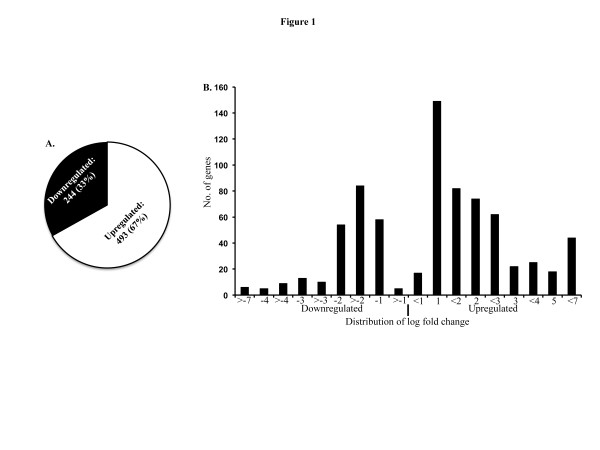
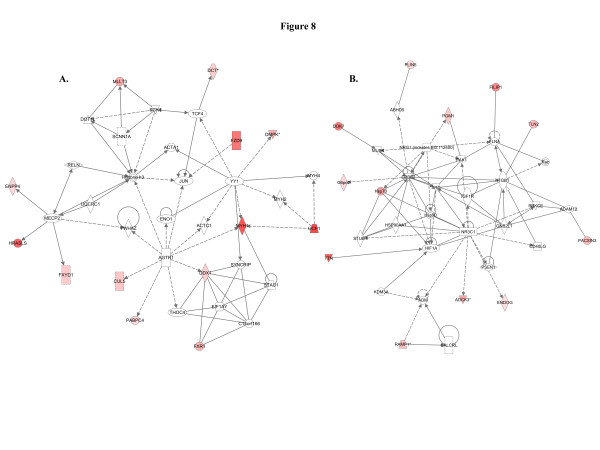
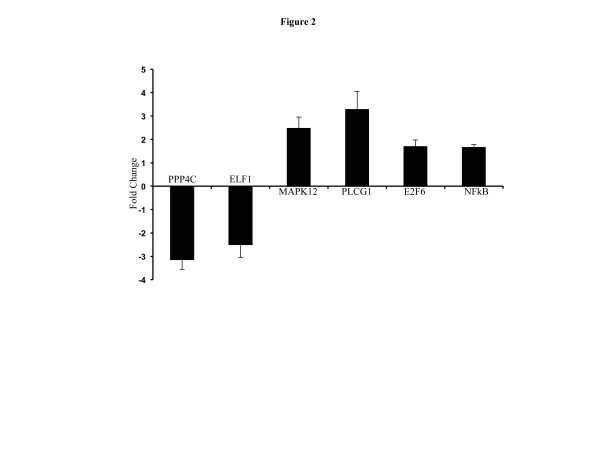
Compared to untreated controls, the mRNA levels of a total of 737 genes were significantly (p<0.05) perturbed above 2-fold of control. More genes (493 genes; 67%) were upregulated than the number of downregulated genes (244 genes; 33%). Functional analysis of the upregulated genes mapped to cell proliferation and cancer related canonical pathways such as 'ERK/MAPK signaling', 'CDK5 signaling', and '14-3-3-mediated signaling'. We also observed upregulation of breast cancer related canonical pathways such as 'breast cancer regulation by Stathmin1', and 'HER-2 signaling in breast cancer' in IPA. Interestingly, the downregulated genes mapped to fewer canonical pathways involved in cell proliferation. We also observed that a number of genes with tumor suppressor function (GPRC5A, ELF1, NAB2, Sema4D, ACPP, MAP2, RUNX1) persistently remained downregulated in response to radiation exposure. Results from qRT-PCR on five selected differentially expressed genes confirmed microarray data. The PCR data on PPP4c, ELF1, MAPK12, PLCG1, and E2F6 showed similar trend in up and downregulation as has been observed with the microarray.
Exposure to a clinically relevant radiation dose led to long-term activation of mammary gland genes involved in proliferative and metabolic pathways, which are known to have roles in carcinogenesis. When considered along with downregulation of a number of tumor suppressor genes, our study has implications for breast cancer initiation and progression after therapeutic radiation exposure.
乳腺组织对电离辐射的致癌作用最为敏感,流行病学研究已经将辐射暴露与乳腺癌联系起来。目前,由于缺乏体内长期随访数据,对乳腺辐射致癌的分子机制了解甚少。本研究旨在描述辐射暴露 2 个月后小鼠乳腺中基因表达的持续改变。
6-8 周龄雌性 C57BL/6J 小鼠接受 2Gy 全身γ射线照射,照射后 2 个月手术切除乳腺。分离 RNA,进行基因表达分析的微阵列杂交。采用 IPA 对微阵列数据进行生物学解释。对选定基因进行实时定量 PCR 以验证微阵列数据。
与未处理的对照组相比,共有 737 个基因的 mRNA 水平显著(p<0.05)上调超过对照组的 2 倍。上调的基因数量(493 个基因;67%)多于下调的基因数量(244 个基因;33%)。上调基因的功能分析映射到细胞增殖和癌症相关的经典途径,如“ERK/MAPK 信号”、“CDK5 信号”和“14-3-3 介导的信号”。我们还观察到 IPA 中乳腺癌相关经典途径的上调,如“Stathmin1 调节乳腺癌”和“HER-2 信号在乳腺癌中的作用”。有趣的是,下调的基因映射到参与细胞增殖的较少经典途径。我们还观察到,一些具有肿瘤抑制功能的基因(GPRC5A、ELF1、NAB2、Sema4D、ACPP、MAP2、RUNX1)在辐射暴露后持续下调。对五个差异表达基因的 qRT-PCR 结果证实了微阵列数据。PPP4c、ELF1、MAPK12、PLCGl 和 E2F6 的 PCR 数据显示与微阵列相似的上调和下调趋势。
暴露于临床相关的辐射剂量会导致参与增殖和代谢途径的乳腺基因长期激活,这些途径已知在致癌作用中起作用。当与一些肿瘤抑制基因的下调相结合时,我们的研究对治疗性辐射暴露后乳腺癌的发生和进展具有重要意义。