BioDNA Laboratories, Malta Life Sciences Park, SGN 3000 San Gwann, Malta.
Department of Anatomy, Faculty of Medicine and Surgery, University of Malta, MSD 2080 Msida, Malta.
Int J Mol Sci. 2022 Jul 5;23(13):7465. doi: 10.3390/ijms23137465.
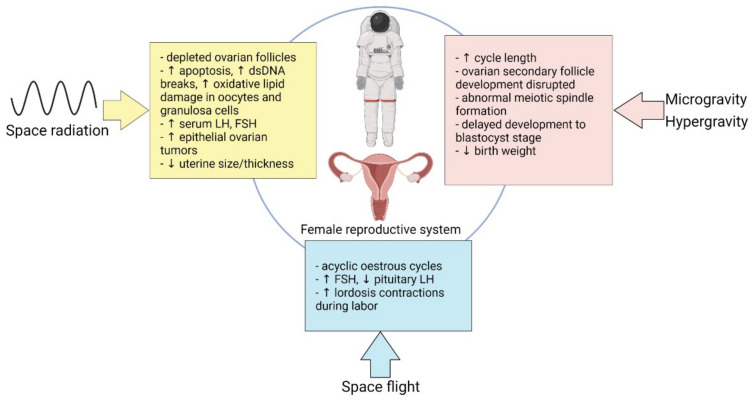
Outer space is an extremely hostile environment for human life, with ionizing radiation from galactic cosmic rays and microgravity posing the most significant hazards to the health of astronauts. Spaceflight has also been shown to have an impact on established cancer hallmarks, possibly increasing carcinogenic risk. Terrestrially, women have a higher incidence of radiation-induced cancers, largely driven by lung, thyroid, breast, and ovarian cancers, and therefore, historically, they have been permitted to spend significantly less time in space than men. In the present review, we focus on the effects of microgravity and radiation on the female reproductive system, particularly gynecological cancer. The aim is to provide a summary of the research that has been carried out related to the risk of gynecological cancer, highlighting what further studies are needed to pave the way for safer exploration class missions, as well as postflight screening and management of women astronauts following long-duration spaceflight.
外层空间是一个对人类生命极其恶劣的环境,来自银河宇宙射线的电离辐射和微重力对宇航员的健康构成了最大的危害。太空飞行也已被证明对已确立的癌症特征有影响,可能增加致癌风险。在地球上,女性患辐射诱发癌症的几率更高,主要是由肺癌、甲状腺癌、乳腺癌和卵巢癌驱动的,因此,从历史上看,女性被允许在太空中的时间比男性少得多。在本综述中,我们重点关注微重力和辐射对女性生殖系统的影响,特别是妇科癌症。目的是总结与妇科癌症风险相关的研究,强调需要进一步研究为更安全的探索级任务以及长期太空飞行后女宇航员的飞行后筛查和管理铺平道路。