Department of Gastroenterology, Henan Provincial People's Hospital, Zhengzhou University, Zhengzhou, Henan, 450000, China.
Gut Pathog. 2012 Dec 8;4(1):18. doi: 10.1186/1757-4749-4-18.
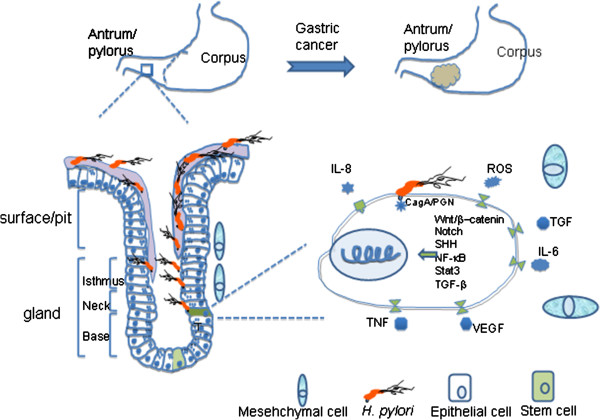
Helicobacter pylori infection is the major cause of gastric cancer, which remains an important health care challenge. Recent investigation in gastric stem cell or progenitor cell biology has uncovered valuable information in understanding the gastric gland renewal and maintenance of homeostasis, they also provide clues for further defining the mechanisms by which gastric cancer may originate and progress. Lgr5, Villin-promoter, TFF2-mRNA and Mist have recently been identified as gastric stem/progenitor cell markers; their identification enriched our understanding on the gastric stem cell pathobiology during chronic inflammation and metaplasia. In addition, advance in gastric cancer stem cell markers such as CD44, CD90, CD133, Musashi-1 reveal novel information on tumor cell behavior and disease progression implicated for therapeutics. However, two critical questions remain to be of considerable challenges for future exploration; one is how H. pylori or chronic inflammation affects gastric stem cell or their progenitors, which give rise to mucus-, acid-, pepsinogen-, and hormone-secreting cell lineages. Another one is how bacterial infection or inflammation induces oncogenic transformation and propagates into tumors. Focus on the interactions of H. pylori with gastric stem/progenitor cells and their microenvironment will be instrumental to decipher the initiation and origin of gastric cancer. Future studies in these areas will be critical to uncover molecular mechanisms of chronic inflammation-mediated oncogenic transformation and provide options for cancer prevention and intervention. We review recent progress and discuss future research directions in these important research fields.
幽门螺杆菌感染是胃癌的主要病因,这仍然是一个重要的医疗保健挑战。最近对胃干细胞或祖细胞生物学的研究揭示了在理解胃腺更新和维持内稳态方面的有价值的信息,这些信息也为进一步确定胃癌可能起源和进展的机制提供了线索。Lgr5、Villin 启动子、TFF2-mRNA 和 Mist 最近被鉴定为胃干细胞/祖细胞标志物;它们的鉴定丰富了我们对慢性炎症和化生过程中胃干细胞病理生物学的理解。此外,胃癌干细胞标志物如 CD44、CD90、CD133、Musashi-1 的进展揭示了肿瘤细胞行为和疾病进展的新信息,这对治疗具有重要意义。然而,两个关键问题仍然是未来探索的重要挑战;一个是幽门螺杆菌或慢性炎症如何影响胃干细胞或其祖细胞,这些细胞产生粘液、酸、胃蛋白酶原和激素分泌细胞谱系。另一个是细菌感染或炎症如何诱导致癌转化并传播为肿瘤。关注幽门螺杆菌与胃干细胞/祖细胞及其微环境的相互作用,对于解析胃癌的发生和起源至关重要。在这些领域的未来研究对于揭示慢性炎症介导的致癌转化的分子机制以及为癌症预防和干预提供选择将是至关重要的。我们回顾了最近的进展,并讨论了这些重要研究领域的未来研究方向。