Division of HIV/AIDS Prevention, National Center for HIV/AIDS, Viral Hepatitis, STD, and TB Prevention, Centers for Disease Control and Prevention, Atlanta, GA 30333, USA.
Retrovirology. 2012 Dec 5;9:100. doi: 10.1186/1742-4690-9-100.
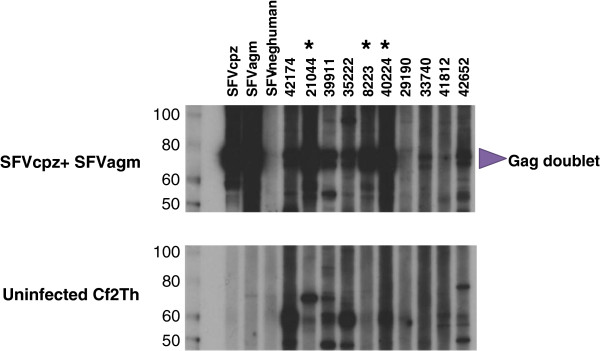
Zoonotic transmission of simian retroviruses in Central Africa is ongoing and can result in pandemic human infection. While simian foamy virus (SFV) infection was reported in primate hunters in Cameroon and Gabon, little is known about the distribution of SFV in Africa and whether human-to-human transmission and disease occur. We screened 3,334 plasmas from persons living in rural villages in central Democratic Republic of Congo (DRC) using SFV-specific EIA and Western blot (WB) tests. PCR amplification of SFV polymerase sequences from DNA extracted from buffy coats was used to measure proviral loads. Phylogenetic analysis was used to define the NHP species origin of SFV. Participants completed questionnaires to capture NHP exposure information.
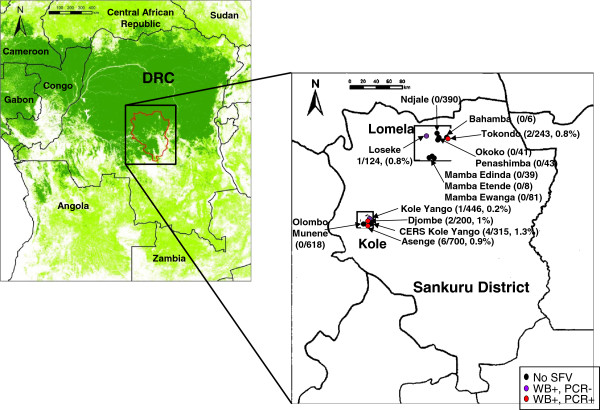
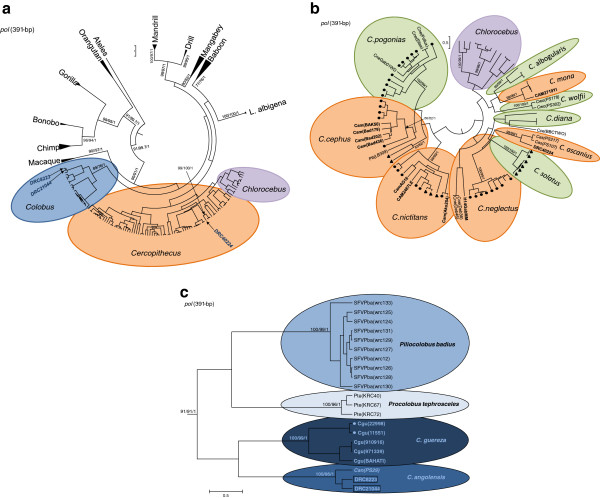
Sixteen (0.5%) samples were WB-positive; 12 of 16 were from women (75%, 95% confidence limits 47.6%, 92.7%). Sequence analysis detected SFV in three women originating from Angolan colobus or red-tailed monkeys; both monkeys are hunted frequently in DRC. NHP exposure varied and infected women lived in distant villages suggesting a wide and potentially diverse distribution of SFV infections across DRC. Plasmas from 22 contacts of 8 WB-positive participants were all WB negative suggesting no secondary viral transmission. Proviral loads in the three women ranged from 14 - 1,755 copies/105 cells.
Our study documents SFV infection in rural DRC for the first time and identifies infections with novel SFV variants from Colobus and red-tailed monkeys. Unlike previous studies, women were not at lower risk for SFV infection in our population, providing opportunities for spread of SFV both horizontally and vertically. However, limited testing of close contacts of WB-positive persons did not identify human-to-human transmission. Combined with the broad behavioral risk and distribution of NHPs across DRC, our results suggest that SFV infection may have a wider geographic distribution within DRC. These results also reinforce the potential for an increased SFV prevalence throughout the forested regions of Africa where humans and simians co-exist. Our finding of endemic foci of SFV infection in DRC will facilitate longitudinal studies to determine the potential for person-to-person transmissibility and pathogenicity of these zoonotic retroviral infections.
中非的灵长类动物源性逆转录病毒的人畜共患传播仍在继续,并可能导致人类大流行感染。虽然在喀麦隆和加蓬的灵长类动物猎手中报告了猴泡沫病毒(SFV)感染,但人们对 SFV 在非洲的分布以及是否存在人与人之间的传播和疾病知之甚少。我们使用 SFV 特异性 EIA 和 Western blot(WB)检测筛查了来自刚果民主共和国(DRC)农村村庄的 3334 份血浆。从白细胞提取的 DNA 中扩增 SFV 聚合酶序列,用于测量前病毒载量。系统发育分析用于确定 SFV 的 NHPs 种源。参与者完成了问卷,以获取 NHPs 暴露信息。
WB 阳性的样本有 16 个(0.5%);其中 16 个中有 12 个来自女性(75%,95%置信区间 47.6%,92.7%)。序列分析检测到来自安哥拉疣猴或红尾猴的三名女性中存在 SFV;这两种猴子在 DRC 都经常被猎杀。NHPs 暴露情况各不相同,感染的女性居住在遥远的村庄,表明 SFV 感染在 DRC 广泛存在且可能具有多样化的分布。8 名 WB 阳性参与者的 22 名接触者的血浆均为 WB 阴性,表明没有继发病毒传播。三名女性的前病毒载量范围为 14-1755 拷贝/105 个细胞。
我们的研究首次在 DRC 农村地区记录了 SFV 感染,并从疣猴和红尾猴中鉴定出新型 SFV 变体感染。与之前的研究不同,在我们的人群中,女性感染 SFV 的风险并不低,这为 SFV 水平和垂直传播提供了机会。然而,对 WB 阳性者的密切接触者进行有限的检测并未发现人与人之间的传播。结合 DRC 广泛存在的 NHPs 和广泛的行为风险,我们的结果表明,SFV 感染可能在 DRC 境内具有更广泛的地理分布。这些结果还强化了在人类和类人猿共存的非洲森林地区 SFV 流行率增加的可能性。我们在 DRC 发现的 SFV 感染地方性流行,将有助于开展纵向研究,以确定这些人畜共患逆转录病毒感染的人际传播和致病性的潜力。