Solberg Monica F, Kvamme Bjørn Olav, Nilsen Frank, Glover Kevin A
Section of Population Genetics and Ecology, Institute of Marine Research, Nordnes, Bergen, Norway.
BMC Res Notes. 2012 Dec 5;5:672. doi: 10.1186/1756-0500-5-672.
Ten generations of domestication selection has caused farmed Atlantic salmon Salmo salar L. to deviate from wild salmon in a range of traits. Each year hundreds of thousands of farmed salmon escape into the wild. Thus, interbreeding between farmed escapees and wild conspecifics represents a significant threat to the genetic integrity of wild salmon populations. In a previous study we demonstrated how domestication has inadvertently selected for reduced responsiveness to stress in farmed salmon. To complement that study, we have evaluated the expression of seven stress-related genes in head kidney of salmon of farmed, hybrid and wild origin exposed to environmentally induced stress.
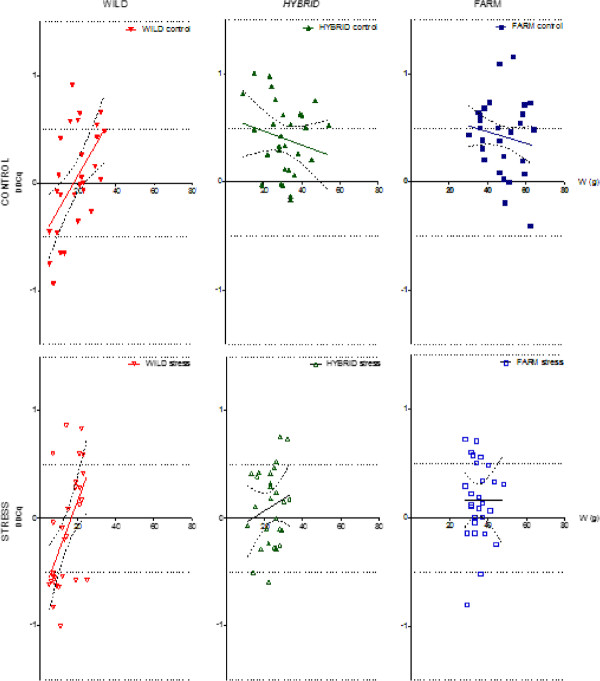
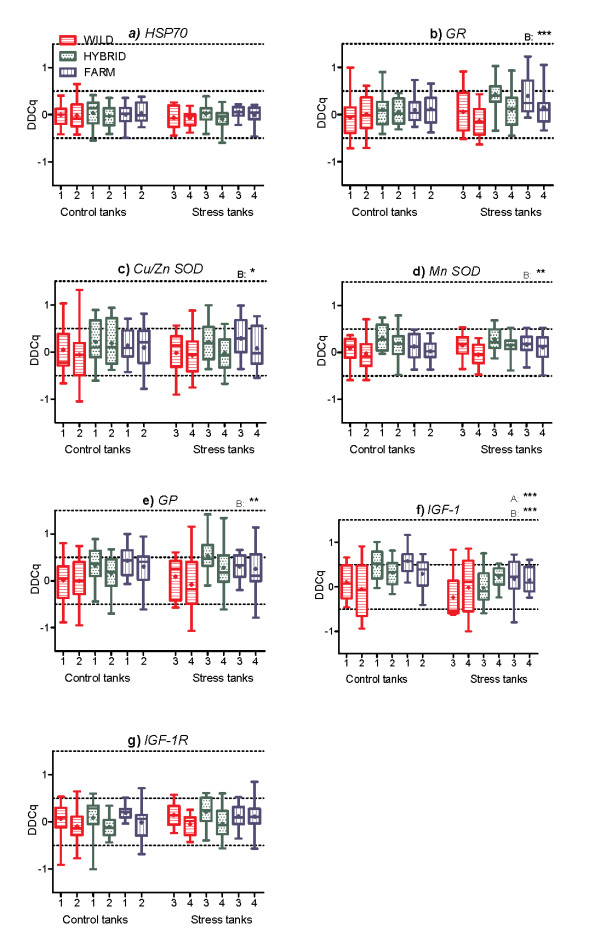
In general, the crowding stressor used to induce environmental stress did not have a strong impact on mRNA expression levels of the seven genes, except for insulin-like growth factor-1 (IGF-1) that was downregulated in the stress treatment relative to the control treatment. mRNA expression levels of glutathione reductase (GR), Cu/Zn superoxide dismutase (Cu/Zn SOD), Mn superoxide dismutase (Mn SOD), glutathione peroxidase (GP) and IGF-1 were affected by genetic origin, thus expressed significantly different between the salmon of farmed, hybrid or wild origin. A positive relationship was detected between body size of wild salmon and mRNA expression level of the IGF-1 gene, in both environments. No such relationship was observed for the hybrid or farmed salmon.
Farmed salmon in this study displayed significantly elevated mRNA levels of the IGF-1 gene relative to the wild salmon, in both treatments, while hybrids displayed a non additive pattern of inheritance. As IGF-1 mRNA levels are positively correlated to growth rate, the observed positive relationship between body size and IGF-1 mRNA levels detected in the wild but neither in the farmed nor the hybrid salmon, could indicate that growth selection has increased IGF-1 levels in farmed salmon to the extent that they may not be limiting growth rate.
十代的驯化选择已导致养殖的大西洋鲑鱼(Salmo salar L.)在一系列性状上与野生鲑鱼产生偏差。每年都有数十万养殖鲑鱼逃入野外。因此,养殖逃逸鱼与野生同种个体之间的杂交对野生鲑鱼种群的遗传完整性构成了重大威胁。在之前的一项研究中,我们展示了驯化如何在不经意间导致养殖鲑鱼对应激的反应性降低。为了补充该研究,我们评估了暴露于环境诱导应激下的养殖、杂交和野生来源鲑鱼的头肾中七个应激相关基因的表达。
总体而言,用于诱导环境应激的拥挤应激源对这七个基因的mRNA表达水平影响不大,除了胰岛素样生长因子1(IGF-1),在应激处理中相对于对照处理其表达下调。谷胱甘肽还原酶(GR)、铜/锌超氧化物歧化酶(Cu/Zn SOD)、锰超氧化物歧化酶(Mn SOD)、谷胱甘肽过氧化物酶(GP)和IGF-1的mRNA表达水平受遗传来源影响,因此在养殖、杂交或野生来源的鲑鱼之间表达存在显著差异。在两种环境下,均检测到野生鲑鱼的体型与IGF-1基因的mRNA表达水平呈正相关。杂交或养殖鲑鱼未观察到这种关系。
在本研究中,无论在何种处理下,养殖鲑鱼的IGF-1基因mRNA水平相对于野生鲑鱼均显著升高,而杂交种则表现出非加性遗传模式。由于IGF-1 mRNA水平与生长速率呈正相关,在野生鲑鱼中观察到但在养殖或杂交鲑鱼中未观察到的体型与IGF-1 mRNA水平之间的正相关关系,可能表明生长选择已使养殖鲑鱼中的IGF-1水平升高到可能不再限制生长速率的程度。