Section of Population Genetics and Ecology, Institute of Marine Research, Bergen, Norway.
PLoS One. 2013;8(1):e54469. doi: 10.1371/journal.pone.0054469. Epub 2013 Jan 31.
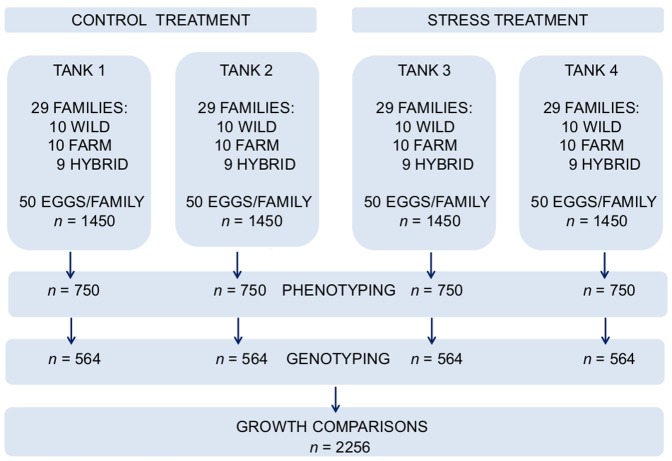
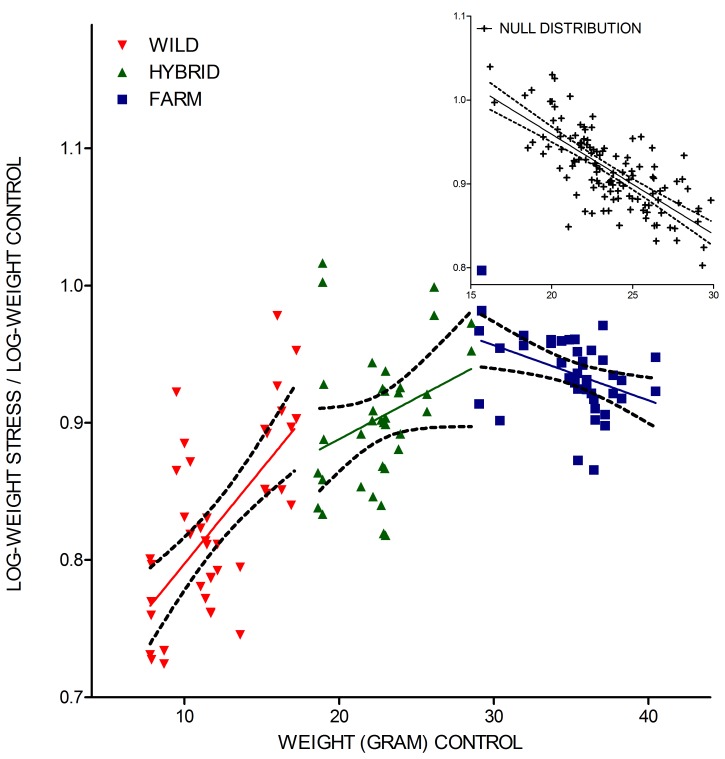
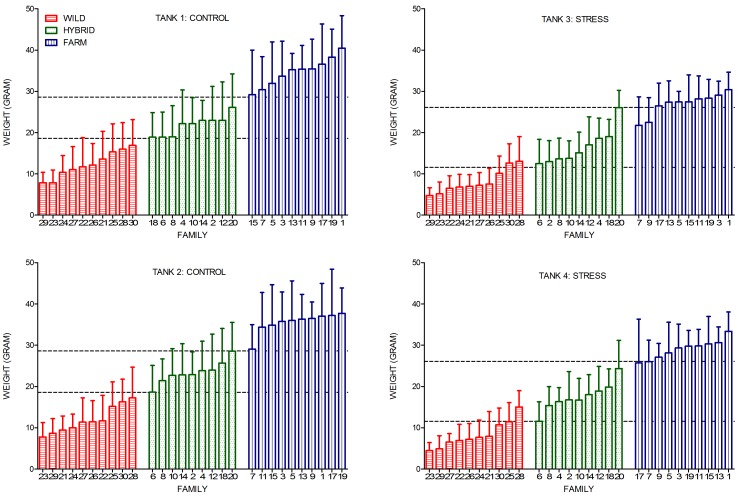
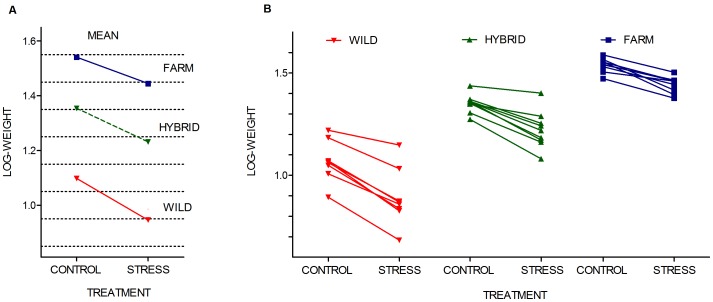
One of the most important traits linked with the successful domestication of animals is reducing their sensitivity to environmental stressors in the human controlled environment. In order to examine whether domestication selection in Atlantic salmon Salmo salar L., over approximately ten generations, has inadvertently selected for reduced responsiveness to stress, we compared the growth reaction norms of 29 wild, hybrid and domesticated families reared together under standard hatchery conditions (control) and in the presence of a stressor (reduced water level twice daily). The experiment was conducted for a 14 week period. Farmed salmon outgrew wild salmon 1:2.93 in the control tanks, and no overlap in mean weight was displayed between families representing the three groups. Thus, the elevation of the reaction norms differed among the groups. Overall, growth was approximately 25% lower in the stressed tanksl; however, farmed salmon outgrew wild salmon 1:3.42 under these conditions. That farmed salmon maintained a relatively higher growth rate than the wild salmon in the stressed tanks demonstrates a lower responsiveness to stress in the farmed salmon. Thus, flatter reaction norm slopes were displayed in the farmed salmon, demonstrating reduced plasticity for this trait under these specific experimental conditions. For all growth measurements, hybrid salmon displayed intermediate values. Wild salmon displayed higher heritability estimates for body weight than the hybrid and farmed salmon in both environments. This suggests reduced genetic variation for body weight in the farmed contra wild salmon studied here. While these results may be linked to the specific families and stocks investigated, and verification in other stocks and traits is needed, these data are consistent with the theoretical predictions of domestication.
动物成功驯化的一个重要特征是降低其对人类控制环境中环境胁迫的敏感性。为了检验大西洋鲑(Salmo salar L.)在大约十代的驯化选择过程中是否无意中选择了对压力的反应降低,我们比较了 29 个野生、杂交和家养的家系在标准孵化条件下(对照)和存在胁迫(每天两次降低水位)时的生长反应规范。实验进行了 14 周。在对照池中,养殖鲑鱼比野生鲑鱼大 1:2.93,三组代表的家系之间没有重叠。因此,反应规范的升高在各组之间存在差异。总体而言,受胁迫的水槽中的生长速度约低 25%;然而,在这些条件下,养殖鲑鱼比野生鲑鱼大 1:3.42。养殖鲑鱼在受胁迫的水槽中保持相对较高的生长速度,表明其对压力的反应较低。因此,养殖鲑鱼的反应规范斜率较平坦,表明在这些特定实验条件下,该性状的可塑性降低。对于所有生长测量,杂交鲑鱼显示出中间值。在两种环境中,野生鲑鱼的体重遗传力估计值均高于杂交和养殖鲑鱼。这表明在本研究中,养殖鲑鱼相对于野生鲑鱼的体重遗传变异减少。虽然这些结果可能与特定的家系和品系有关,需要在其他品系和性状中进行验证,但这些数据与驯化的理论预测一致。