Department of Microbiology, School of Medicine, and Washington National Primate Research Center, University of Washington, Seattle, WA 98195-8070, USA.
Semin Immunol. 2013 Oct 31;25(3):228-39. doi: 10.1016/j.smim.2012.11.001. Epub 2012 Dec 5.
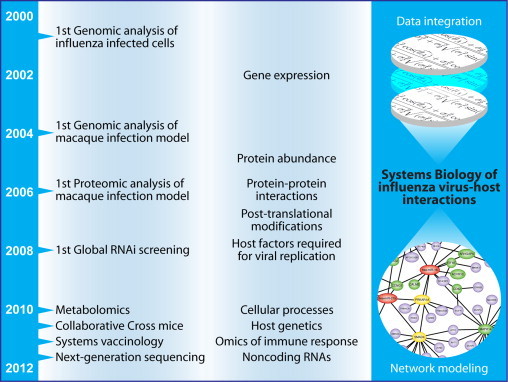
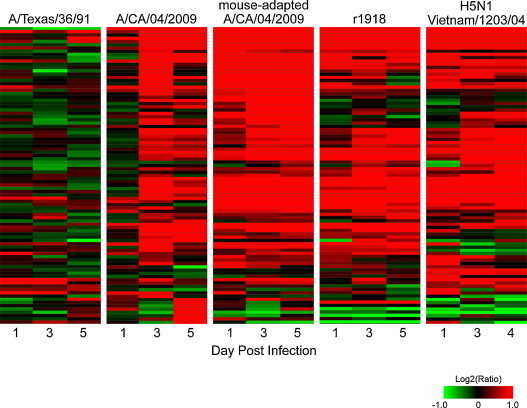
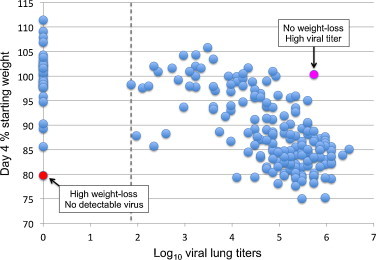
Influenza virus research has recently undergone a shift from a virus-centric perspective to one that embraces the full spectrum of virus-host interactions and cellular signaling events that determine disease outcome. This change has been brought about by the increasing use and expanding scope of high-throughput molecular profiling and computational biology, which together fuel discovery in systems biology. In this review, we show how these approaches have revealed an uncontrolled inflammatory response as a contributor to the extreme virulence of the 1918 pandemic and avian H5N1 viruses, and how this response differs from that induced by the 2009 H1N1 viruses responsible for the most recent influenza pandemic. We also discuss how new animal models, such as the Collaborative Cross mouse systems genetics platform, are key to the necessary systematic investigation of the impact of host genetics on infection outcome, how genome-wide RNAi screens have identified hundreds of cellular factors involved in viral replication, and how systems biology approaches are making possible the rational design of new drugs and vaccines against an ever-evolving respiratory virus.
流感病毒研究最近经历了从以病毒为中心的视角向涵盖病毒-宿主相互作用和决定疾病结果的细胞信号事件的全谱的转变。这种转变是由高通量分子谱分析和计算生物学的日益广泛应用和扩展范围带来的,它们共同推动了系统生物学的发现。在这篇综述中,我们展示了这些方法如何揭示出不受控制的炎症反应是 1918 年大流行和禽流感 H5N1 病毒极度毒力的原因,以及这种反应与 2009 年导致最近流感大流行的 H1N1 病毒引起的反应有何不同。我们还讨论了新的动物模型,如合作交叉小鼠系统遗传学平台,如何成为对宿主遗传学对感染结果的影响进行必要系统研究的关键,基因组范围的 RNAi 筛选如何鉴定数百种参与病毒复制的细胞因子,以及系统生物学方法如何使针对不断进化的呼吸道病毒的新药和疫苗的合理设计成为可能。