Department of Statistics and Applied Probability, National University of Singapore, Singapore.
PLoS Med. 2012;9(12):e1001355. doi: 10.1371/journal.pmed.1001355. Epub 2012 Dec 11.
Millennium Development Goal 4 calls for an annual rate of reduction (ARR) of the under-five mortality rate (U5MR) of 4.4% between 1990 and 2015. Progress is measured through the point estimates of the United Nations Inter-agency Group for Child Mortality Estimation (UN IGME). To facilitate evidence-based conclusions about progress toward the goal, we assessed the uncertainty in the estimates arising from sampling errors and biases in data series and the inferior quality of specific data series.
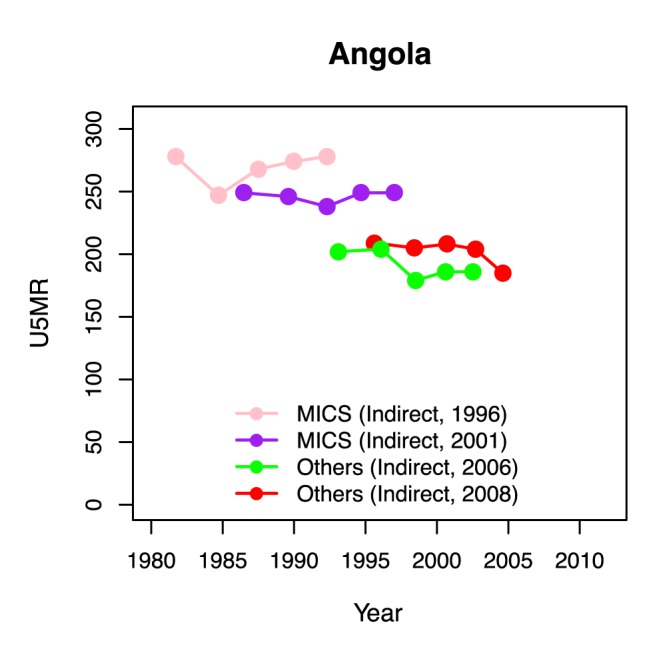
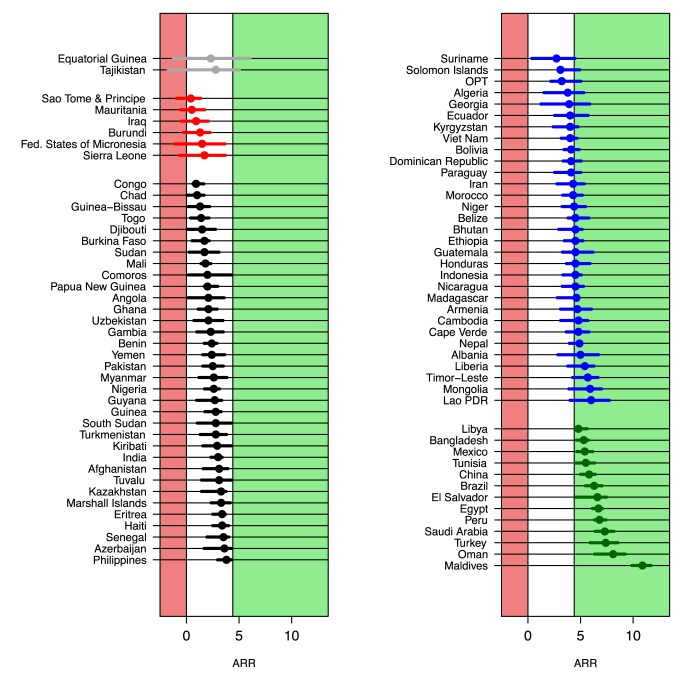
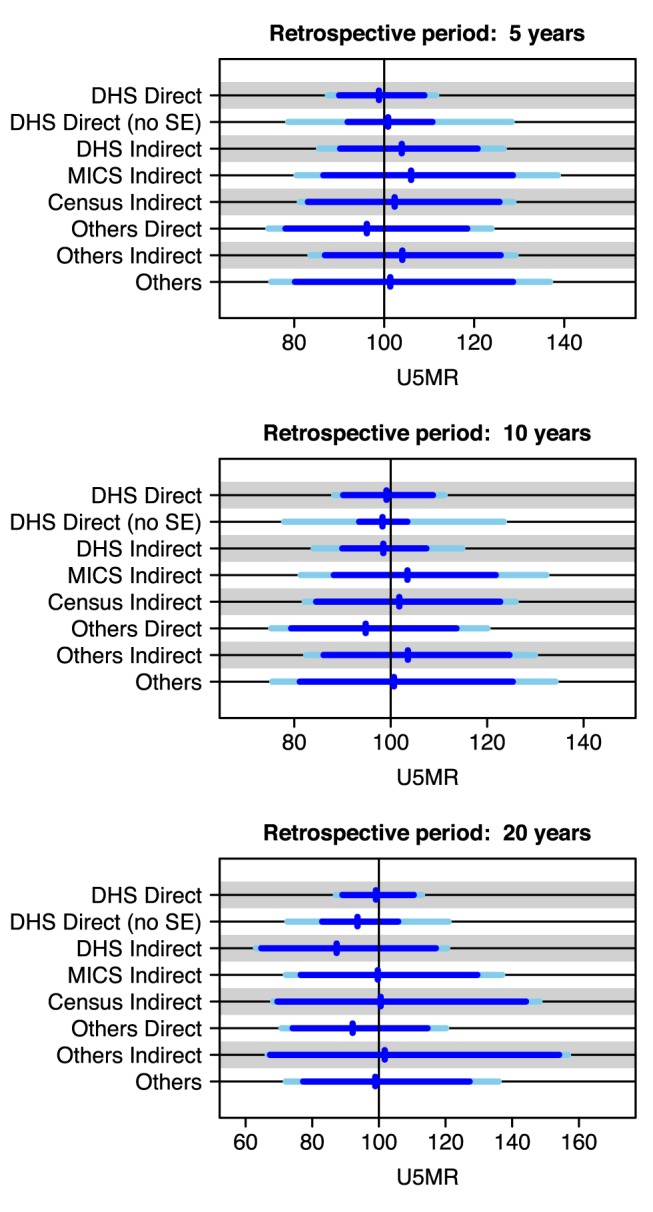
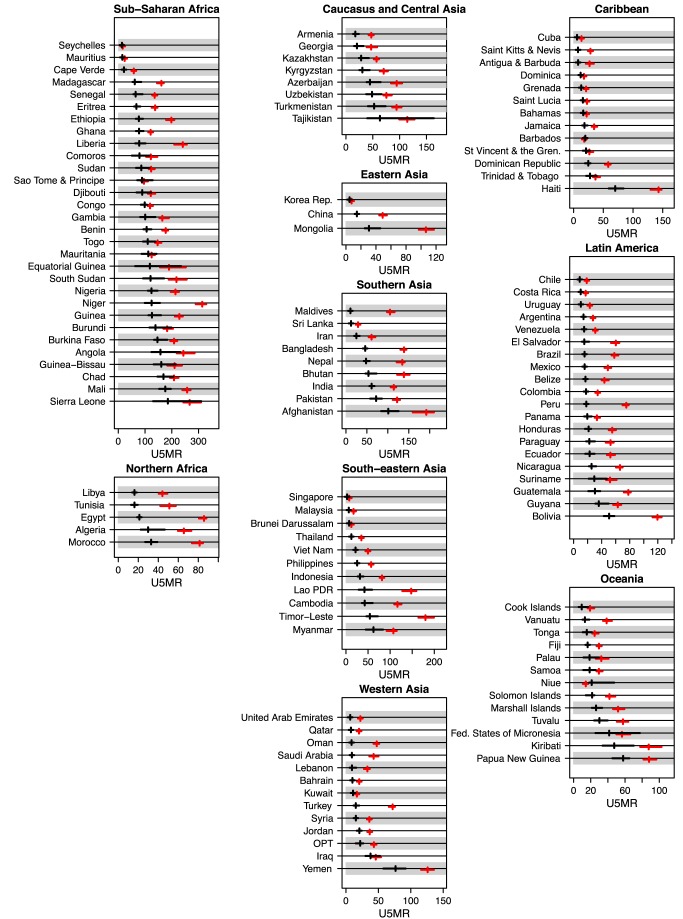
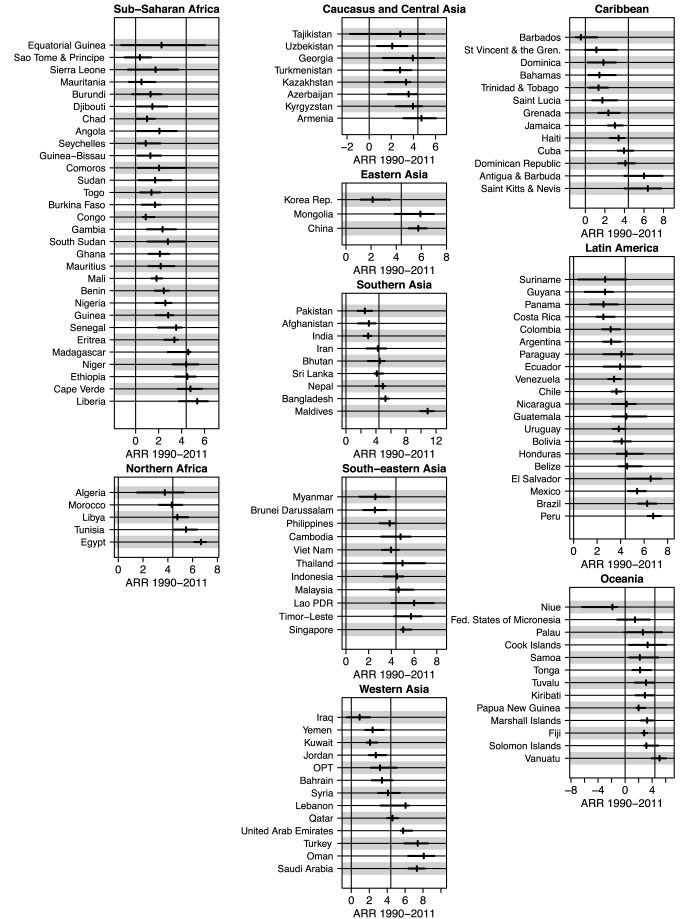
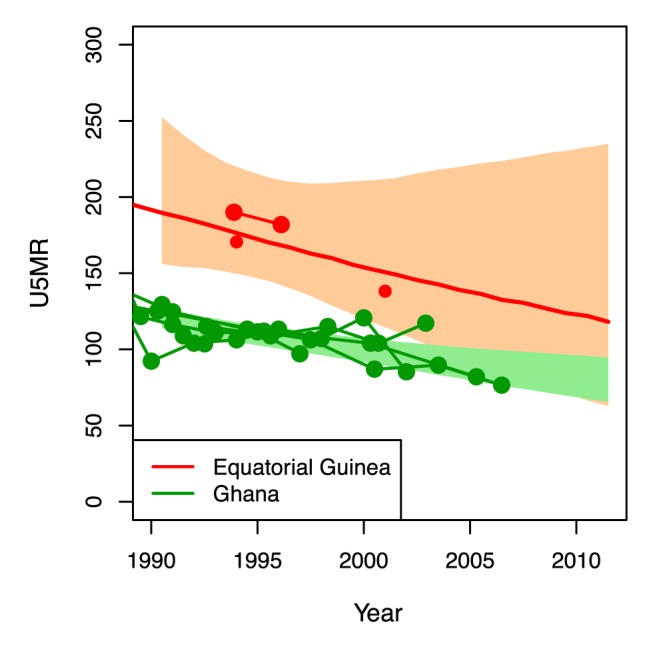
We implemented a bootstrap procedure to construct 90% uncertainty intervals (UIs) for the U5MR and ARR to complement the UN IGME estimates. We constructed the bounds for all countries without a generalized HIV epidemic, where a standard estimation approach is carried out (174 countries). In the bootstrap procedure, potential biases in levels and trends of data series of different source types were accounted for. There is considerable uncertainty about the U5MR, particularly for high mortality countries and in recent years. Among 86 countries with a U5MR of at least 40 deaths per 1,000 live births in 1990, the median width of the UI, relative to the U5MR level, was 19% for 1990 and 48% for 2011, with the increase in uncertainty due to more limited data availability. The median absolute width of the 90% UI for the ARR from 1990 to 2011 was 2.2%. Although the ARR point estimate for all high mortality countries was greater than zero, for eight of them uncertainty included the possibility of no improvement between 1990 and 2011. For 13 countries, it is deemed likely that the ARR from 1990 to 2011 exceeded 4.4%.
In light of the upcoming evaluation of Millennium Development Goal 4 in 2015, uncertainty assessments need to be taken into account to avoid unwarranted conclusions about countries' progress based on limited data.
千年发展目标 4 呼吁在 1990 年至 2015 年期间,将五岁以下儿童死亡率(U5MR)的年下降速度(ARR)降低 4.4%。进展情况通过联合国儿童死亡率估计机构间小组(UN IGME)的点估计数来衡量。为了便于根据目标取得进展的证据得出结论,我们评估了由于抽样误差和数据系列偏差以及特定数据系列质量较差而导致的估计值的不确定性。
我们实施了自举程序,为 U5MR 和 ARR 构建了 90%的置信区间(UI),以补充 UN IGME 的估计数。我们为没有普遍艾滋病毒流行的所有国家(174 个国家)构建了界限,在这些国家中采用了标准估计方法。在自举过程中,考虑了不同来源类型的数据系列的水平和趋势中的潜在偏差。U5MR 存在很大的不确定性,特别是在高死亡率国家和近年来。在 1990 年每 1000 例活产中有至少 40 例死亡的 86 个国家中,相对于 U5MR 水平,UI 的中位数宽度在 1990 年为 19%,在 2011 年为 48%,由于数据可用性有限,不确定性增加。1990 年至 2011 年 ARR 的 90%UI 的中位数绝对宽度为 2.2%。尽管所有高死亡率国家的 ARR 点估计值均大于零,但其中八个国家的不确定性包括在 1990 年至 2011 年期间没有改善的可能性。对于 13 个国家,从 1990 年到 2011 年,ARR 很可能超过 4.4%。
鉴于 2015 年即将对千年发展目标 4 进行评估,需要考虑不确定性评估,以避免根据有限的数据对各国的进展得出不合理的结论。