The Generation R study group, Erasmus University Medical Centre, Rotterdam, The Netherlands.
BMC Public Health. 2012 Dec 19;12:1092. doi: 10.1186/1471-2458-12-1092.
Studies have shown that, compared to native counterparts, preschoolers from ethnic minorities are at an increased risk of problem behaviour. Socio-economic factors only partly explain this increased risk. This study aimed to further unravel the differences in problem behaviour among ethnic minority and native preschoolers by examining the mediating role of family functioning and parenting factors.
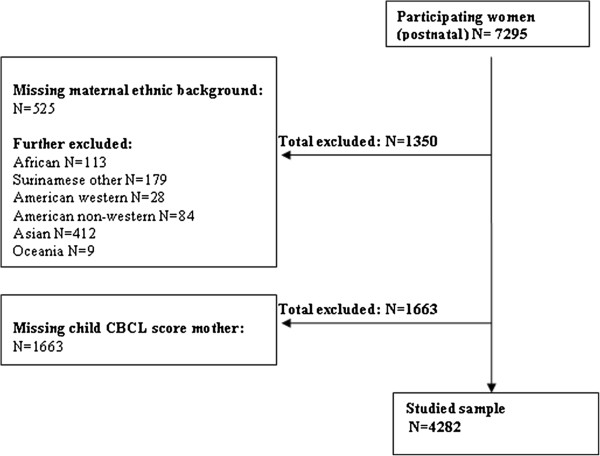
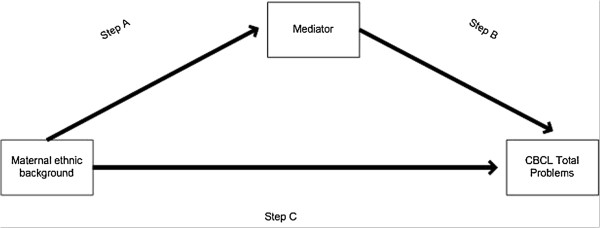
We included 4,282 preschoolers participating in the Generation R Study, an ethnically-diverse cohort study with inclusion in early pregnancy. At child age 3 years, parents completed the Child Behavior Checklist (CBCL/1,5-5); information on demographics, socio-economic status and measures of family functioning (maternal psychopathology; general family functioning) and parenting (parenting stress; harsh parenting) were retrieved from questionnaires. CBCL Total Problems scores in each ethnic subgroup were compared with scores in the Dutch reference population. Mediation was evaluated using multivariate regression models.
After adjustment for confounders, preschoolers from ethnic minorities were more likely to present problem behaviour than the Dutch subgroup (e.g. CBCL Total Problems Turkish subgroup (OR 7.0 (95% CI 4.9; 10.1)). When considering generational status, children of first generation immigrants were worse off than the second generation (P<0.01). Adjustment for socio-economic factors mediated the association between the ethnic minority status and child problem behaviour (e.g. attenuation in OR by 54.4% (P<0.05) from OR 5.1 (95% CI 2.8; 9.4) to OR 2.9 (95% CI 1.5; 5.6) in Cape Verdean subgroup). However, associations remained significant in most ethnic subgroups. A final adjustment for family functioning and parenting factors further attenuated the association (e.g. attenuation in OR by 55.5% (P<0.05) from OR 2.2 (95% CI 1.3; 4.4) to OR 1.5 (95% CI 1.0; 2.4) in European other subgroup).
This study showed that preschoolers from ethnic minorities and particularly children of first generation immigrants are at an increased risk of problem behaviour compared to children born to a Dutch mother. Although socio-economic factors were found to partly explain the association between the ethnic minority status and child problem behaviour, a similar part was explained by family functioning and parenting factors. Considering these findings, it is important for health care workers to also be attentive to symptoms of parental psychopathology (e.g. depression), poor family functioning, high levels of parenting stress or harsh parenting in first and second generation immigrants with young children.
研究表明,与本地同龄人相比,少数民族的学龄前儿童问题行为的风险更高。社会经济因素只能部分解释这种风险增加的原因。本研究旨在通过检查家庭功能和养育因素的中介作用,进一步揭示少数民族和本地学龄前儿童在问题行为上的差异。
我们纳入了 4282 名参与 Generation R 研究的学龄前儿童,该研究是一项具有种族多样性的队列研究,在妊娠早期进行了纳入。在儿童 3 岁时,父母完成了儿童行为检查表(CBCL/1.5-5);从问卷中获取了人口统计学、社会经济地位以及家庭功能(母亲心理病理学;一般家庭功能)和养育(养育压力;严厉养育)的测量值。在每个少数民族亚组中,将 CBCL 总问题评分与荷兰参考人群的评分进行比较。使用多元回归模型评估中介作用。
在调整混杂因素后,少数民族的学龄前儿童比荷兰亚组更有可能出现问题行为(例如,土耳其亚组的 CBCL 总问题评分(OR7.0(95%CI4.9;10.1))。当考虑代际地位时,第一代移民的儿童比第二代移民的儿童更差(P<0.01)。社会经济因素的调整部分解释了少数民族地位与儿童问题行为之间的关联(例如,佛得角亚组的 OR 从 5.1(95%CI2.8;9.4)降至 2.9(95%CI1.5;5.6),衰减幅度为 54.4%(P<0.05))。然而,在大多数少数民族亚组中,关联仍然显著。最后,对家庭功能和养育因素的调整进一步减弱了关联(例如,在欧洲其他亚组中,OR 从 2.2(95%CI1.3;4.4)降至 1.5(95%CI1.0;2.4),衰减幅度为 55.5%(P<0.05))。
本研究表明,与荷兰母亲所生的儿童相比,少数民族的学龄前儿童,尤其是第一代移民的儿童,出现问题行为的风险更高。尽管社会经济因素被发现部分解释了少数民族地位与儿童问题行为之间的关联,但家庭功能和养育因素也解释了类似的部分。考虑到这些发现,卫生保健工作者注意第一代和第二代移民的幼儿的父母心理病理学(例如抑郁)、家庭功能不良、养育压力或严厉养育等症状很重要。