Department of Biochemistry, Faculty of Medicine, The National University of Malaysia, Kuala Lumpur, Malaysia.
Nutr J. 2013 Jan 3;12:2. doi: 10.1186/1475-2891-12-2.
Cigarette smoke contains free radicals and an have adverse effect to the immune system. Supplementation of palm oil vitamin E (palmvitee), is known has antioxidant properties is thought to be beneficial for system immune protection against free radicals activity. The objective of the study was to determine the effect of palmvitee supplementation on immune response in smokers.
This study involved a group of smokers and nonsmokers who received 200 mg/day palmvitee and placebo for the control group. Blood samples were taken at 0, 12 and 24 weeks of supplementation. Plasma tocopherol and tocotrienol were determined by HPLC, lymphocyte proliferation by lymphocyte transformation test (LTT) and enumeration of lymphocytes T and B cells by flow cytometry. Statistical analysis was performed by Mann-Whitney U-test for non-parametric data distribution and correlation among the variables was examined by Spearman.
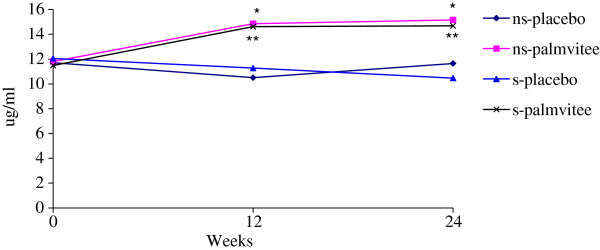
Plasma tocopherol and tocotrienol were increased in vitamin E supplemented group as compared to placebo group. Urine cotinine levels and serum α1-antitrypsin were significantly higher in smokers compared to nonsmokers. Lymphocyte proliferation induced by PHA showed an increasing trend with palmvitee supplementation in both smokers and nonsmokers. Natural killer cells were decreased; CD4+ cells and B cells were increased in smokers compared to nonsmokers but were unaffected with vitamin E supplementation except in the percentage of B cells which were increased in nonsmokers supplemented palmvitee compared to placebo. CD4+/CD8+ ratio was increased in smokers compared to nonsmokers. The high TWBC count observed in smokers correlated with the increased CD4+ and B cells.
Smoking caused alterations in certain immune parameters and palmvitee supplementation tended to cause an increase in lymphocytes transformation test but had no effect on CD3+, CD4+, CD8+, NK cells and B cells except B cells percentage in nonsmokers.
香烟烟雾中含有自由基,会对免疫系统产生不良影响。棕榈油维生素 E(palmvitee)补充剂具有抗氧化特性,被认为有益于系统免疫保护免受自由基活动的影响。本研究的目的是确定 palmvitee 补充剂对吸烟者免疫反应的影响。
本研究涉及一组吸烟者和不吸烟者,他们每天接受 200 毫克 palmvitee 和安慰剂作为对照组。在补充的 0、12 和 24 周时采集血样。通过 HPLC 测定血浆生育酚和生育三烯酚,通过淋巴细胞转化试验(LTT)测定淋巴细胞增殖,通过流式细胞术计数 T 和 B 淋巴细胞。非参数数据分布的统计分析采用 Mann-Whitney U 检验,变量之间的相关性采用 Spearman 检验。
与安慰剂组相比,维生素 E 补充组的血浆生育酚和生育三烯酚增加。与不吸烟者相比,吸烟者的尿可替宁水平和血清α1-抗胰蛋白酶显著升高。PHA 诱导的淋巴细胞增殖在吸烟者和不吸烟者中均呈上升趋势随着 palmvitee 的补充。自然杀伤细胞减少;与不吸烟者相比,吸烟者的 CD4+细胞和 B 细胞增加,但维生素 E 补充剂对其没有影响,除了不吸烟者补充 palmvitee 后 B 细胞的百分比增加。与不吸烟者相比,吸烟者的 CD4+/CD8+比值增加。吸烟者中观察到的高 TWBC 计数与增加的 CD4+和 B 细胞相关。
吸烟导致某些免疫参数发生变化,而 palmvitee 补充剂倾向于增加淋巴细胞转化试验,但对 CD3+、CD4+、CD8+、NK 细胞和 B 细胞没有影响,除了不吸烟者中 B 细胞的百分比增加。