Department of Laboratory Medicine and Pathology, Mayo Clinic College of Medicine, 4500 San Pablo Rd, Jacksonville, Florida 32224, USA.
Ann Clin Microbiol Antimicrob. 2013 Jan 7;12:2. doi: 10.1186/1476-0711-12-2.
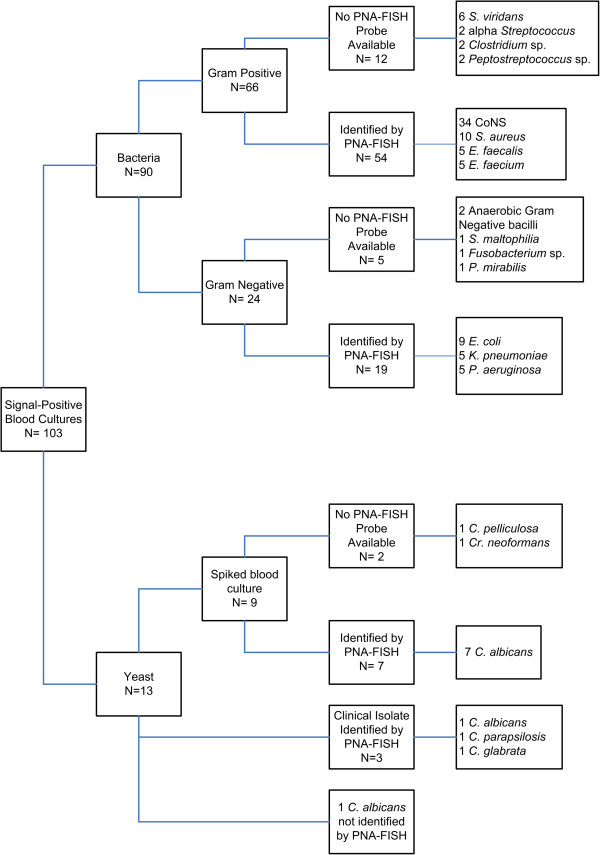
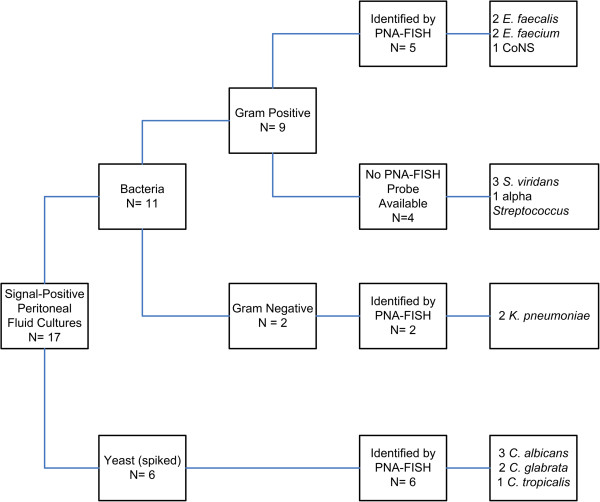
Peptide nucleic acid fluorescent in situ hybridization (PNA-FISH) is a rapid and established method for identification of Candida sp., Gram positive, and Gram negative bacteria from positive blood cultures. This study reports clinical experience in the evaluation of 103 positive blood cultures and 17 positive peritoneal fluid cultures from 120 patients using PNA-FISH. Our study provides evidence as to potential pharmaceutical cost savings based on rapid pathogen identification, in addition to the novel application of PNA-FISH to peritoneal fluid specimens.
Identification accuracy and elapsed time to identification of Gram positives, Gram negatives, and Candida sp., isolated from blood and peritoneal fluid cultures were assessed using PNA-FISH (AdvanDx), as compared to standard culture methods. Patient charts were reviewed to extrapolate potential pharmaceutical cost savings due to adjustment of antimicrobial or antifungal therapy, based on identification by PNA-FISH.
In blood cultures, time to identification by standard culture methods for bacteria and Candida sp., averaged 83.6 hours (95% CI 56.7 to 110.5). Identification by PNA-FISH averaged 11.2 hours (95% CI 4.8 to 17.6). Overall PNA-FISH identification accuracy was 98.8% (83/84, 95% CI 93.5% to 99.9%) as compared to culture. In peritoneal fluid, identification of bacteria by culture averaged 87.4 hours (95% CI -92.4 to 267.1). Identification by PNA-FISH averaged 16.4 hours (95% CI -57.3 to 90.0). Overall PNA-FISH identification accuracy was 100% (13/13, 95% CI 75.3% to 100%). For Candida sp., pharmaceutical cost savings based on PNA-FISH identification could be $377.74/day. For coagulase-negative staphylococcus (CoNS), discontinuation of vancomycin could result in savings of $20.00/day.
In this retrospective study, excellent accuracy of PNA-FISH in blood and peritoneal fluids with reduced time to identification was observed, as compared to conventional culture-based techniques. Species-level identification based on PNA-FISH could contribute to notable cost savings due to adjustments in empiric antimicrobial or antifungal therapy as appropriate to the pathogen identified.
肽核酸荧光原位杂交(PNA-FISH)是一种快速且成熟的方法,可用于鉴定阳性血培养物中的念珠菌属、革兰阳性菌和革兰阴性菌。本研究报告了 120 名患者的 103 份阳性血培养物和 17 份阳性腹腔液培养物使用 PNA-FISH 的临床经验。我们的研究提供了基于快速病原体鉴定的潜在药物成本节约的证据,此外还将 PNA-FISH 应用于腹腔液标本。
使用 PNA-FISH(AdvanDx)评估革兰阳性菌、革兰阴性菌和从血液和腹腔液培养物中分离的念珠菌属的鉴定准确性和鉴定所需的时间,与标准培养方法进行比较。根据 PNA-FISH 的鉴定,回顾患者的图表以推断出由于调整抗菌或抗真菌治疗而产生的潜在药物成本节约。
在血培养物中,标准培养方法鉴定细菌和念珠菌属的时间平均为 83.6 小时(95%CI 56.7 至 110.5)。PNA-FISH 鉴定的平均时间为 11.2 小时(95%CI 4.8 至 17.6)。与培养相比,PNA-FISH 的总体鉴定准确性为 98.8%(83/84,95%CI 93.5%至 99.9%)。在腹腔液中,细菌的培养鉴定平均为 87.4 小时(95%CI-92.4 至 267.1)。PNA-FISH 鉴定的平均时间为 16.4 小时(95%CI-57.3 至 90.0)。PNA-FISH 的总体鉴定准确性为 100%(13/13,95%CI 75.3%至 100%)。对于念珠菌属,基于 PNA-FISH 鉴定的药物成本节约每天可能为 377.74 美元。对于凝固酶阴性葡萄球菌(CoNS),停止万古霉素治疗可能会节省每天 20.00 美元。
在这项回顾性研究中,与传统的基于培养的技术相比,PNA-FISH 在血液和腹腔液中的准确性优异,鉴定时间缩短。基于 PNA-FISH 的种属鉴定可能会由于适当调整针对鉴定病原体的经验性抗菌或抗真菌治疗而导致显著的成本节约。