School of Mechanical and Aerospace Engineering, Nanyang Technological University, Singapore.
Emergency Medicine, Stanford University, Stanford, California 94305, USA.
Biotechnol Adv. 2019 May-Jun;37(3):476-490. doi: 10.1016/j.biotechadv.2019.02.013. Epub 2019 Feb 20.
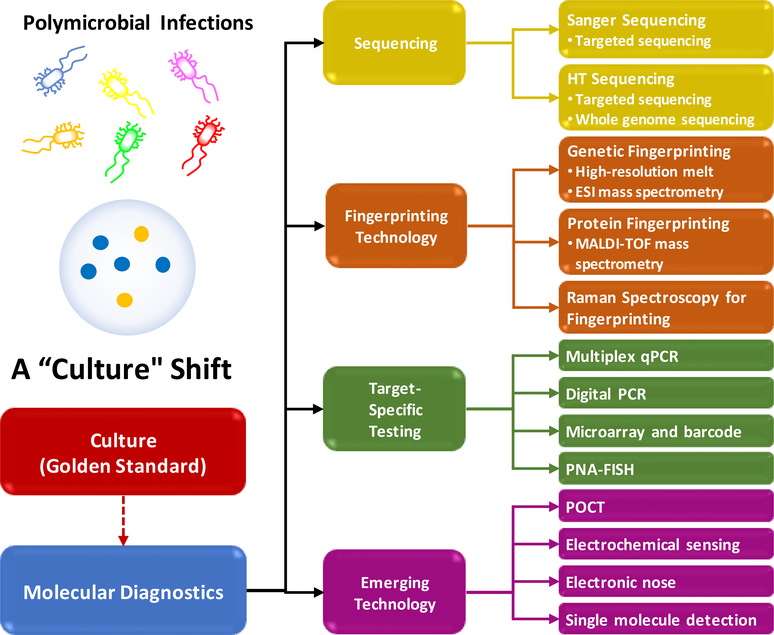
With the advancement of microbiological discovery, it is evident that many infections, particularly bloodstream infections, are polymicrobial in nature. Consequently, new challenges have emerged in identifying the numerous etiologic organisms in an accurate and timely manner using the current diagnostic standard. Various molecular diagnostic methods have been utilized as an effort to provide a fast and reliable identification in lieu or parallel to the conventional culture-based methods. These technologies are mostly based on nucleic acid, proteins, or physical properties of the pathogens with differing advantages and limitations. This review evaluates the different molecular methods and technologies currently available to diagnose polymicrobial infections, which will help determine the most appropriate option for future diagnosis.
随着微生物学发现的进步,很明显,许多感染,特别是血流感染,本质上是多种微生物的。因此,使用当前的诊断标准,准确和及时地识别众多病原体的新挑战已经出现。已经使用了各种分子诊断方法,作为替代或平行于传统基于培养的方法提供快速可靠鉴定的努力。这些技术主要基于病原体的核酸、蛋白质或物理特性,具有不同的优缺点。这篇综述评估了目前可用于诊断混合感染的不同分子方法和技术,这将有助于确定未来诊断的最合适选择。