Hospital das Clínicas da Faculdade de Medicina da Universidade de São Paulo, Pathology Department, Microbiology Laboratory, São Paulo/SP, Brazil.
Clinics (Sao Paulo). 2012 Dec;67(12):1427-31. doi: 10.6061/clinics/2012(12)13.
Enterobacteriaceae bacteria harboring Klebsiella pneumoniae carbapenemase are a serious worldwide threat. The molecular identification of these pathogens is not routine in Brazilian hospitals, and a rapid phenotypic screening test is desirable. This study aims to evaluate the modified Hodge test as a phenotypic screening test for Klebsiella pneumoniae carbapenemase.
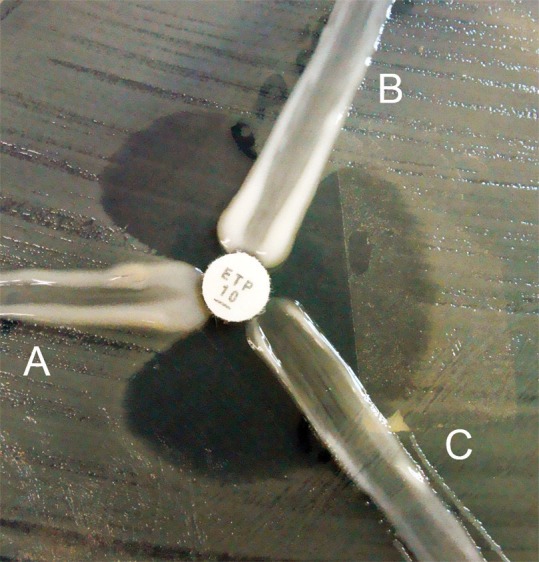
From April 2009 to July 2011, all Enterobacteriaceae bacteria that were not susceptible to ertapenem according to Vitek2 analysis were analyzed with the modified Hodge test. All positive isolates and a random subset of negative isolates were also assayed for the presence of blaKPC. Isolates that were positive in modified Hodge tests were sub-classified as true-positives (E. coli touched the ertapenem disk) or inconclusive (distortion of the inhibition zone of E. coli, but growth did not reach the ertapenem disk). Negative results were defined as samples with no distortion of the inhibition zone around the ertapenem disk.
Among the 1521 isolates of Enterobacteriaceae bacteria that were not susceptible to ertapenem, 30% were positive for blaKPC, and 35% were positive according to the modified Hodge test (81% specificity). Under the proposed sub-classification, true positives showed a 98% agreement with the blaKPC results. The negative predictive value of the modified Hodge test for detection was 100%. KPC producers showed high antimicrobial resistance rates, but 90% and 77% of these isolates were susceptible to aminoglycoside and tigecycline, respectively.
Standardizing the modified Hodge test interpretation may improve the specificity of KPC detection. In this study, negative test results ruled out 100% of the isolates harboring Klebsiella pneumoniae carbapenemase 2. The test may therefore be regarded as a good epidemiological tool.
携带肺炎克雷伯菌碳青霉烯酶的肠杆菌科细菌是一种严重的全球威胁。这些病原体的分子鉴定在巴西医院并非常规,因此需要一种快速的表型筛选试验。本研究旨在评估改良 Hodge 试验作为一种检测肺炎克雷伯菌碳青霉烯酶的表型筛选试验。
2009 年 4 月至 2011 年 7 月,所有根据 Vitek2 分析对厄他培南不敏感的肠杆菌科细菌均进行改良 Hodge 试验分析。所有阳性分离株和随机选择的阴性分离株也进行 blaKPC 检测。改良 Hodge 试验阳性的分离株进一步分为真阳性(大肠埃希菌接触厄他培南纸片)或不确定(大肠埃希菌抑制圈变形,但生长未达厄他培南纸片)。阴性结果定义为厄他培南纸片周围抑制圈无变形的样本。
在 1521 株对厄他培南不敏感的肠杆菌科细菌分离株中,30%携带 blaKPC,35%根据改良 Hodge 试验阳性(特异性 81%)。根据提出的分类,真阳性与 blaKPC 结果具有 98%的一致性。改良 Hodge 试验检测的阴性预测值为 100%。产 KPC 者表现出较高的抗菌药物耐药率,但 90%和 77%的分离株对氨基糖苷类和替加环素分别敏感。
标准化改良 Hodge 试验的解释可能会提高 KPC 检测的特异性。在本研究中,阴性试验结果排除了 100%携带肺炎克雷伯菌碳青霉烯酶 2 的分离株。因此,该试验可被视为一种良好的流行病学工具。