Department of Psychiatry and Behavioural Neurosciences, McMaster University and Offord Centre for Child Studies, Hamilton, ON, L8S 4K1, Canada.
Malar J. 2013 Jan 9;12:14. doi: 10.1186/1475-2875-12-14.
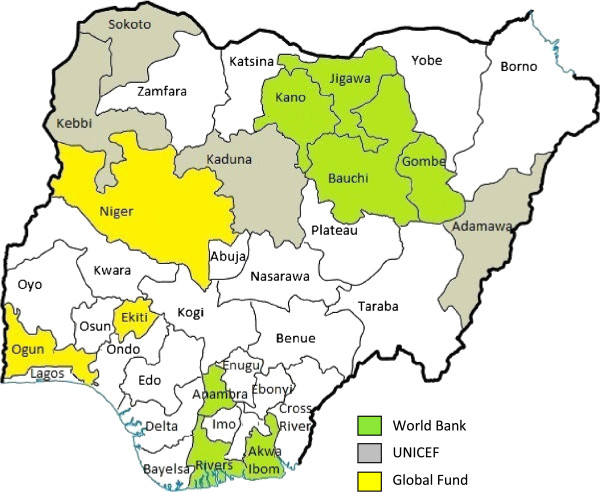
Nigeria carries the greatest malaria burden among countries in the world. As part of the National Malaria Control Strategic Plan, free long-lasting insecticidal nets (LLINs) were distributed in 14 states of Nigeria through mass campaigns led by different organizations (the World Bank, UNICEF, or the Global Fund) between May 2009 and August 2010. The objective of this study was to evaluate the association between LLIN distribution campaigns and child malaria in Nigeria.
Data were from the Nigeria Malaria Indicator Survey which was carried out from October to December 2010 on a nationally representative sample of households. Participants were women aged 15-49 years and their children aged less than five years (N = 4082). The main outcome measure was the presence or absence of malaria parasites in blood samples of children (6-59 months).
Compared with children living in communities with no campaigns, those in the campaign areas were less likely to test positive for malaria after adjusting for geographic locations, community- and individual-level characteristics including child-level use of insecticide-treated nets (ITNs). The protective effects were statistically significant for the World Bank Booster Project areas (OR = 0.18, 95% CI = 0.04-0.73) but did not reach statistical significance for other campaign areas. Results also showed that community-level wealth (OR = 0.51, 95% CI = 0.34-0.76), community-level maternal knowledge regarding malaria prevention (OR = 0.70, 95% CI = 0.50-0.97), and child-level use of ITNs (OR = 0.79, 95% CI = 0.63-0.99) were negatively associated with child malaria.
The observed protective effects on child malaria of these campaigns (statistically significant in the World Bank Booster Project areas and non-significant in the other areas) need to be corroborated by future effectiveness studies. Results also show that improving community-level maternal knowledge through appropriate channels might be helpful in preventing child malaria in Nigeria.
尼日利亚是世界上疟疾负担最重的国家之一。作为国家疟疾控制战略计划的一部分,2009 年 5 月至 2010 年 8 月期间,不同组织(世界银行、儿基会或全球基金)在尼日利亚 14 个州开展了大规模运动,免费发放长效驱虫蚊帐(LLINs)。本研究旨在评估 LLIN 分发运动与尼日利亚儿童疟疾之间的关联。
数据来自 2010 年 10 月至 12 月进行的具有全国代表性的家庭样本的尼日利亚疟疾指标调查。参与者为年龄在 15-49 岁的妇女及其年龄在 5 岁以下的儿童(N=4082)。主要结局指标为儿童(6-59 个月)血样中是否存在疟原虫。
与未开展运动的社区的儿童相比,调整地理位置、社区和个体特征(包括儿童使用驱虫蚊帐)后,处于运动地区的儿童疟原虫检测呈阳性的可能性较小。世界银行助推项目地区的保护作用具有统计学意义(OR=0.18,95%CI=0.04-0.73),但其他运动地区未达到统计学意义。结果还表明,社区层面的财富(OR=0.51,95%CI=0.34-0.76)、社区层面的产妇疟疾预防知识(OR=0.70,95%CI=0.50-0.97)和儿童层面的驱虫蚊帐使用(OR=0.79,95%CI=0.63-0.99)与儿童疟疾呈负相关。
这些运动对儿童疟疾的观察到的保护作用(在世界银行助推项目地区具有统计学意义,而在其他地区则无统计学意义)需要通过未来的效果研究加以证实。结果还表明,通过适当渠道提高社区层面的产妇知识可能有助于预防尼日利亚儿童疟疾。