Department of Nutrition Sciences, University of Alabama at Birmingham, Birmingham, AL, USA.
Nutr Metab (Lond). 2013 Jan 8;10(1):3. doi: 10.1186/1743-7075-10-3.
Risk for obesity differs with ethnicity/race and is associated with insulin sensitivity (SI), insulin responsiveness, and dietary glycemic load (GL). The objective of this study was to test the hypotheses that, 1) obesity-prone, normal weight, African-American (AA) women would be more insulin sensitive than BMI-matched, never overweight AA women; 2) increased adiposity over time would be associated with greater baseline SI and higher dietary GL in AA but not European-American (EA) women; and 3) increased adiposity over time would be predicted by SI in women with high but not low acute insulin response to glucose (AIRg).
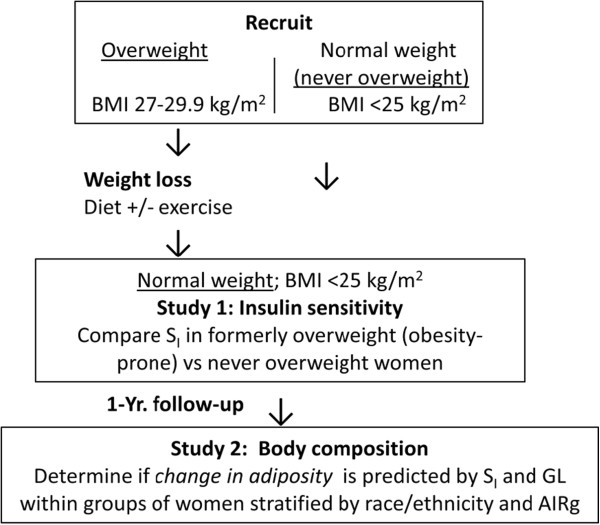
Two controlled weight loss interventions were conducted involving overweight (BMI 25.0-29.9 kg/m2) premenopausal AA and EA women. The first included matching with normal-weight (BMI <25.0 kg/m2) controls following weight loss, and then comparing SI. The second included a 1-year follow-up of weight-reduced participants to identify predictors of change in %body fat. Main outcome measure in the first study was insulin sensitivity (SI) as assessed with intravenous glucose tolerance test (IVGTT), and in the second study was change in %fat, as assessed with DXA, over one year. AIRg was assessed during IVGTT, and free-living diet was determined by food record.
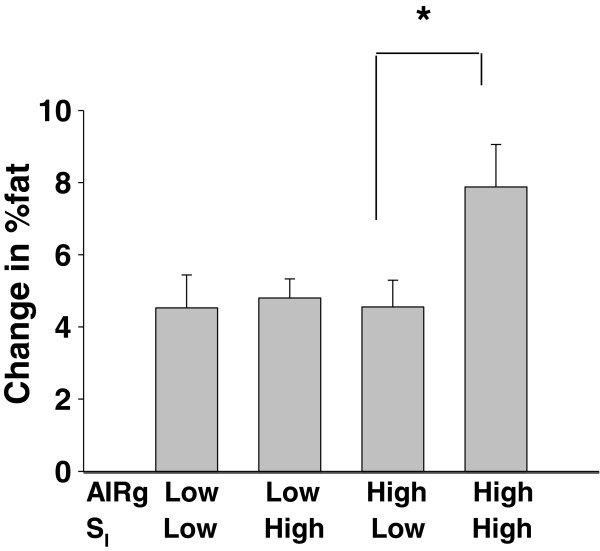
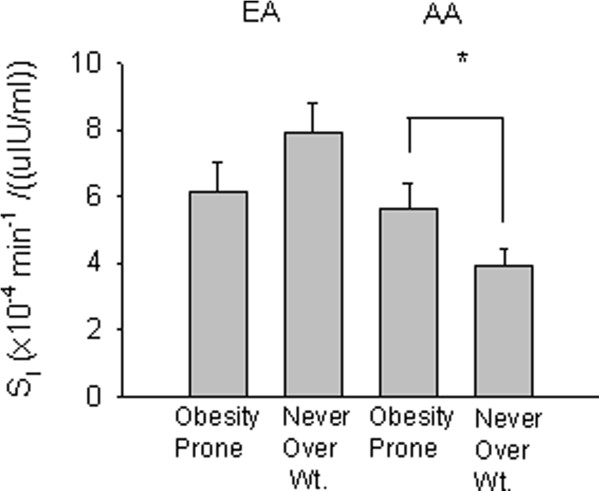
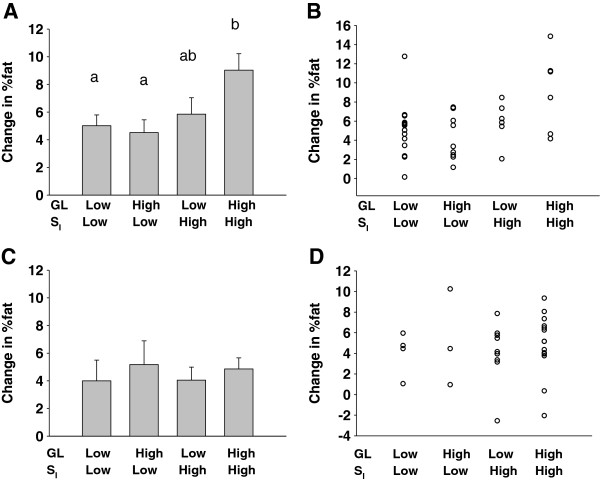
In the first study, formerly overweight AA women were 43% more insulin sensitive than BMI-matched never overweight AA (P < 0.05). In the second study, SI was positively associated with change in %fat over 1 year only in AA women (P < 0.05) and women with high AIRg (P < 0.05). In addition, AA who were insulin sensitive and who consumed a higher GL diet tended to gain greater %fat (P = 0.086 for diet x SI interaction). In both studies, AA women had higher AIRg (P < 0.001) than EA women.
Formerly overweight (obesity-prone) AA women were more insulin sensitive than never overweight AA women, a quality that may predispose to adiposity, particularly when combined with a high GL diet. This ethnicity/race-specific effect may be due to high insulin responsiveness among AA.
肥胖风险因种族/民族而异,与胰岛素敏感性(SI)、胰岛素反应性和饮食血糖负荷(GL)有关。本研究旨在检验以下假设:1)肥胖倾向的正常体重非裔美国人(AA)女性比 BMI 匹配的非超重 AA 女性更敏感;2)随着时间的推移,脂肪增加与 AA 女性而非欧洲裔美国人(EA)女性的基础 SI 更高和饮食 GL 更高有关;3)随着时间的推移,高急性胰岛素反应性葡萄糖(AIRg)的女性的 SI 预测脂肪增加。
进行了两项控制体重的干预措施,涉及超重(BMI 25.0-29.9kg/m2)的绝经前 AA 和 EA 女性。第一项包括体重减轻后与正常体重(BMI <25.0kg/m2)对照组相匹配,然后比较 SI。第二项包括对减肥参与者进行为期一年的随访,以确定脂肪变化的预测因素。第一项研究的主要观察指标是静脉葡萄糖耐量试验(IVGTT)评估的胰岛素敏感性(SI),第二项研究是一年内通过 DXA 评估的%脂肪变化。在 IVGTT 期间评估 AIRg,通过食物记录确定自由生活饮食。
在第一项研究中,以前超重的 AA 女性比 BMI 匹配的非超重 AA 女性敏感 43%(P <0.05)。在第二项研究中,仅在 AA 女性(P <0.05)和高 AIRg 女性(P <0.05)中,SI 与 1 年内的%脂肪变化呈正相关。此外,胰岛素敏感且饮食 GL 较高的 AA 女性倾向于增加更多的%脂肪(饮食 x SI 相互作用的 P=0.086)。在两项研究中,AA 女性的 AIRg 均高于 EA 女性(P <0.001)。
以前超重(肥胖倾向)的 AA 女性比从未超重的 AA 女性更敏感,这种质量可能导致肥胖,尤其是与高 GL 饮食结合时。这种种族/民族特异性的影响可能是由于 AA 人群的胰岛素反应性较高。