Faculté de Chirurgie Dentaire de Strasbourg, Université de Strasbourg, 1 place de l'Hôpital, Strasbourg 67000, France.
Orphanet J Rare Dis. 2013 Jan 14;8:9. doi: 10.1186/1750-1172-8-9.
Cockayne Syndrome CS (Type A - CSA; or CS Type I OMIM #216400) (Type B - CSB; or CS Type II OMIM #133540) is a rare autosomal recessive neurological disease caused by defects in DNA repair characterized by progressive cachectic dwarfism, progressive intellectual disability with cerebral leukodystrophy, microcephaly, progressive pigmentary retinopathy, sensorineural deafness photosensitivity and possibly orofacial and dental anomalies.
We studied the cranio-oro-facial status of a group of 17 CS patients from 15 families participating in the National Hospital Program for Clinical Research (PHRC) 2005 « Clinical and molecular study of Cockayne syndrome ». All patients were examined by two investigators using the Diagnosing Dental Defects Database (D[4]/phenodent) record form.
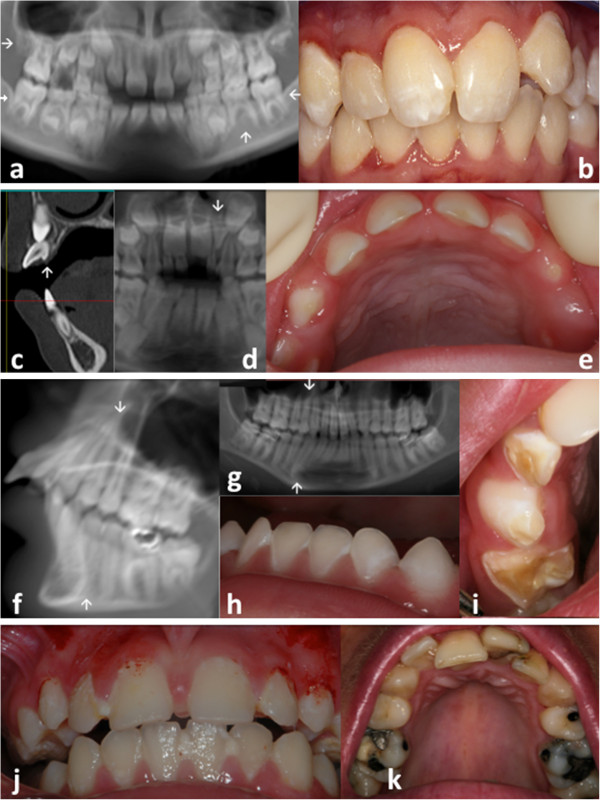
Various oro-facial and dental anomalies were found: retrognathia; micrognathia; high- arched narrow palate; tooth crowding; hypodontia (missing permanent lateral incisor, second premolars or molars), screwdriver shaped incisors, microdontia, radiculomegaly, and enamel hypoplasia. Eruption was usually normal. Dental caries was associated with enamel defects, a high sugar/carbohydrate soft food diet, poor oral hygiene and dry mouth. Cephalometric analysis revealed mid-face hypoplasia, a small retroposed mandible and hypo-development of the skull.
CS patients may have associated oro-dental features, some of which may be more frequent in CS children - some of them being described for the first time in this paper (agenesis of second permanent molars and radiculomegaly). The high susceptibility to rampant caries is related to a combination of factors as well as enamel developmental defects. Specific attention to these anomalies may contribute to diagnosis and help plan management.
Cockayne 综合征(CSA,CS 型 A;或 CS 型 I,OMIM#216400)和 CSB(CS 型 B;或 CS 型 II,OMIM#133540)是一种罕见的常染色体隐性遗传性神经系统疾病,由 DNA 修复缺陷引起,其特征为进行性恶病质侏儒症、进行性脑白质营养不良伴智力障碍、小头畸形、进行性色素性视网膜炎、感觉神经性耳聋、光敏感和可能的颌面和牙齿异常。
我们研究了参加国家医院临床研究计划(PHRC)2005 年“ Cockayne 综合征的临床和分子研究”的 15 个家庭的 17 名 CS 患者的颅面状况。所有患者均由两位研究者使用诊断牙科缺陷数据库(D[4]/phenodent)记录表进行检查。
发现了各种颌面和牙齿异常:下颌后缩;小下颌;高拱形狭窄腭;牙齿拥挤;缺牙(恒牙侧切牙、第二前磨牙或磨牙缺失),螺丝刀状切牙,小牙畸形,根肥大,釉质发育不全。出牙通常正常。龋齿与釉质缺陷、高糖/碳水化合物软食、不良口腔卫生和口干有关。头影测量分析显示中面部发育不良、下颌后缩和颅骨发育不良。
CS 患者可能有相关的口腔牙科特征,其中一些在 CS 儿童中更为常见 - 其中一些在本文中首次描述(第二磨牙和根肥大缺失)。猖獗性龋齿的高易感性与多种因素有关,以及釉质发育缺陷。对这些异常的特别关注可能有助于诊断并有助于制定管理计划。