Department of Epidemiology, Johns Hopkins Bloomberg School of Public Health, Baltimore, Maryland, USA.
Environ Health Perspect. 2013 Mar;121(3):345-51. doi: 10.1289/ehp.1205305. Epub 2013 Jan 15.
Arsenic (III) methyltransferase (AS3MT) has been related to urine arsenic metabolites in association studies. Other genes might also play roles in arsenic metabolism and excretion.
We evaluated genetic determinants of urine arsenic metabolites in American Indian adults from the Strong Heart Study (SHS).
We evaluated heritability of urine arsenic metabolites [percent inorganic arsenic (%iAs), percent monomethylarsonate (%MMA), and percent dimethylarsinate (%DMA)] in 2,907 SHS participants with urine arsenic measurements and at least one relative within the cohort. We conducted a preliminary linkage analysis in a subset of 487 participants with available genotypes on approximately 400 short tandem repeat markers using a general pedigree variance component approach for localizing quantitative trait loci (QTL).
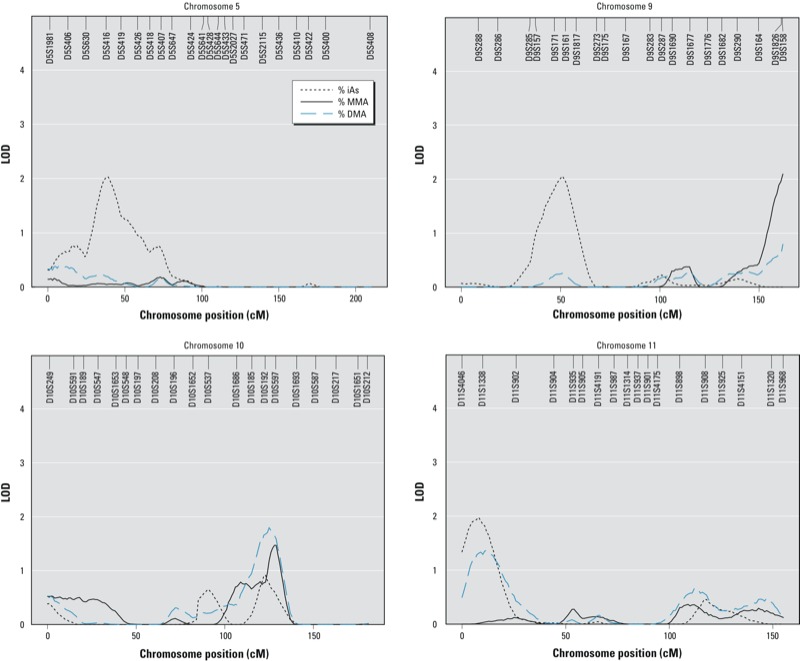
The medians (interquartile ranges) for %iAs, %MMA, and %DMA were 7.7% (5.4-10.7%), 13.6% (10.5-17.1%), and 78.4% (72.5-83.1%), respectively. The estimated heritability was 53% for %iAs, 50% for %MMA, and 59% for %DMA. After adjustment for sex, age, smoking, body mass index, alcohol consumption, region, and total urine arsenic concentrations, LOD [logarithm (to the base of 10) of the odds] scores indicated suggestive evidence for genetic linkage with QTLs influencing urine arsenic metabolites on chromosomes 5 (LOD = 2.03 for %iAs), 9 (LOD = 2.05 for %iAs and 2.10 for %MMA), and 11 (LOD = 1.94 for %iAs). A peak for %DMA on chromosome 10 within 2 Mb of AS3MT had an LOD of 1.80.
This population-based family study in American Indian communities supports a genetic contribution to variation in the distribution of arsenic metabolites in urine and, potentially, the involvement of genes other than AS3MT.
砷(III)甲基转移酶(AS3MT)已在关联研究中与尿液砷代谢物相关。其他基因也可能在砷代谢和排泄中发挥作用。
我们评估了来自“强壮之心研究(SHS)”的美国印第安成年人尿液砷代谢物的遗传决定因素。
我们评估了 2907 名 SHS 参与者的尿液砷代谢物(无机砷百分比(%iAs)、单甲基砷酸盐百分比(%MMA)和二甲基砷酸盐百分比(%DMA))的遗传度,这些参与者的尿液中均有砷测量值,且在队列中至少有一位亲属。我们在大约 400 个短串联重复标记物上有可用基因型的 487 名参与者的子集中进行了初步连锁分析,使用一般谱系方差分量方法来定位数量性状基因座(QTL)。
%iAs、%MMA 和 %DMA 的中位数(四分位距)分别为 7.7%(5.4-10.7%)、13.6%(10.5-17.1%)和 78.4%(72.5-83.1%)。估计的遗传度为 %iAs 的 53%,%MMA 的 50%和 %DMA 的 59%。在校正性别、年龄、吸烟、体重指数、饮酒、地区和总尿液砷浓度后,对数(以 10 为底)的优势比(LOD)评分表明,染色体 5(%iAs 的 LOD = 2.03)、9(%iAs 的 LOD = 2.05 和 %MMA 的 LOD = 2.10)和 11(%iAs 的 LOD = 1.94)上影响尿液砷代谢物的 QTL 存在遗传连锁的提示性证据。位于 AS3MT 附近 2Mb 内的染色体 10 上的 %DMA 峰值的 LOD 为 1.80。
这项基于人群的美国印第安人社区的家族研究支持遗传因素对尿液中砷代谢物分布的变异有贡献,并且可能涉及除 AS3MT 以外的其他基因。