Department of Pharmacology and Toxicology, University of Kansas, Lawrence, Kansas 66045, USA.
Drug Metab Rev. 2013 Feb;45(1):48-59. doi: 10.3109/03602532.2012.748793.
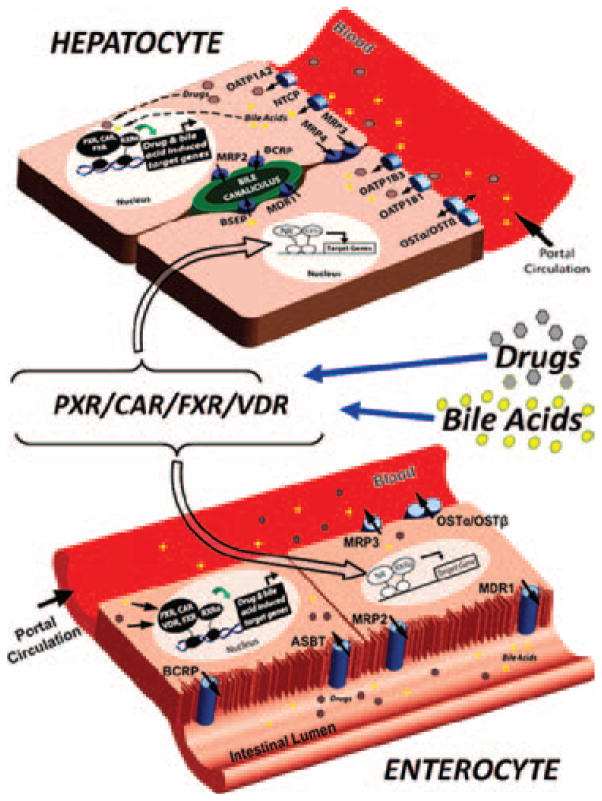
Adverse drug events (ADEs) are a common cause of patient morbidity and mortality and are classically thought to result, in part, from variation in expression and activity of hepatic enzymes of drug metabolism. It is now known that alterations in the expression of genes that encode drug- and bile-acid-transporter proteins in both the gut and liver play a previously unrecognized role in determining patient drug response and eventual clinical outcome. Four nuclear receptor (NR) superfamily members, including pregnane X receptor (PXR, NR1I2), constitutive androstane receptor (NR1I3), farnesoid X receptor (NR1H4), and vitamin D receptor (NR1I1), play pivotal roles in drug- and bile-acid-activated programs of gene expression to coordinately regulate drug- and bile-acid transport activity in the intestine and liver. This review focuses on the NR-mediated gene activation of drug and bile-acid transporters in these tissues as well as the possible underlying molecular mechanisms.
药物不良反应(ADE)是导致患者发病率和死亡率的常见原因,传统上认为其部分原因是药物代谢的肝酶表达和活性存在差异。现在已知,在肠道和肝脏中编码药物和胆汁酸转运蛋白的基因表达的改变在决定患者的药物反应和最终临床结果方面起着以前未被认识的作用。四种核受体(NR)超家族成员,包括妊娠相关 X 受体(PXR,NR1I2)、组成型雄烷受体(NR1I3)、法尼醇 X 受体(NR1H4)和维生素 D 受体(NR1I1),在药物和胆汁酸激活的基因表达程序中发挥关键作用,以协调调节肠道和肝脏中的药物和胆汁酸转运活性。本综述重点介绍了这些组织中 NR 介导的药物和胆汁酸转运蛋白的基因激活,以及可能的潜在分子机制。