Department of Integrative Medical Sciences, Northeast Ohio Medical University, Rootstown, Ohio 44272, USA.
Drug Metab Rev. 2013 Feb;45(1):145-55. doi: 10.3109/03602532.2012.740048.
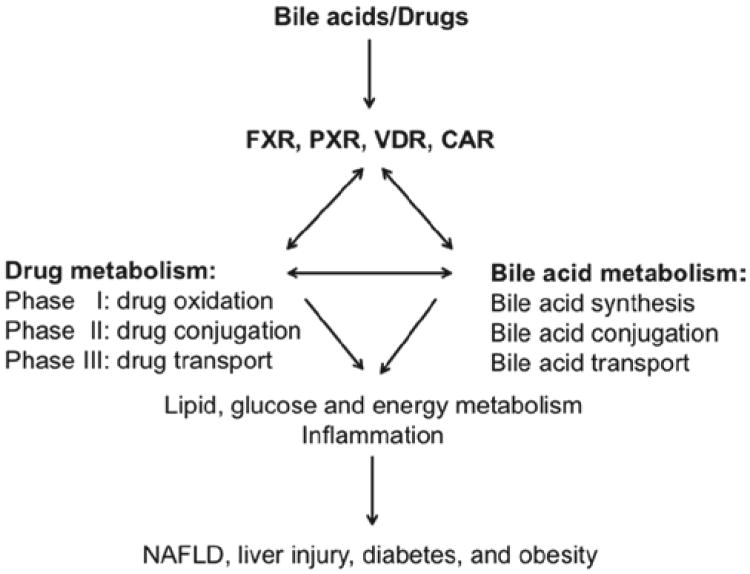
Bile acids are signaling molecules that activate nuclear receptors, such as farnesoid X receptor, pregnane X receptor, constitutive androstane receptor, and vitamin D receptor, and play a critical role in the regulation of lipid, glucose, energy, and drug metabolism. These xenobiotic/endobiotic-sensing nuclear receptors regulate phase I oxidation, phase II conjugation, and phase III transport in bile acid and drug metabolism in the digestive system. Integration of bile acid metabolism with drug metabolism controls absorption, transport, and metabolism of nutrients and drugs to maintain metabolic homeostasis and also protects against liver injury, inflammation, and related metabolic diseases, such as nonalcoholic fatty liver disease, diabetes, and obesity. Bile-acid-based drugs targeting nuclear receptors are in clinical trials for treating cholestatic liver diseases and fatty liver disease.
胆汁酸是信号分子,可激活核受体,如法尼醇 X 受体、孕烷 X 受体、组成型雄烷受体和维生素 D 受体,并在脂质、葡萄糖、能量和药物代谢的调节中发挥关键作用。这些外源性/内源性感应核受体调节消化系统中胆汁酸和药物代谢的 I 相氧化、II 相结合和 III 相转运。胆汁酸代谢与药物代谢的整合控制营养物质和药物的吸收、转运和代谢,以维持代谢平衡,并防止肝损伤、炎症和相关代谢疾病,如非酒精性脂肪性肝病、糖尿病和肥胖症。针对核受体的基于胆汁酸的药物正在临床试验中,用于治疗胆汁淤积性肝病和脂肪肝。