Gravitt Patti E
Perdana University Graduate School of Medicine, Jalan MAEPS Perdana, Serdang, Selangor MY 43400, Johns Hopkins Bloomberg School of Public Health, 615 N. Wolfe St., Baltimore, MD 21205, USA.
Open Virol J. 2012;6:198-203. doi: 10.2174/1874357901206010198. Epub 2012 Dec 28.
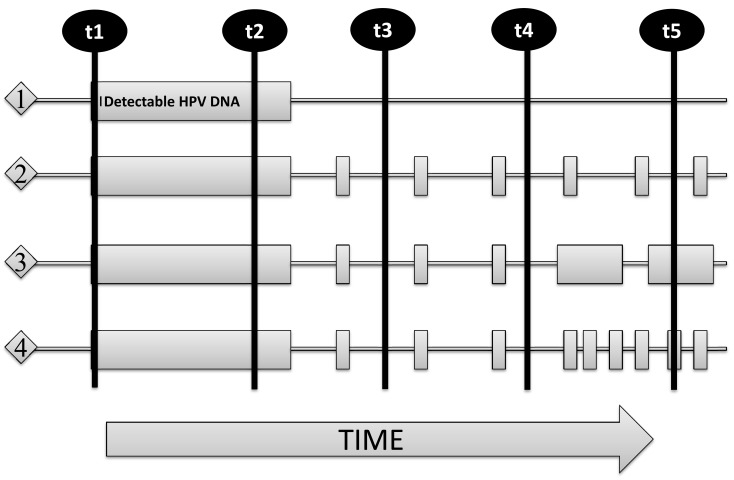
At present, there is no consensus in the scientific community regarding the ability for human papillomavirus (HPV) infections to establish latency. Based on animal studies, a model of papillomavirus latency has been proposed in which papillomaviruses can be retained in the basal epithelial stem cell pool as latent infections and periodically induced to reactivate when the stem cell divides and one daughter cell is committed to terminal differentiation and induction of the viral life cycle. Tissue resident memory T-cells are hypothesized to control these periodic reactivation episodes and thus limit their duration. In this paper, evidence from human studies consistent with this model of papillomavirus latency is reviewed. Given the strong circumstantial evidence supporting a natural history of HPV infection which includes a immunologically controlled latent state, the longer term implications of HPV latency on a highly infected and aging population may warrant a more serious evaluation.
目前,科学界对于人乳头瘤病毒(HPV)感染能否建立潜伏期尚无共识。基于动物研究,已提出一种乳头瘤病毒潜伏期模型,即乳头瘤病毒可作为潜伏感染保留在基底上皮干细胞池中,并在干细胞分裂且一个子细胞进入终末分化并诱导病毒生命周期时周期性地被激活。组织驻留记忆T细胞被认为可控制这些周期性的激活事件,从而限制其持续时间。本文回顾了来自人体研究的与该乳头瘤病毒潜伏期模型一致的证据。鉴于有强有力的间接证据支持HPV感染的自然史包括免疫控制的潜伏状态,HPV潜伏期对高感染率和老龄化人群的长期影响可能值得更深入的评估。