Departamento de Parasitologia, Instituto de Ciências Biomédicas, Universidade de São Paulo, São Paulo, São Paulo, Brasil.
PLoS One. 2013;8(1):e53816. doi: 10.1371/journal.pone.0053816. Epub 2013 Jan 14.
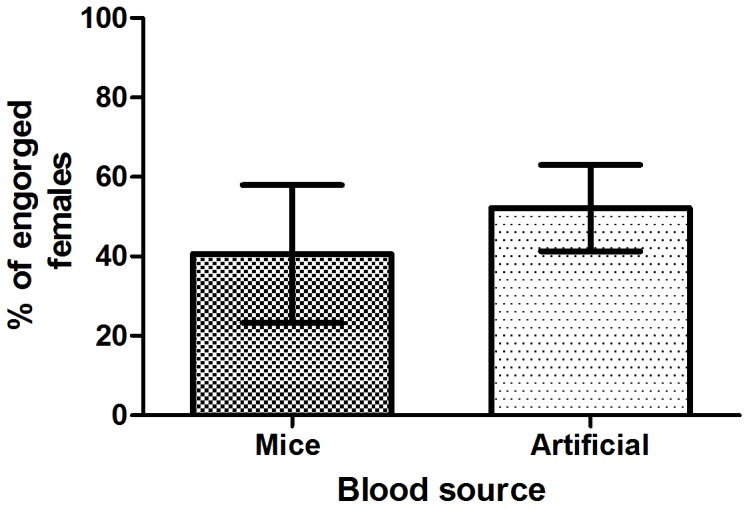
Aedes aegypti, the main vector of dengue virus, requires a blood meal to produce eggs. Although live animals are still the main blood source for laboratory colonies, many artificial feeders are available. These feeders are also the best method for experimental oral infection of Ae. aegypti with Dengue viruses. However, most of them are expensive or laborious to construct. Based on principle of Rutledge-type feeder, a conventional conical tube, glycerol and Parafilm-M were used to develop a simple in-house feeder device. The blood feeding efficiency of this apparatus was compared to a live blood source, mice, and no significant differences (p = 0.1189) were observed between artificial-fed (51.3% of engorgement) and mice-fed groups (40.6%). Thus, an easy to assemble and cost-effective artificial feeder, designated "Glytube" was developed in this report. This simple and efficient feeding device can be built with common laboratory materials for research on Ae. aegypti.
埃及伊蚊是登革热病毒的主要传播媒介,需要吸血才能产卵。尽管活体动物仍然是实验室品系的主要血液来源,但有许多人工饲养器可供选择。这些饲养器也是用登革热病毒对埃及伊蚊进行实验性口服感染的最佳方法。然而,大多数饲养器昂贵或难以构建。本研究基于 Rutledge 型饲养器的原理,使用常规的圆锥形管、甘油和 Parafilm-M 开发了一种简单的内部饲养器设备。该仪器的吸血效率与活体血液来源——小鼠进行了比较,人工喂养组(51.3%的饱食率)与小鼠喂养组之间没有显著差异(p=0.1189)。因此,本研究中开发了一种易于组装且具有成本效益的人工饲养器,命名为“Glytube”。这种简单高效的饲养装置可以用常见的实验室材料构建,用于埃及伊蚊的研究。