Department of Internal Medicine, University of Iowa, Iowa City, Iowa, USA.
Mol Ther Nucleic Acids. 2012 Aug 28;1(8):e41. doi: 10.1038/mtna.2012.36.
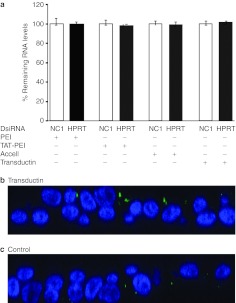
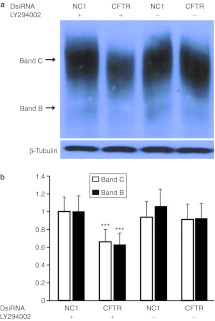
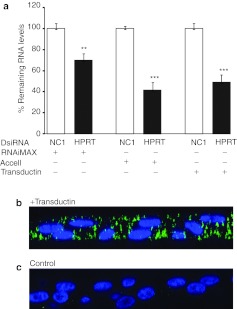
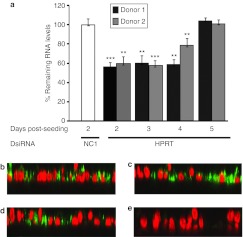
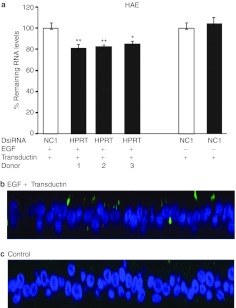
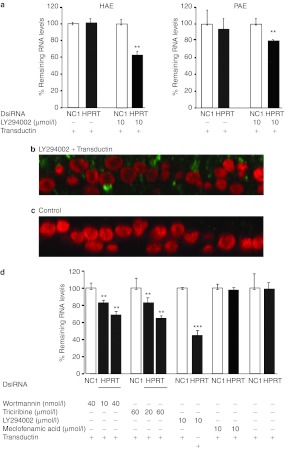
The application of RNA interference-based gene silencing to the airway surface epithelium holds great promise to manipulate host and pathogen gene expression for therapeutic purposes. However, well-differentiated airway epithelia display significant barriers to double-stranded small-interfering RNA (siRNA) delivery despite testing varied classes of nonviral reagents. In well-differentiated primary pig airway epithelia (PAE) or human airway epithelia (HAE) grown at the air-liquid interface (ALI), the delivery of a Dicer-substrate small-interfering RNA (DsiRNA) duplex against hypoxanthine-guanine phosphoribosyltransferase (HPRT) with several nonviral reagents showed minimal uptake and no knockdown of the target. In contrast, poorly differentiated cells (2-5-day post-seeding) exhibited significant oligonucleotide internalization and target knockdown. This finding suggested that during differentiation, the barrier properties of the epithelium are modified to an extent that impedes oligonucleotide uptake. We used two methods to overcome this inefficiency. First, we tested the impact of epidermal growth factor (EGF), a known enhancer of macropinocytosis. Treatment of the cells with EGF improved oligonucleotide uptake resulting in significant but modest levels of target knockdown. Secondly, we used the connectivity map (Cmap) database to correlate gene expression changes during small molecule treatments on various cells types with genes that change upon mucociliary differentiation. Several different drug classes were identified from this correlative assessment. Well-differentiated epithelia treated with DsiRNAs and LY294002, a PI3K inhibitor, significantly improved gene silencing and concomitantly reduced target protein levels. These novel findings reveal that well-differentiated airway epithelia, normally resistant to siRNA delivery, can be pretreated with small molecules to improve uptake of synthetic oligonucleotide and RNA interference (RNAi) responses.Molecular Therapy - Nucleic Acids (2012) 1, e41; doi:10.1038/mtna.2012.36; published online 28 August 2012.
基于 RNA 干扰的基因沉默技术在气道表面上皮细胞中的应用具有很大的应用前景,可以用于操纵宿主和病原体的基因表达以达到治疗目的。然而,尽管已经测试了多种非病毒试剂,但在分化良好的气道上皮细胞中,双链小干扰 RNA(siRNA)的传递仍然存在很大的障碍。在分化良好的原代猪气道上皮细胞(PAE)或在气-液界面(ALI)培养的人气道上皮细胞(HAE)中,用几种非病毒试剂传递针对次黄嘌呤-鸟嘌呤磷酸核糖基转移酶(HPRT)的 Dicer 底物小干扰 RNA(DsiRNA)双链体,显示出最小的摄取和对靶标的敲低。相比之下,分化程度较低的细胞(接种后 2-5 天)则表现出明显的寡核苷酸内化和靶标敲低。这一发现表明,在分化过程中,上皮细胞的屏障特性发生了改变,从而阻碍了寡核苷酸的摄取。我们使用了两种方法来克服这一缺陷。首先,我们测试了表皮生长因子(EGF)的影响,EGF 是一种已知的巨胞饮增强剂。用 EGF 处理细胞可提高寡核苷酸的摄取,从而导致靶基因的显著但适度的敲低。其次,我们使用连接图谱(Cmap)数据库将各种细胞类型中小分子处理对基因表达变化的影响与黏液纤毛分化时的基因变化进行关联。从这种相关性评估中确定了几种不同的药物类别。用 DsiRNA 和磷脂酰肌醇 3-激酶抑制剂 LY294002 处理分化良好的上皮细胞,可显著改善基因沉默,并同时降低靶蛋白水平。这些新发现表明,正常情况下对 siRNA 传递具有抗性的分化良好的气道上皮细胞可以用小分子预处理以提高合成寡核苷酸的摄取和 RNA 干扰(RNAi)反应。《分子治疗-核酸》(2012 年)1,e41;doi:10.1038/mtna.2012.36;在线发表于 2012 年 8 月 28 日。