Disease Research Laboratory, 720 Cumberland St, Dunedin 9016, New Zealand.
Vet Res. 2013 Jan 24;44(1):5. doi: 10.1186/1297-9716-44-5.
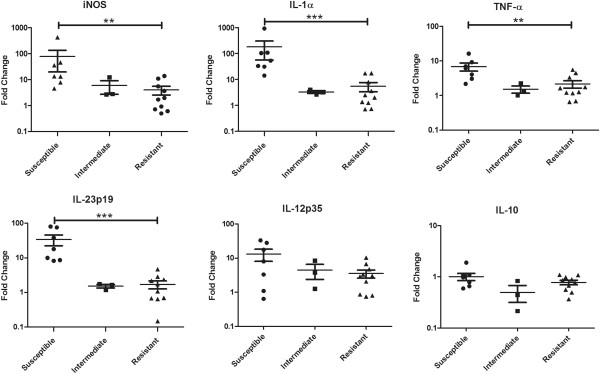
While many factors contribute to resistance and susceptibility to infectious disease, a major component is the genotype of the host and the way in which it is expressed. Johne's disease is a chronic inflammatory bowel disease affecting ruminants and is caused by infection with Mycobacterium avium subspecies paratuberculosis (MAP). We have previously identified red deer breeds (Cervus elaphus) that are resistant; have a low rate of MAP infection and do not progress to develop Johne's disease. In contrast, susceptible breeds have a high rate of MAP infection as seen by seroconversion and progress to develop clinical Johne's disease. The aim of this study was to determine if immunological differences exist between animals of resistant or susceptible breeds. Macrophage cultures were derived from the monocytes of deer genotypically defined as resistant or susceptible to the development of Johne's disease. Following in vitro infection of the cells with MAP, the expression of candidate genes was assessed by quantitative PCR as well as infection rate and cell death rate. The results indicate that macrophages from susceptible animals show a significantly higher upregulation of inflammatory genes (iNOS, IL-1α, TNF-α and IL-23p19) than the macrophages from resistant animals. Cells from resistant animals had a higher rate of apoptosis at 24 hours post infection (hpi) compared to macrophages from susceptible animals. The excessive expression of inflammatory mRNA transcripts in susceptible animals could cause inefficient clearing of the mycobacterial organism and the establishment of disease. Controlled upregulation of inflammatory pathways coupled with programmed cell death in the macrophages of resistant animals may predispose the host to a protective immune response against this mycobacterial pathogen.
虽然许多因素导致对传染病的抵抗力和易感性,但主要因素是宿主的基因型及其表达方式。约翰氏病是一种影响反刍动物的慢性炎症性肠病,由感染分枝杆菌亚种副结核分枝杆菌(MAP)引起。我们之前已经确定了对该病具有抗性的赤鹿品种( Cervus elaphus );其 MAP 感染率低,并且不会发展为约翰氏病。相比之下,易感品种的 MAP 感染率很高,因为血清转化阳性且发展为临床约翰氏病。本研究的目的是确定抗性或易感品种的动物之间是否存在免疫差异。从被基因定义为对约翰氏病发展具有抗性或易感的鹿的单核细胞中获得巨噬细胞培养物。在 MAP 对细胞进行体外感染后,通过定量 PCR 评估候选基因的表达以及感染率和细胞死亡率。结果表明,与抗性动物的巨噬细胞相比,易感动物的巨噬细胞中炎症基因(iNOS、IL-1α、TNF-α 和 IL-23p19)的上调明显更高。与易感动物的巨噬细胞相比,感染后 24 小时(hpi)时,抗性动物的细胞凋亡率更高。易感动物中炎症 mRNA 转录本的过度表达可能导致对分枝杆菌病原体的清除效率降低,并导致疾病的发生。在抗性动物的巨噬细胞中,炎症途径的受控上调与程序性细胞死亡相结合,可能使宿主易患针对这种分枝杆菌病原体的保护性免疫反应。