Department of Physiology, Hypertension and Renal Center of Excellence, Tulane University, New Orleans, Louisiana, USA.
Diabetes. 2013 Jun;62(6):2078-87. doi: 10.2337/db12-1374. Epub 2013 Jan 24.
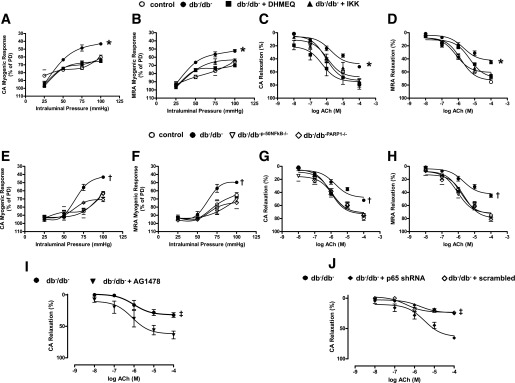
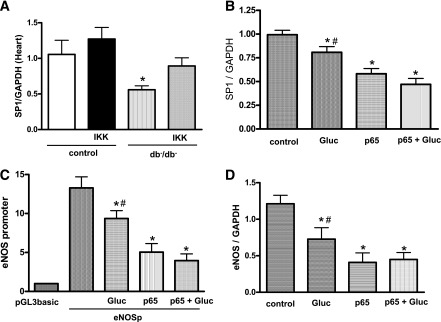
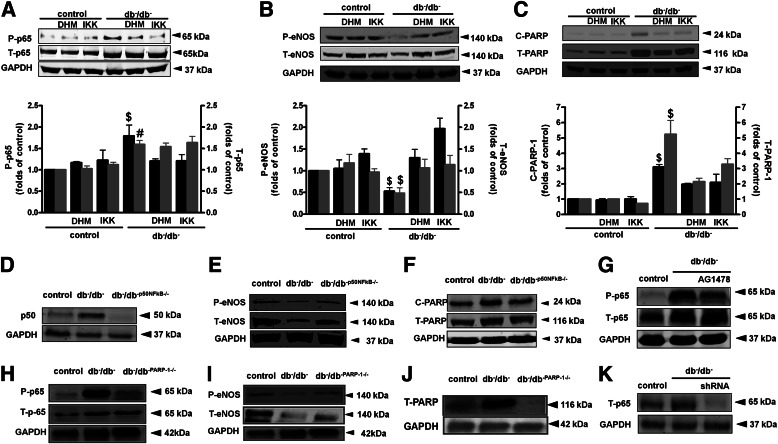
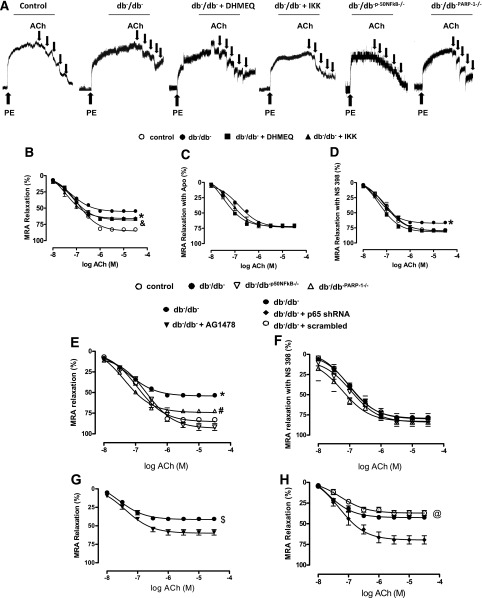
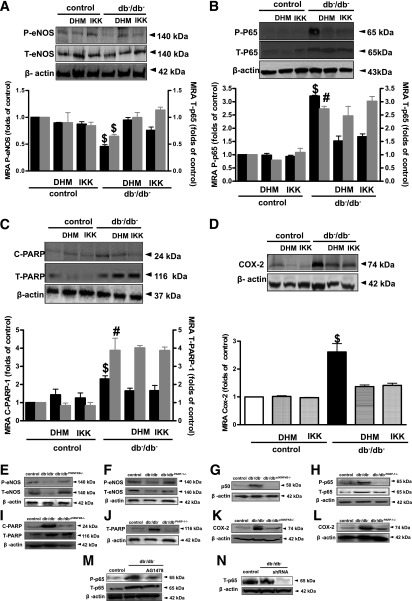
Type 2 diabetes (T2D) is associated with vascular dysfunction. We hypothesized that increased nuclear factor-κB (NF-κB) signaling contributes to vascular dysfunction in T2D. We treated type 2 diabetic (db(-)/db(-)) and control (db(-)/db(+)) mice with two NF-κB inhibitors (6 mg/kg dehydroxymethylepoxyquinomicin twice a week and 500 μg/kg/day IKK-NBD peptide) for 4 weeks. Pressure-induced myogenic tone was significantly potentiated, while endothelium-dependent relaxation (EDR) was impaired in small coronary arterioles and mesenteric resistance artery from diabetic mice compared with controls. Interestingly, diabetic mice treated with NF-κB inhibitors had significantly reduced myogenic tone potentiation and improved EDR. Importantly, vascular function was also rescued in db(-)/db(-p50NF-κB-/-) and db(-)/db(-PARP-1-/-) double knockout mice compared with db(-)/db(-) mice. Additionally, the acute in vitro downregulation of NF-κB-p65 using p65NF-κB short hairpin RNA lentivirus in arteries from db(-)/db(-) mice also improved vascular function. The NF-κB inhibition did not affect blood glucose level or body weight. The RNA levels for Sp-1 and eNOS phosphorylation were decreased, while p65NF-κB phosphorylation, cleaved poly(ADP-ribose) polymerase (PARP)-1, and cyclooxygenase (COX)-2 expression were increased in arteries from diabetic mice, which were restored after NF-κB inhibition and in db(-)/db(-p50NF-κB-/-) and db(-)/db(-PARP-1-/-) mice. In the current study, we provided evidence that enhanced NF-κB activity impairs vascular function by PARP-1-, Sp-1-, and COX-2-dependent mechanisms in male type 2 diabetic mice. Therefore, NF-κB could be a potential target to overcome diabetes-induced vascular dysfunction.
2 型糖尿病(T2D)与血管功能障碍有关。我们假设核因子-κB(NF-κB)信号的增加导致 T2D 中的血管功能障碍。我们用两种 NF-κB 抑制剂(每周两次 6mg/kg 脱氢羟甲环氧喹啉和每天 500μg/kg IKK-NBD 肽)治疗 2 型糖尿病(db(-)/db(-))和对照(db(-)/db(+))小鼠 4 周。与对照组相比,糖尿病小鼠的小冠状动脉和肠系膜阻力动脉的压力诱导肌源性张力显著增强,而内皮依赖性舒张(EDR)受损。有趣的是,用 NF-κB 抑制剂治疗的糖尿病小鼠的肌源性张力增强显著减少,EDR 得到改善。重要的是,与 db(-)/db(-)小鼠相比,db(-)/db(-p50NF-κB-/-)和 db(-)/db(-PARP-1-/-)双敲除小鼠的血管功能也得到了挽救。此外,在 db(-)/db(-)小鼠的动脉中,使用 p65NF-κB 短发夹 RNA 慢病毒急性下调 NF-κB-p65 也改善了血管功能。NF-κB 抑制不影响血糖水平或体重。Sp-1 和 eNOS 磷酸化的 RNA 水平降低,而 p65NF-κB 磷酸化、切割多聚(ADP-核糖)聚合酶(PARP)-1 和环加氧酶(COX)-2 的表达在糖尿病小鼠的动脉中增加,这些在 NF-κB 抑制后和 db(-)/db(-p50NF-κB-/-)和 db(-)/db(-PARP-1-/-)小鼠中得到恢复。在本研究中,我们提供的证据表明,增强的 NF-κB 活性通过 PARP-1、Sp-1 和 COX-2 依赖的机制损害了雄性 2 型糖尿病小鼠的血管功能。因此,NF-κB 可能是克服糖尿病诱导的血管功能障碍的潜在靶点。