Karlsruhe Institute of Technology Karlsruhe, Germany ; Central Institute of Mental Health Mannheim, Germany.
Front Psychol. 2013 Jan 18;3:596. doi: 10.3389/fpsyg.2012.00596. eCollection 2012.
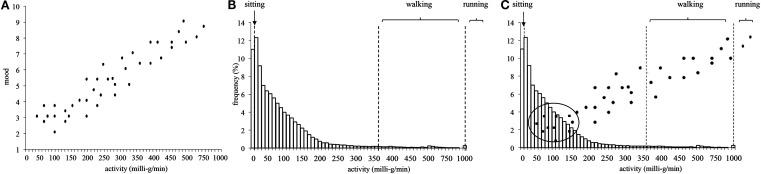
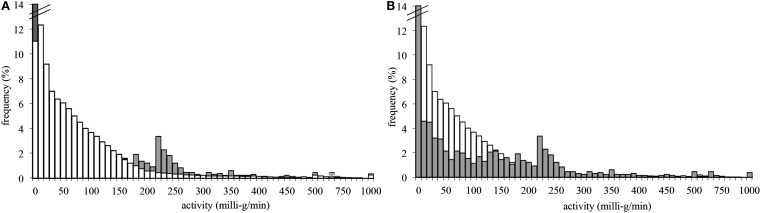
Although there is a wealth of evidence that physical activity has positive effects on psychological health, a large proportion of people are inactive. Data regarding counts, steps, and movement patterns are limited in their ability to explain why people remain inactive. We propose that multimodal ambulatory monitoring, which combines the assessment of physical activity with the assessment of psychological variables, helps to elucidate real world physical activity. Whereas physical activity can be monitored continuously, psychological variables can only be assessed at discrete intervals, such as every hour. Moreover, the assessment of psychological variables must be linked to the activity of interest. For example, if an inactive and overweight person is physically active once a week, psychological variables should be assessed during this episode. Linking the assessment of psychological variables to episodes of an activity of interest can be achieved with interactive monitoring. The primary aim of our interactive multimodal ambulatory monitoring approach was to intentionally increase the number of e-diary assessments during "active" episodes. We developed and tested an interactive monitoring algorithm that continuously monitors physical activity in everyday life. When predefined thresholds are surpassed, the algorithm triggers a signal for participants to answer questions in their electronic diary. Using data from 70 participants wearing an accelerative device for 24 h each, we found that our algorithm quadrupled the frequency of e-diary assessments during the activity episodes of interest compared to random sampling. Multimodal interactive ambulatory monitoring appears to be a promising approach to enhancing our understanding of real world physical activity and movement.
虽然有大量证据表明身体活动对心理健康有积极影响,但很大一部分人不活跃。关于计数、步数和运动模式的数据在解释为什么人们保持不活跃方面能力有限。我们提出,多模态动态监测,将身体活动评估与心理变量评估相结合,有助于阐明现实世界中的身体活动。虽然身体活动可以连续监测,但心理变量只能在离散的时间间隔内评估,例如每小时一次。此外,心理变量的评估必须与感兴趣的活动相关联。例如,如果一个不活跃和超重的人每周进行一次身体活动,那么应该在这个时间段评估心理变量。将心理变量的评估与感兴趣的活动的时间段联系起来,可以通过互动监测来实现。我们的交互式多模态动态监测方法的主要目的是有意增加“活跃”时间段内电子日记评估的次数。我们开发并测试了一种交互式监测算法,该算法可以连续监测日常生活中的身体活动。当超过预定义的阈值时,该算法会触发信号,提示参与者在电子日记中回答问题。使用佩戴加速计 24 小时的 70 名参与者的数据,我们发现,与随机抽样相比,我们的算法将感兴趣的活动时间段内电子日记评估的频率提高了四倍。多模态交互式动态监测似乎是一种很有前途的方法,可以帮助我们更好地理解现实世界中的身体活动和运动。