Centre for Academic Primary Care, School of Social and Community Medicine, University of Bristol, Bristol BS8 2PS, UK.
BMJ. 2013 Jan 29;346:f43. doi: 10.1136/bmj.f43.
To assess the clinical effectiveness, effect on waiting times, and patient acceptability of PhysioDirect services in patients with musculoskeletal problems, compared with usual care.
Pragmatic randomised controlled trial to assess equivalence in clinical effectiveness. Patients were individually randomised in a 2:1 ratio to PhysioDirect or usual care.
Four physiotherapy services in England.
Adults (aged ≥ 18 years) referred by general practitioners or self referred for musculoskeletal physiotherapy.
PhysioDirect services invited patients to telephone a physiotherapist for initial assessment and advice, followed by face-to-face physiotherapy if necessary. Usual care involved patients joining a waiting list for face-to-face treatment.
Numbers of appointments, waiting time for treatment, and non-attendance rates. Primary outcome was physical health (SF-36v2 physical component score) at six months. Secondary outcomes included four other measures of health outcome, mental component score and scales from the SF-36v2, time lost from work, and patient satisfaction and preference. Participants were not blind to allocation, but outcome data were collected blind to allocation.
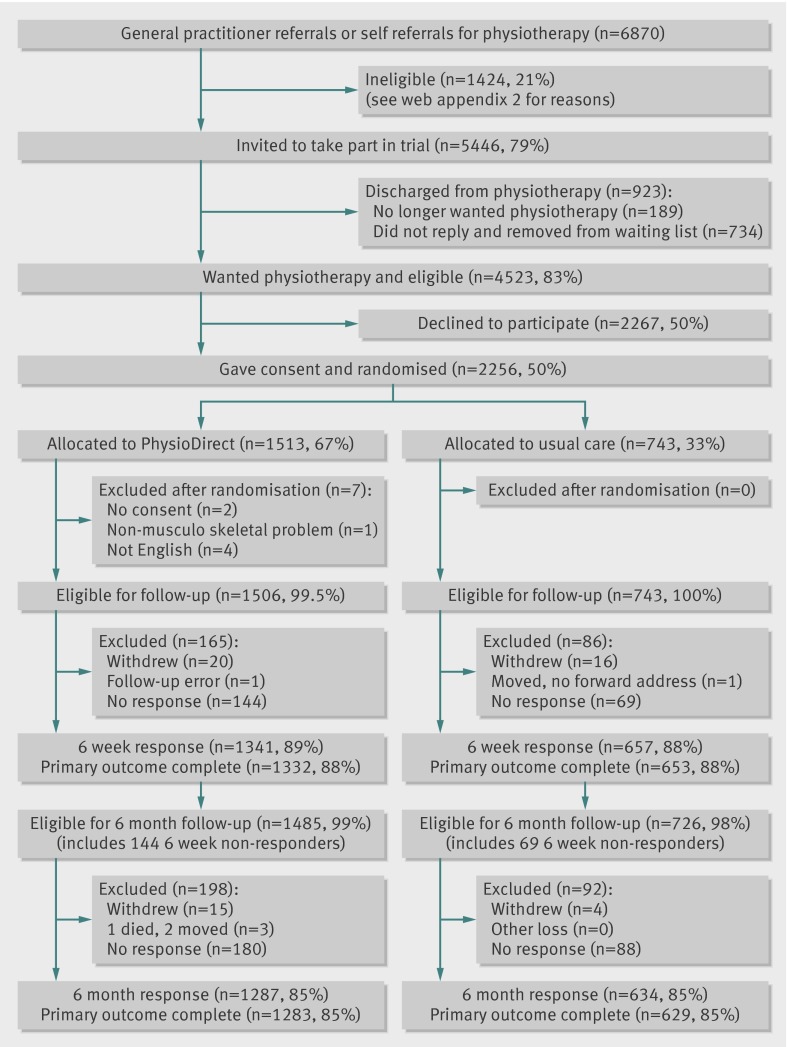
Of 1506 patients allocated to PhysioDirect and 743 to usual care, 85% provided primary outcome data at six months (1283 and 629 patients, respectively). PhysioDirect patients had fewer face-to-face appointments than usual care patients (mean 1.91 v 3.11; incidence rate ratio 0.59 (95% confidence interval 0.53 to 0.65)), a shorter waiting time (median 7 days v 34 days; arm time ratio 0.32 (0.29 to 0.35)), and lower rates of non-attendance (incidence rate ratio 0.55 (0.41 to 0.73)). After six months' follow-up, the SF-36v2 physical component score was equivalent between groups (adjusted difference in means -0.01 (-0.80 to 0.79)). Health outcome measures suggested a trend towards slightly greater improvement in the PhysioDirect arm at six week follow-up and no difference at six months. There was no difference in time lost from work. PhysioDirect patients were no more satisfied with access to physiotherapy than usual care patients, but had slightly lower satisfaction overall at six months (difference in satisfaction -3.8% (-7.3% to -0.3%); P=0.031). PhysioDirect patients were more likely than usual care patients to prefer PhysioDirect in future. No adverse events were detected.
PhysioDirect is equally clinically effective compared with usual care, provides faster access to physiotherapy, and seems to be safe. However, it could be associated with slightly lower patient satisfaction.
Current Controlled Trials ISRCTN55666618.
评估 PhysioDirect 服务与常规护理相比,在肌肉骨骼问题患者中的临床效果、对等待时间的影响和患者接受度。
评估临床等效性的实用随机对照试验。将患者按 2:1 的比例进行个体随机分组,分为 PhysioDirect 组或常规护理组。
英格兰的四个物理治疗服务机构。
由全科医生转诊或自行转诊接受肌肉骨骼物理治疗的成年人(年龄≥18 岁)。
PhysioDirect 服务邀请患者致电物理治疗师进行初步评估和建议,如果需要,再进行面对面的物理治疗。常规护理涉及让患者加入面对面治疗的等候名单。
预约次数、治疗等待时间和未出席率。主要结局是 6 个月时的身体健康(SF-36v2 生理成分评分)。次要结局包括其他四项健康结局指标、心理成分评分和 SF-36v2 量表、因工作缺勤时间以及患者满意度和偏好。参与者未对分组情况进行盲法,但对分组情况进行了盲法收集结局数据。
在被分配到 PhysioDirect 的 1506 名患者和被分配到常规护理的 743 名患者中,分别有 85%(1283 名和 629 名患者)在 6 个月时提供了主要结局数据。与常规护理组相比,PhysioDirect 组患者接受的面对面治疗预约次数更少(平均 1.91 次比 3.11 次;发病率比 0.59(95%置信区间 0.53 至 0.65)),等待时间更短(中位数 7 天比 34 天;手臂时间比 0.32(0.29 至 0.35)),未出席率更低(发病率比 0.55(0.41 至 0.73))。在 6 个月的随访后,两组的 SF-36v2 生理成分评分相当(调整后的平均差异-0.01(-0.80 至 0.79))。健康结局指标表明,PhysioDirect 组在 6 周随访时的改善趋势略大,而在 6 个月时没有差异。因工作缺勤时间无差异。与常规护理组相比,PhysioDirect 组患者对获得物理治疗的满意度没有更高,但在 6 个月时整体满意度略低(满意度差异-3.8%(-7.3%至-0.3%);P=0.031)。PhysioDirect 组患者比常规护理组患者更有可能在未来更喜欢 PhysioDirect。未发现不良事件。
与常规护理相比,PhysioDirect 在临床效果上相当,能更快地获得物理治疗,并且似乎是安全的。然而,它可能与患者满意度略低有关。
当前对照试验 ISRCTN55666618。
